Blythe unfolded the sheet with stiff fingers. The ink was faded, written in the cramped, scholarly hand of her uncle Marcus, whom everyone in the county had believed dead in a carriage wreck in the San Joaquin valley five years ago. The lines were brief, dated three weeks back from a placer camp near Sonora: *The registrar Slocum is clearing titles with stolen seals from the estate office. Do not let him touch the probate box; the original grant is sewn into the binding of the parish register at Downieville.*
Blythe stared at the words, her chest tightening until the cold air in the room felt heavy as lead. “He’s not just altering tax rolls,” she whispered. “He’s looting every unclaimed claim in the watershed.”
Nathan leaned back against the stone fireplace, his arms crossed over his chest, his gaze steady on her face. “Which means when we go to the land office tomorrow morning with the gold dust, we aren’t just paying a tax bill. We’re walking into a hornets’ nest.”
“We have to go,” Caleb said from the corner, where he had been oiling the action of a buffalo rifle by the light of a tallow dip. “If we don’t, Slocum’s men will take the mill by dark.”
Nathan reached out, his broad palm pressing down for one steadying, silent second over Caleb’s clenched fist on the gunstock, stopping the boy’s restless movement without a word of reprimand. Then he looked back at Blythe, his grey eyes softening around the edges with a quiet, stubborn warmth that had nothing to do with the fire.
“We go,” Nathan said. “And we take the pans.”
* * *
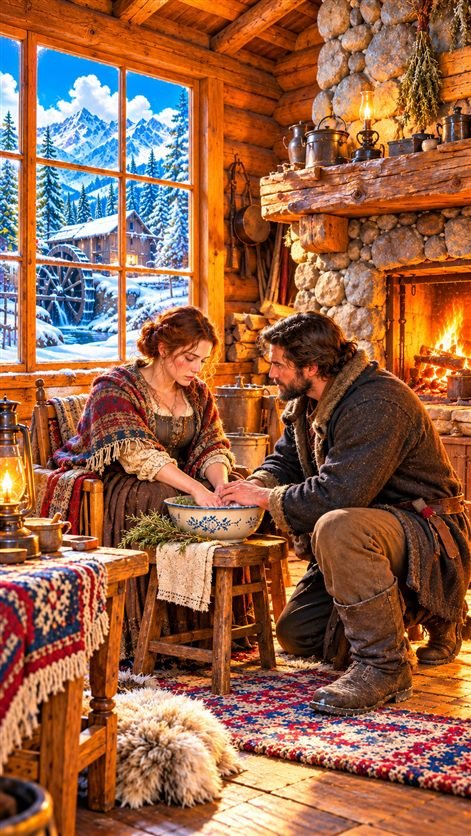
The night turned bitter before midnight, the temperature dropping until the mill wheel groaned in its frozen housing, locked hard in a collar of solid blue ice. Inside the cabin, the smoky madrone-wood fire in the mill hearth cast long, trembling shadows across the rough log walls. Blythe sat on a low stool by the hearth, her fingers plunged deep into a basin of lukewarm tallow and herbs that Hetty, the old woman who cooked for the timber hands, had left before the road drifted shut.
Nathan knelt beside her, his movements uncharacteristically slow. He took her right hand from the basin, his large fingers enclosing her red, swollen skin with an infinite, clumsy gentleness, and began to wipe away the excess grease with a clean square of linen.
“You won’t have much feeling in those fingers tomorrow when you lift the iron pan,” he said quietly.
“I’ll feel the gold,” she answered, not pulling her hand away.
“You’re stubborn enough for ten miners, Blythe Sinclair,” he said, his thumb brushing a raw knuckle with a slow, deliberate stroke. “When this is over—when we have the register back from Downieville—what will you do with the mill?”
“Keep cutting timber,” she said, looking straight into his eyes. “And keep you from running the saws dry.”
The ice outside groaned against the millrace, a long, tearing sound of timber and water under pressure, but inside the warmth of the hearth held them in a tight, silent circle. Nathan didn’t move his hand from hers, his thumb tracing the blue vein along her wrist where the old scar from the wagon harness still crossed the skin like a pale thread.
“The mill stays,” he said softly. “And so do I.”
The grey dawn broke over the North Fork with the hard, blue clarity of a winter sky that promised no thaw. By seven, the frozen gravel banks were rimed with frost that crunched like broken glass under the iron-shod wheels of the buckboard. Slocum’s men had already taken the lower bridge, three riders in heavy sheepskin coats stationed where the road narrowed between the granite bluffs and the icy current. They carried repeating rifles rested across their saddlebows, their horses stamping in the cold air, turning the trampled red clay into frozen ruts.
Micah, the depot storekeeper, stood outside his locked door with his hands shoved deep into his pockets, refusing to meet Blythe’s eye as she drove the buckboard past. The community had seen Slocum’s posted notices on the hitching posts: *Default of tax assessment constitutes immediate forfeiture to county administration.* By morning church-bell time, the entire settlement had drawn its curtains and bolted its shutters. The miners from the upper flume stayed in their cabins, their doors barred from within, unwilling to risk a bullet or a foreclosed lease for a family they believed was already beaten.
* * *
At the headgate, the wind off the snowfields cut straight through wool and canvas. Blythe stepped down from the buckboard, her left foot coming down gingerly on the frozen stones, her hand gripping the cherrywood cane with enough force to whiten her knuckles. Nathan dropped from the wagon bed behind her, landing with a heavy, deadened thud on the gravel, his skinning knife already loose in its sheath at his belt.
At dawn she panned the last bucket with ice-numbed hands, and the gold weighs out exactly to the debt, while Slocum’s men besiege the flume.
Mother lode iron pans scarred by quartz sand scraped harshly against the rimed stones as Blythe dipped the edge into the black, sluggish water of the tailrace. The ice here had been broken three hours before with crowbars and timber wedges, but a fresh skin of clear glass was already forming across the surface, catching the low winter sun like a sheet of mica. With fingers that felt thick and clumsy as dry wood, she swirled the heavy gravel, letting the lighter quartz and slate wash over the side while the dense, yellow-grey flour-gold settled into the bottom angle of the pan.
“They’re coming up the ditch road,” Caleb called from the top of the flume box, his voice sharp with alarm as he dropped behind the low stone breastwork they had piled the night before.
Slocum rode a heavy bay gelding that picked its way carefully among the frozen ruts. Two hired hands followed him closely, their rifles held across their thighs, their breath pluming in grey gouts against the white limestone bluffs. Slocum pulled his horse to a halt ten paces from the tailrace, his silver penknife already out, his nail scraping a slow, rhythmic *tink* against the horn handle.
“The hour is past nine, Miss Sinclair,” Slocum said, his voice carrying clearly over the roar of the water through the gap. “The tax-roll office closed its ledger ten minutes ago in town. This property is now a county holding under my direct administration.”
Blythe did not look up from the pan. She swirled the water once more, her movements slow, deliberate, and entirely unhurried, until the yellow crescent of heavy dust gleamed dull and flat against the dark iron. She lifted the pan with both hands, water dripping from her frozen cuffs, and set it down heavily on the flat top of a cedar stump directly in front of Slocum’s horse.
“The debt was three pounds of gold dust, registered and assayed under the territorial statute,” Blythe said, her voice steady and clear, cutting through the rush of the river. “This pan holds three pounds and four ounces. The receiver’s box is in the buckboard, Mr. Slocum. You may weigh it yourself or take your men back down the trail.”
Slocum didn’t look at the pan. His eyes, small and pale as boiled onions, fixed on Blythe’s face with a cold, triumphant amusement. “There is no receiver’s box recognized on an expired patent, Sinclair. The land was forfeited at midnight. Your papers are waste paper.”
He reached down from the saddle, his gloved hand closing over the edge of the iron pan to shove it off the stump into the freezing mud.