📜 Frontier Fast Facts: Boomtown Lifecycle
Famous Mining Camps: Bodie, California; Virginia City, Nevada; Deadwood, South Dakota; Tombstone, Arizona.
Speed of Expansion: A camp of 50 prospectors could explode into a city of 10,000 within six months.
Extraction Evolution: Placer panning (individual) -> Hydraulic mining -> Deep underground shaft/stamp milling (corporate).
Ultimate Fate: Over 90% of frontier boomtowns decayed into ghost towns once veins were exhausted.
Across the windswept mountain passes of Nevada, the gulches of South Dakota’s Black Hills, and the jagged deserts of Arizona stand the bleached pine ruins of frontier ghost towns. These weather-beaten timber frames and rusting stamp mill shafts are the silent remnants of one of the most volatile economic cycles in human history: the 19th-century Western mining boom.
Phase One: The Strike and the Rush
The life cycle of every boomtown followed a predictable, frenzied script. It began with an individual prospector panning a creek gravel bar and discovering coarse “color” (gold dust) or tracing an outcrop of dark quartz vein rich with silver chloride. Word leaked out to neighboring camps, and within forty-eight hours, the rush was on.
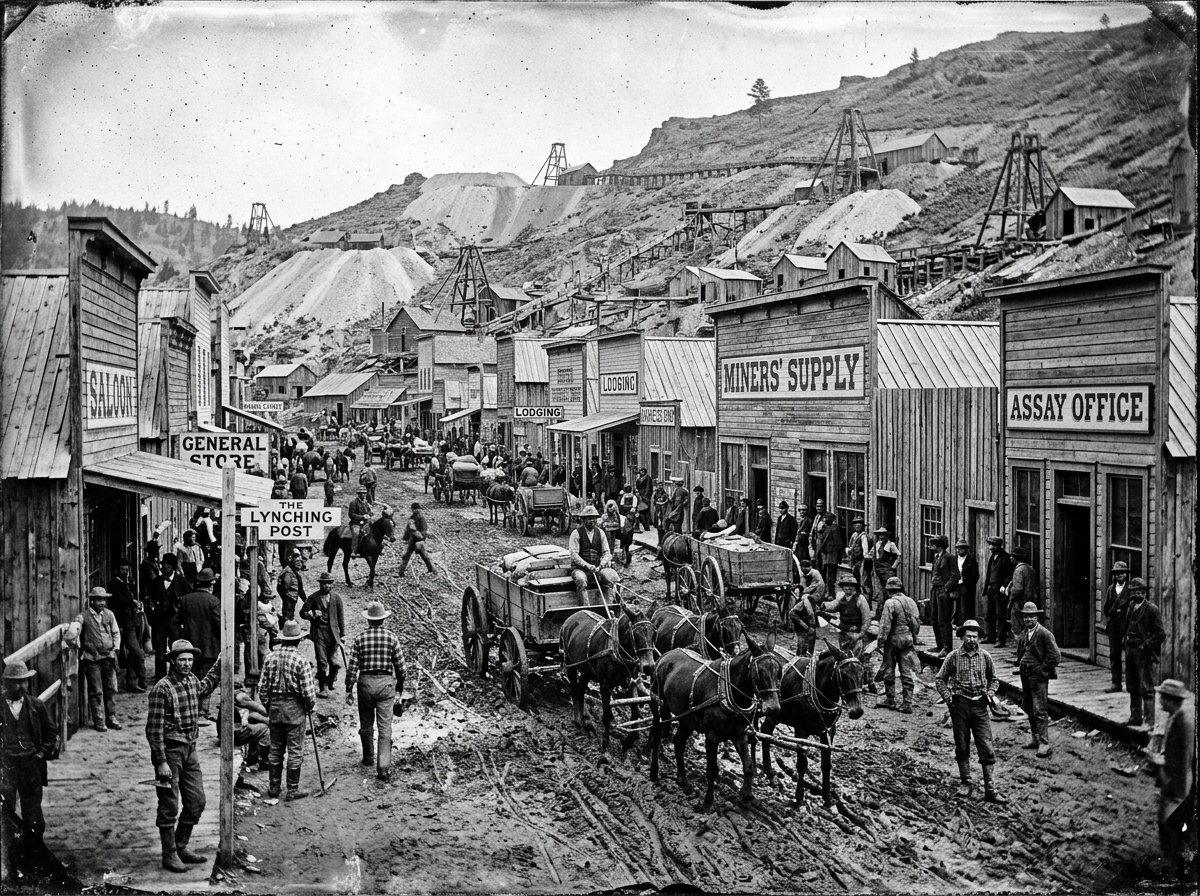
First came the tent city: canvas saloons, gambling tables operating under brush ramadas, and miners staking 100-foot claims with wooden pegs along the gulch. Prices skyrocketed instantly; with transport limited to mule trains, a sack of flour or a gallon of kerosene commanded ten times its Eastern price.
Phase Two: The Metropolis of Mud and Mahogany
If the strike proved to be a deep, permanent mineral vein — such as the fabulous Comstock Lode at Virginia City, Nevada, or the silver deposits of Tombstone, Arizona — the tent city was quickly replaced by timber and masonry. Sawmills shrieked day and night, brick banks were built, and luxurious two-story hotels were erected.
Virginia City, perched above four hundred million dollars of silver, soon boasted five banks, six churches, an opera house where European divas sang, gas streetlights, and twenty daily newspapers (where a young Samuel Clemens first used the pen name Mark Twain). The wealth was staggering, but so was the urban precarity: constructed entirely of dry pine timber and illuminated by kerosene lamps, nearly every boomtown suffered catastrophic fires that leveled downtown districts in a single afternoon.
From Placer Panning to Industrial Shafts
The image of the solitary sourdough with a tin pan kneeling by a babbling creek was only true for the first few months of a strike. Surface placer deposits were exhausted rapidly. To extract gold and silver locked deep inside subterranean granite veins required massive capital investment: deep vertical shafts plunged thousands of feet into the earth, steam pumps worked around the clock to exhaust scalding subterranean water, and heavy iron stamp mills crushed thousands of tons of ore daily with earth-shaking thuds.
By the 1880s, independent prospectors had become wage-earning underground miners, joining labor organizations like the Western Federation of Miners to battle dangerous mine gas, cave-ins, and silicosis.
Phase Three: The Bust and the Desertion
Just as suddenly as they were born, boomtowns withered. When the high-grade ore vein “pinched out,” or the global market price of silver collapsed — as occurred during the Panic of 1893 with the repeal of the Sherman Silver Purchase Act — capital evaporated overnight.
Miners abandoned unpaid boarding house bills, loaded their pack mules, and struck out across the range for the next rumored strike. Within months, grand hotels stood vacant, wind whistled through fractured storefronts, and desert chaparral reclaimed boardwalks where thousands had walked. Preserved today in the dry mountain air of places like Bodie, California, these ghost towns remain monuments to frontier ambition, sudden fortune, and the ephemeral nature of the American Gold Rush.
Historical Provenance & Archival Standards
Wild West Stories Historical Research Division • Primary Source Cross-Referenced
This historical monograph is compiled from digitized records preserved at the National Archives and Records Administration (NARA), the Library of Congress Prints and Photographs Division, and Western state historical registries. All dates, geographic coordinates, and legal proceedings have been verified against original 19th-century newspaper archives and territorial government registries.