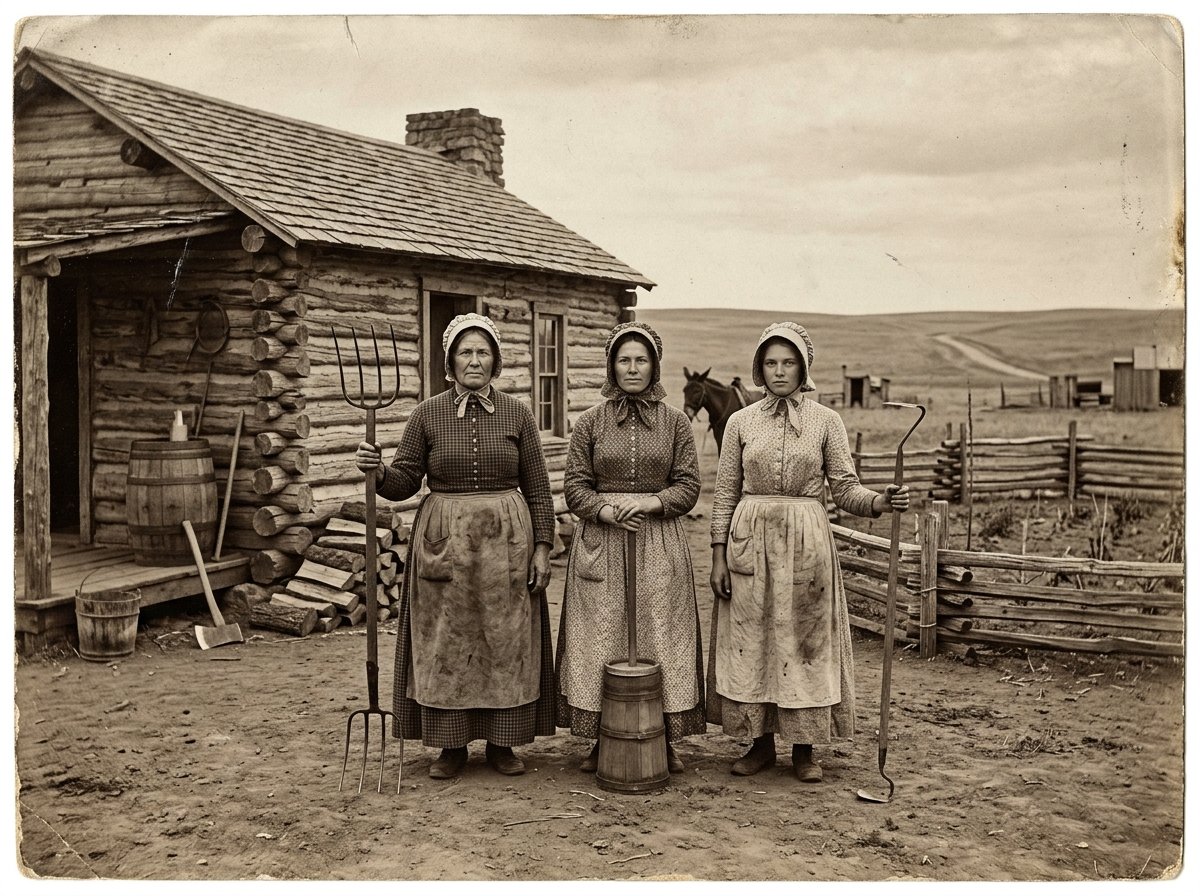
📜 Frontier Fast Facts: Women of the West
First State with Women’s Suffrage: Wyoming Territory (December 10, 1869)
Land Ownership: Over 12% of homestead claims in Colorado and Wyoming proved up by single women and widows.
Notable Trailblazers: Esther Hobart Morris (first female judge), Dr. Bethenia Owens-Adair, Clara Brown, Martha Canary.
Frontier Reality: Demanded equal physical partnership, breaking rigid 19th-century Victorian gender spheres.
Traditional Hollywood cinema long portrayed women of the Old West in two simplistic caricatures: the helpless prairie maiden awaiting rescue or the hardened dancehall singer. Historical archival records, diaries, and territorial ledgers tell a vastly different and far more inspiring story. On the harsh frontier, women were cattle ranchers, newspaper editors, pioneering physicians, mine owners, and civic leaders whose resilience forged modern American democracy.
The Shattering of Victorian Domestic Spheres
In the industrialized cities of the American East, 19th-century society adhered strictly to the “Cult of True Womanhood” — which dictated that women belong exclusively in the domestic sphere of piety, submissiveness, and household nurture. Crossing the Missouri River obliterated these artificial restrictions.
On wagon trains and prairie homesteads, survival required complete operational partnership. Women drove heavy ox teams, wielded axes to clear timber, repaired broken wagon axles, slaughtered livestock, and defended isolated cabins against wolves and prairie fires. When husbands died from cholera or farming accidents, pioneer widows did not pack up and surrender; they assumed sole management of hundreds of acres of crops and thousands of head of cattle.
Wyoming and the Birth of Equal Suffrage (1869)
It was neither Boston nor New York that first granted women the constitutional right to vote and hold public office; it was the rugged frontier territory of Wyoming. On December 10, 1869, territorial governor John A. Campbell signed the landmark woman suffrage bill into law, half a century before the 19th Amendment was ratified nationwide.
Wyoming lawmakers recognized that frontier women contributed equally to the founding of territorial society. Shortly thereafter, Esther Hobart Morris was appointed justice of the peace in South Pass City, becoming the first female judge in the modern world, presiding over dozens of civil and criminal cases with widely praised fairness and efficiency.
Pioneer Entrepreneurs: Clara Brown
Among the most remarkable business figures in Colorado mining history was Clara Brown. Born into enslavement in Virginia, she was separated from her husband and four children on the auction block. After purchasing her freedom at age fifty-six, “Aunt Clara” worked her way west as a wagon cook for gold prospectors heading to the Rocky Mountains.
Settling in the boomtown of Central City, Colorado, she established the town’s first commercial laundry, invested her earnings in mining claims, and amassed a substantial fortune. Brown used her wealth to finance the migration of dozens of emancipated Black families from the South, providing housing, healthcare, and education to miners of all backgrounds.
The True Western Legacy
The women of the frontier proved that capability and courage are bound to no gender. In battling drought, isolation, disease, and the frontier wilderness, they did not simply participate in the settlement of the West — they transformed the social and political landscape of the nation.
Historical Provenance & Archival Standards
Wild West Stories Historical Research Division • Primary Source Cross-Referenced
This historical monograph is compiled from digitized records preserved at the National Archives and Records Administration (NARA), the Library of Congress Prints and Photographs Division, and Western state historical registries. All dates, geographic coordinates, and legal proceedings have been verified against original 19th-century newspaper archives and territorial government registries.