Chiseling frozen gravel. The ringing blow set a shiver straight up Blythe Sinclair’s spine and down into the left hip that had never mended right since the mountain stage overturned in sixty-four.
*The Frost Will Keep No Books.* The tax collector’s ink was dry, but the debt was a lie.
* * *
The ledger slammed onto Micah’s dry-goods counter with a sound like a dry branch snapping under a boot. Slocum did not bother to lift his gaze from the iron-banded register, his right thumb rhythmically pressing the horn handle of a silver penknife against his thumbnail. Across the narrow aisle, between stacked sacks of grey oats and barrels of salt pork, Blythe kept her weight shifted hard onto her good right leg, her hand resting on the smooth cherrywood crook of her walking stick. Her younger brother Caleb stood beside her, his knuckles white where he gripped the edge of the counter, his boots stained with red clay from the upper flume.
“The date on this roll is altered,” Blythe said. Her voice was low, worn thin by thirty hours of hauling cordwood through the mountain fog, yet it held a steady, flat edge that brooked no debate. “My father paid the water-right assessment in October. I have the counterfoil stamped by the former registrar before he took sick.”
Slocum scraped his nail again, a sharp *tink-tink* of steel against horn. “The former registrar died with an empty bottle and a clouded brain, Miss Sinclair. This document bears the county seal of the current term. If the timber mill and the gravel bar above the flume are not cleared by noon tomorrow, the sheriff’s bailiff will nail the foreclosure writ to your front lintel.”
“You have no jurisdiction above the second ditch,” Caleb muttered, his voice cracking with the hot temper of eighteen. “Nathan Xavier laid those logs himself; he holds the millwright’s lien.”
“Nathan Xavier,” Slocum said, his lips curling into a dry, paper-thin smile, “has been cutting timber on land that lapsed back to the county three weeks ago. Mr. Xavier is welcome to try his hand at court, but he will find the benches occupied.”
The depot door swung wide on rusted iron hinges, bringing a sharp gust of Sierra wind that smelled of wet pine duff and coming sleet. Nathan Xavier stepped out from the grey shadows of the porch, filling the low doorway with the broad, square line of his shoulders and the dark wool of an unwashed mackinaw. He did not look at Slocum. His grey eyes, flat and unreadable as pond ice under a cloudy sky, settled entirely on Blythe’s face, noting the dark smudges of exhaustion beneath her eyes and the way she leaned fractionally harder into her cane.
“The flume isn’t lapsing,” Nathan said. His voice was a slow, deep rumble that seemed to vibrate straight up from the floorboards. “And nobody is nailing anything to her door while there’s wood left in the yard to burn.”
“It’s a matter of law, Xavier,” Slocum said, standing up and smoothing his broadcloth waistcoat over a narrow belly. “Not timber-felling.”
“Law is just a tool,” Nathan replied, stepping past him without a glance, his boots heavy on the planking. He stopped beside Blythe, his sleeve brushing her wool shawl. “And right now, the only tool that matters is an ice chisel and a pick. The creek’s icing over at the headgate. If we don’t break the skim before dark, the pressure will split the sluice box.”
He reached down, his large, calloused palm closing firmly and steadily over Blythe’s fingers where they gripped her cane, not to take it from her, but to steady her stance against the draft coming through the floor. The touch was brief, heavy with an unspoken ballast, before he turned his shoulder to Slocum and gestured toward the door.
“Come on, Sinclair,” Nathan said. “The ice isn’t going to chip itself.”
* * *
The North Fork was locked in grey silence, the water reduced to a black, sluggish vein moving between thick shelves of blue-white river ice. Blythe knelt carefully on a folded sheepskin pelt spread over the frozen gravel, her left leg stretched straight out behind her to ease the old ache in her hip. With an ice chisel handled by a locally turned manzanita wood grip, she struck the surface with a rhythmic, measured cadence, feeling through the cold iron handle for the dull, muffled thud that marked where the gravel met the solid sheet.
With an ice chisel and a pick she cut a hole in the river ice and felt the gravel below, enduring the freezing damp that seeped up through her wool stockings. The water here was forty degrees of mountain melt, smelling of wet silt and crushed quartz sand from the mother lode flumes upstream.
“Not so hard,” Nathan said, dropping down onto one knee beside her. His breath plumed white in the heavy, damp air as he took the pick from her numb fingers to break the thickest margin of the shelf. “If you shatter the pan-gravel before the current clears the slush, the silt settles back into the riffles and we lose the trace.”
“I’ve panned this bar since I was twelve, Nathan,” she said, though her teeth clicked slightly against the cold. “I know how the gravel beds lie.”
“You know how they lie in July,” he muttered, swinging the pick with a short, controlled drop that bit deep without jarring his wrists. “In December, the frost sets the stones like mortar. If Slocum’s tax lien holds up, you won’t be panning this gravel anyway; he’ll have a hydraulic monitor washing the whole bank into the valley.”
“He won’t hold it,” Blythe said, her eyes fixed on the dark, swirling eddy where the chisel had broken through. “There’s an entry in the old probate book that names the water right as an absolute grant to my grandfather’s mill. Slocum had to bleach the margin with acid to make room for his new date.”
Nathan paused, his glove resting on the handle of the pick. He looked at her sideways, his dark beard frosted with rime, his expression unreadable. “You think you can prove chemical erasure before the filing deadline tomorrow noon?”
“I don’t need a court,” she said, lifting a heavy iron pan from the bank. “I need the gold in this gravel to pay the disputed balance into the receiver’s box in gold coin. Once the coin is lodged, the law requires them to hold the title open for sixty days of verification.”
“That’s three pounds of dust,” Nathan said, standing up and offering her his large, thick hand. She did not take it at first, balancing herself on her cane to rise, but he simply reached out and caught her elbow, lifting her weight effortlessly over an uneven patch of frozen shelf. “The bars are iced over solid. You’ll freeze your fingers to the bone before you clear two pans.”
“Then we had better start now,” she said.
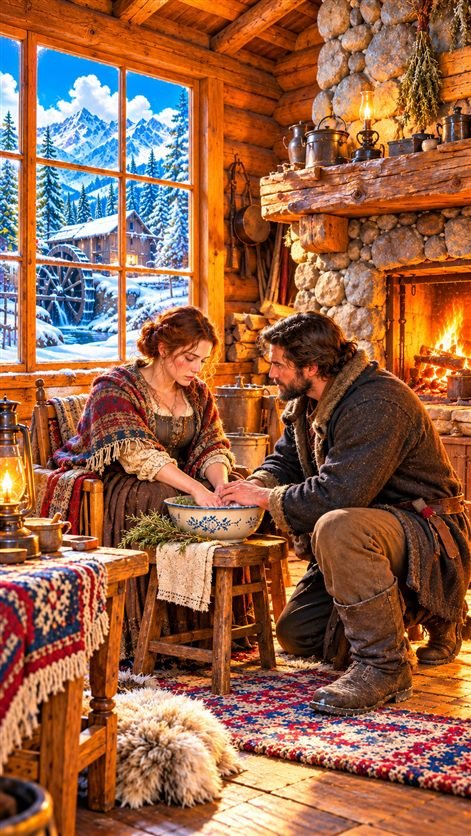
They worked in the grey dusk until the light failed behind the granite teeth of the ridge. By the time the lanterns were lit in the rough-hewn mill cabin, Blythe’s hands were swollen and red, the skin across her knuckles cracked by the combination of lye-soap and river ice. Nathan set a heavy iron kettle of water onto the hearth coals, tossing in a handful of dried winter savory and a slab of coarse cornmeal to bake two rough ash-cakes on the hot stones.
As the kettle began to hiss, Nathan pulled a small square of folded paper from his mackinaw pocket and tossed it onto the pine table between them.
“Stage driver brought this up from Sacramento this morning,” he said, keeping his voice carefully neutral. “Left it at the depot before Slocum locked the door.”

Caleb Sterling is an American frontier fiction writer and Old West history researcher based near Sheridan, Wyoming. Dedicated to authentic 19th-century pioneer lore, trail diaries, and homestead sagas, he has penned over 240 serialized tales celebrating the resilience, romance, and untamed spirit of the American frontier.