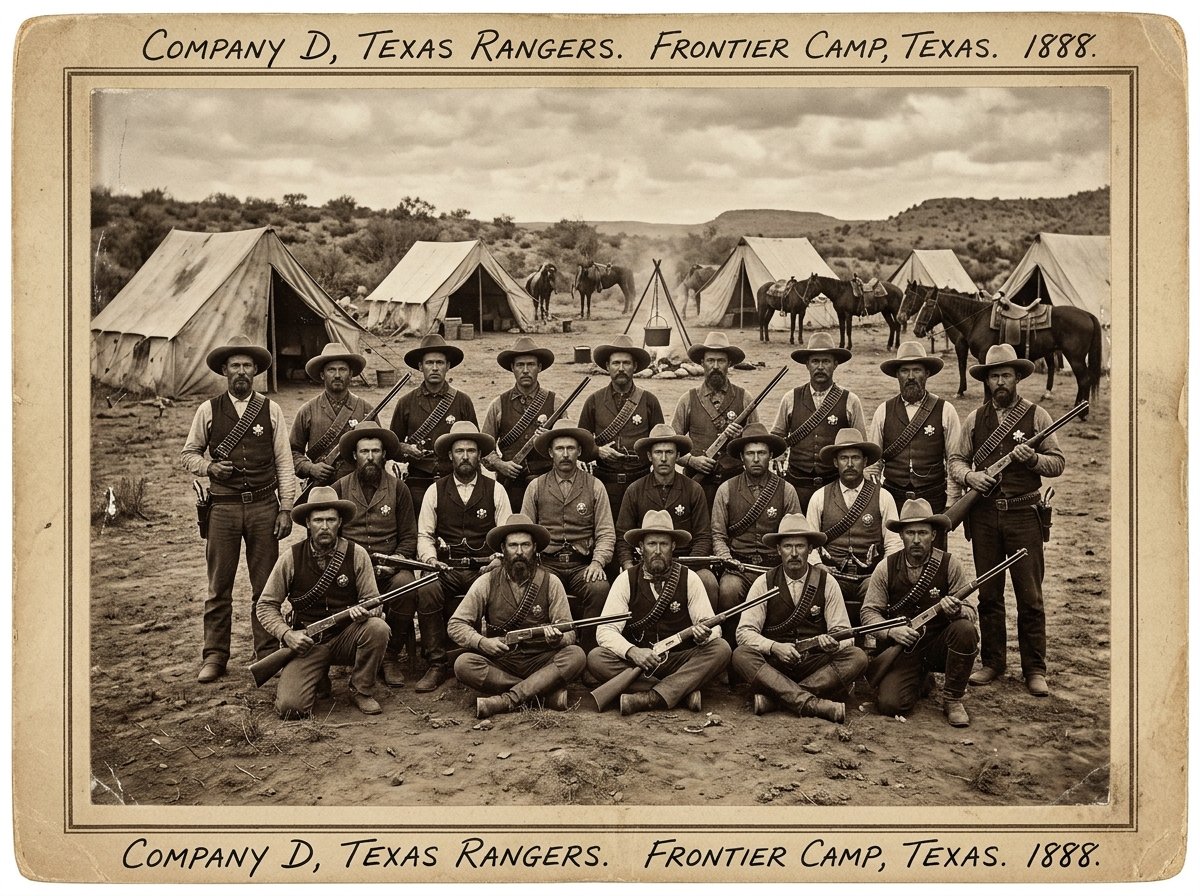
📜 Frontier Fast Facts: The Texas Rangers
Founded: 1823 by Stephen F. Austin (10 men hired as common rangers)
Evolution: Irregular militia -> Indian fighters -> Border cavalry -> State law enforcement.
Famous Outlaws Captured/Killed: John Wesley Hardin, Sam Bass, King Fisher.
Motto: “One Riot, One Ranger.” (Derived from Ranger lore in Dallas, 1896)
Among all law enforcement bodies that emerged from the American West, none attained the mythical status, controversy, and tactical reputation of the Texas Rangers. Neither standard police nor regular army soldiers, the Rangers were a specialized corps of mounted frontiersmen whose history spans revolutions, border wars, and the pacification of the dangerous southwest brush country.
The Origins: Austin’s Colony Militia (1823)
The Rangers were born out of desperate practical necessity. In 1823, when Stephen F. Austin received permission from the Mexican government to settle 300 American families in Texas, the fledgling colonies faced persistent raids from Karankawa and Comanche war parties. Having no regular army, Austin personally paid ten men to “range over the country” and protect the frontier settlements, christening them the Rangers.
During the Texas Revolution of 1836, Rangers served as couriers, rearguard scouts, and skirmishers under General Sam Houston, aiding in the decisive victory at San Jacinto that established the independent Republic of Texas.
The Revolution in Firepower: Colt Paterson Revolvers
Early Texas Rangers faced overwhelming tactical disadvantages when confronting Comanche horse archers on the open plains. A Comanche warrior could discharge a dozen accurate arrows from horseback while a Ranger struggled to dismount and reload a muzzle-loading rifle.
In the early 1840s, Captain John Coffee “Jack” Hays equipped his Rangers with Samuel Colt’s revolutionary invention: the five-shot Paterson revolver. At the Battle of Walker’s Creek in 1844, Hays’s fifteen Rangers charged an armed Comanche force four times their number, continuously discharging revolving cylinders without pausing to reload. The success made the Colt revolver the definitive weapon of the American frontier and cemented the partnership between Colt and the Ranger service.
The Frontier Battalion and the Outlaw Wars (1874)
Following the chaos of the Civil War and Reconstruction, the Texas Legislature formally created the “Frontier Battalion” in 1874, commanded by Major John B. Jones. Six companies of seventy-five Rangers were dispatched to pacify two distinct fronts: northern Comanche territory and the violent outlaw belt along the Mexican border.
Under legendary Ranger captains like Leander McNelly, the force ruthlessly dismantled organized criminal gangs. When John Wesley Hardin — one of the deadliest gunfighters in American history, credited with over twenty killings — fled to Florida under an assumed name, Ranger Lieutenant John B. Armstrong pursued him across state lines, confronting Hardin on a passenger train in Pensacola, knocking him unconscious, and bringing him back to Texas for prison sentence.
The Philosophy of Frontier Justice
The Rangers lived by an unwritten ethos shaped by hardship: they supplied their own horses, saddles, and weapons, subsisted on parched corn and beef jerky for weeks at a time, and were expected to resolve disputes with decisive authority. While later historical examinations have highlighted episodes of extrajudicial border violence during the Porfirio D-az era, the 19th-century Texas Ranger remains a cornerstone archetype of Western resilience and territorial law enforcement.
Historical Provenance & Archival Standards
Wild West Stories Historical Research Division • Primary Source Cross-Referenced
This historical monograph is compiled from digitized records preserved at the National Archives and Records Administration (NARA), the Library of Congress Prints and Photographs Division, and Western state historical registries. All dates, geographic coordinates, and legal proceedings have been verified against original 19th-century newspaper archives and territorial government registries.