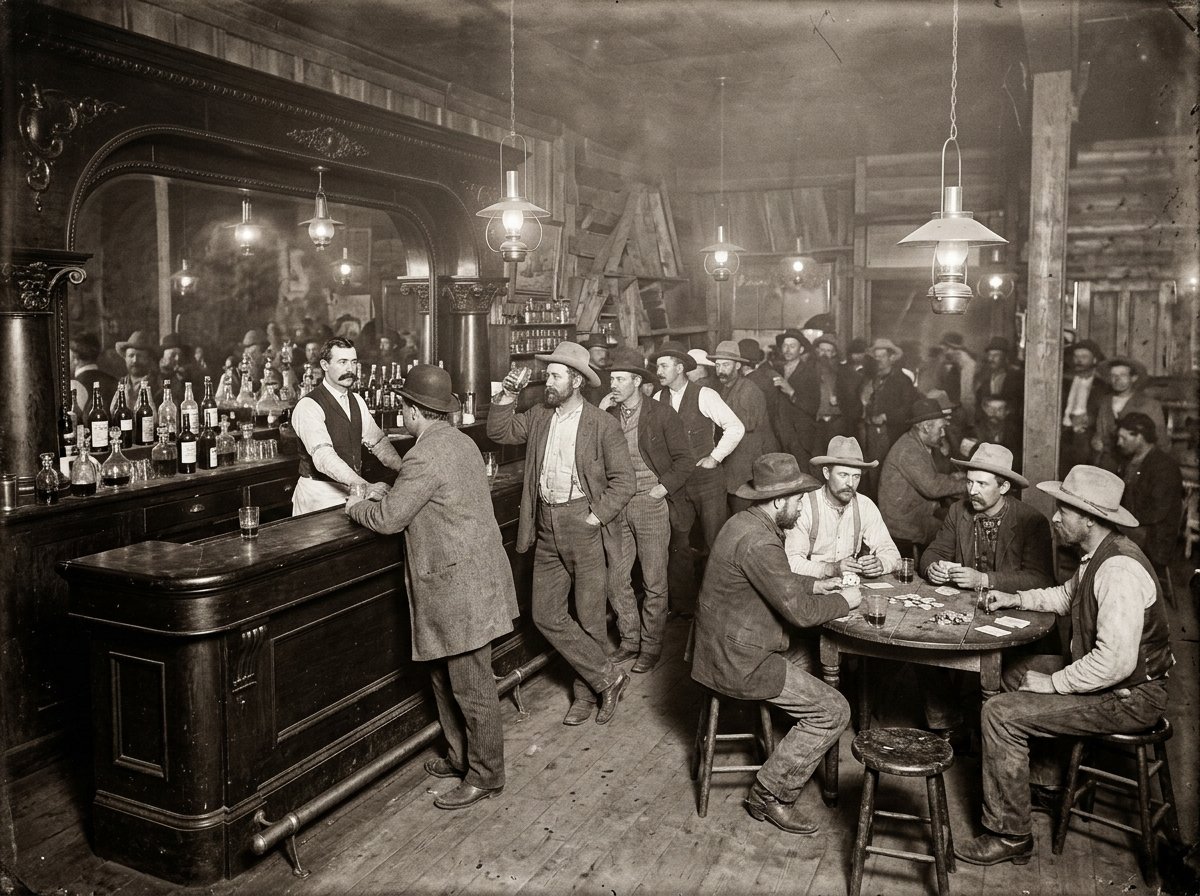
📜 Frontier Fast Facts: The Frontier Saloon
First Establishment: Brown’s Hole, Wyoming (1822, serving fur trappers)
Primary Role: Town hall, polling station, post office, labor exchange, social club.
Most Popular Game: Faro (not poker); fast-paced, high stakes, player against the dealer.
Weapon Policy: Firearms checked behind the bar in most regulated boomtowns.
In the popular imagination, the 19th-century Western saloon is a den of constant violence: swinging batwing doors, piano players diving behind upright uprights, and gunfights breaking out over cheating poker deals every evening. While frontier taverns could certainly be volatile, the historical reality reveals a far more complex institution: the saloon was the vital beating heart of early frontier civic life.
The Multi-Purpose Civic Center
When a mining strike occurred or a railroad crew pitched camp, the first substantial building constructed was invariably a saloon. Before towns built municipal courthouses, churches, or schoolhouses, the saloon served as the all-purpose meeting hall.
Coroners conducted autopsies on pool tables. Circuit judges held court trials with juries seated along wooden benches while spectators bought whiskey. Mining claims were filed over beer-stained mahogany bars, and the saloon keeper frequently operated the town’s only secure safe, holding mail, bank deposits, and legal contracts for illiterate miners.
What Frontier Men Actually Drank
Contrary to Western movies where bartenders pour amber aged bourbon from decanters, early frontier alcohol was notoriously rough and unregulated. Raw grain alcohol was shipped in oak barrels by wagon, then stretched by unscrupulous barkeeps who blended in brown sugar, burnt tobacco, molasses, and even drops of turpentine or nitric acid to give the concoction its trademark kick — known by colorful monikers like “tanglefoot,” “forty-rod,” and “coffin varnish.”
Ice was nonexistent until railroads arrived, meaning beer was served warm and flat. In wealthy mining capitals like Virginia City or Tombstone, however, saloons imported fine French champagne, oysters on ice from San Francisco, and Havana cigars, rivaling the luxury of Delmonico’s in Manhattan.
The Free Lunch Tradition
To attract customers, saloons introduced the famous “free lunch” system. For the price of a single five-cent glass of beer or ten-cent whiskey, a patron gained access to a buffet table laden with heavily salted cold meats, hard-boiled eggs, rye bread, pickles, and salty cheeses. The salt stimulated intense thirst, ensuring the patron purchased three or four more drinks before leaving, giving rise to the economic adage: “There ain’t no such thing as a free lunch.”
Faro: The King of Frontier Card Games
While modern audiences associate cowboys exclusively with Texas Hold’em poker, the undisputed king of 19th-century gaming tables was Faro. Imported from France and Louisiana, Faro was fast, easy to learn, and offered minimal house edge when played honestly. Crowds packed around green baize felt tables decorated with thirteen cards of the spade suit, placing wagers with gold dust and bone chips while a “case keeper” tracked dealt cards on an abacus-like wooden frame.
Strict Gun-Check Ordinances
The Hollywood image of armed men drinking while wearing low-slung gunbelts is largely fiction for established towns. In frontier cattle towns like Dodge City, Wichita, and Abilene, city councils enacted strict gun control. Upon entering city limits, signs warned: “All firearms must be deposited with the Marshal or checked behind the bar.” Saloon keepers maintained brass tags and gun racks, returning weapons only when patrons were mounted and riding out of town.
Historical Provenance & Archival Standards
Wild West Stories Historical Research Division • Primary Source Cross-Referenced
This historical monograph is compiled from digitized records preserved at the National Archives and Records Administration (NARA), the Library of Congress Prints and Photographs Division, and Western state historical registries. All dates, geographic coordinates, and legal proceedings have been verified against original 19th-century newspaper archives and territorial government registries.