I took his name to hide our shared ruin. But the ledger ink told the court a different truth.
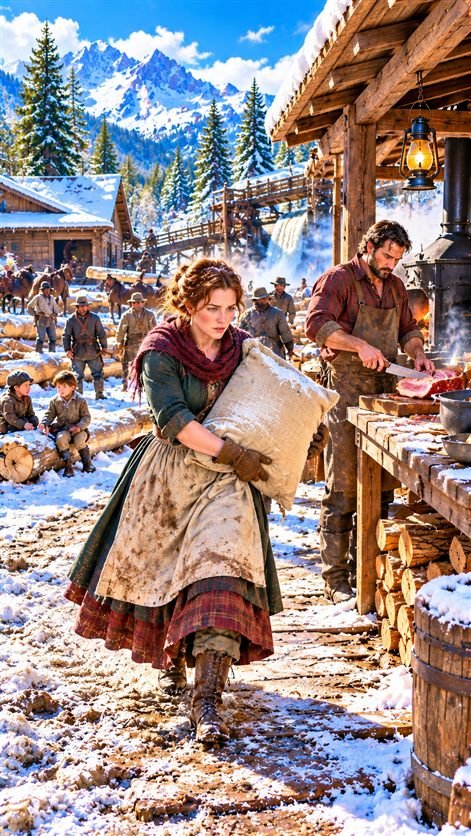
The heavy fir timber of the sawmill porch groaned beneath Rowena Whitmore’s boots as she hauled a hundred-pound sack of unsifted rye across the splintered pine floorboards. It was the stinging bite of early November frost, carrying the sharp scent of damp sawdust and river silt, that made her fingers numb inside her grease-stained leather work gloves. Around her, the Washington territory timber camp bustled with the rough-hewn friction of laborers dragging cant hooks, hoisting wet hemlock logs, and spitting tobacco into the sawdust. Rowena was the daughter of a ruined man whose name had been dragged through every probate court from Puget Sound to the Cascades, leaving her saddled with debts she never contracted and a reputation that closed doors before she could even knock. To survive the bitter autumn wind slicing down from the granite peaks, she had taken the grueling work of camp cook and ledger clerk, hauling iron kettles and kneading heavy dough at four o’clock every morning while the loggers slept in their damp bunks. The physical weight of the labor was staggering, yet it was nothing compared to the humiliating whispers of the townspeople who gathered at the company store every Saturday to mock her fallen family. She gripped the heavy flour sack tighter, lifting it with a sharp heave onto the sturdy trestle table beside the cast-iron cookstove, her breath pluming into white vapor in the drafty room.
At the other end of the long trestle table, Emmett Whitmore, the toll-bridge keeper and sawmill foreman whose distant kinship to her disgraced father had cast an unwanted shadow over her arrival, stood carving slices of salted pork with a heavy bone-handled knife. Emmett was a man carved from the same hard pine as the valley’s ancient trees—broad-shouldered, quiet-eyed, and perpetually begrimed with cedar dust and wood smoke. He did not look up as Rowena dropped the sack, his weathered jaw set in a hard, uncompromising line that suggested he carried burdens far heavier than any timber cart. Yet, beneath his gruff exterior, Emmett possessed an instinctive fairness that had kept him from turning her out when the town council tried to revoke her boarding license. The small-town chorus of gossiping boarders, storekeepers, and church elders watched them through the multi-paned grease-smeared windows from the gravel yard outside, whispering behind wool-gloved hands as Rowena swept up stray woodchips with a birch-twig broom. The social crucible of the lumber camp spared no one, and Rowena knew every motion she made was scrutinized by men who wanted nothing more than to see a Whitmore stumble and break.
Working side by side in the suffocating heat of the cookshack, the two of us began the heavy noon meal preparations under the watchful eye of the camp hands crowded onto the benches. Emmett dumped a wooden bucket of lard into a blackened iron skillet, the fat sizzling violently against the cast iron as he tossed in chopped onions and coarse salt. “If you keep flour sacks stacked that high near the stove draft, Miss Whitmore, the rising damp will ruin half a barrel before Sunday,” Emmett said, his voice a low, gravelly rumble that barely carried over the steady thrum of the river over the spillway outside. Rowena paused, her broom poised over a pile of sawdust, her chin lifting with defensive pride. “The floorboards are drier here than in the root cellar, Mr. Whitmore, and I prefer my flour where I can watch it rather than rotting in the dark,” she replied, her tone sharp with dry wit. Emmett stopped slicing the salt pork, turning his dark, steady gaze upon her, a flicker of grudging amusement touching the corners of his mouth. “Watch it all you like, but a Washington frost don’t care about your watchfulness once the river fog rolls in off the sound,” he retorted, dropping another slab of pork into the spitting grease. “Just see that the coffee’s boiled strong enough to float a horseshoe by noon, or these teamsters will have my hide before yours.” Rowena bit back a retort, turning back to her sweeping with vigorous, rhythmic strokes that kicked up a cloud of fine gray dust. For ten long minutes, the only sound inside the kitchen was the rhythmic scraping of her broom and the hiss of pork fat, a silent negotiation of boundaries between two proud souls forced by circumstance into an uneasy partnership.
The tactile labor of the frontier kitchen demanded unyielding endurance and precise timing. Rowena rolled up her sleeves, revealing forearms corded with muscle from months of hauling water and kneading sourdough, and reached for the heavy wooden dough trough. She measured out coarse salt, pale yellow lard, and rye flour, pouring in lukewarm well water with careful, practiced exactness. Her hands sank into the sticky mass, fingers folding and pressing the dough against the rough-grained wood with steady, methodical force. Beside her, Emmett hauled a fresh cord of dry alder wood through the back door, kicking the heavy timber aside with his heavy work boot before feeding the roaring iron stove. The physical exertion of wood-splitting and dough-kneading filled the cramped space with the sharp tang of sweat, wood sap, and baking yeast. “You’ve got the arm for heavy dough,” Emmett observed quietly, pausing to wipe his brow with a bandanna as he watched her knuckles flex against the gluten. “Most women coming out of the eastern seminaries faint at the sight of a flour weevil, let alone a hundred-pound sack.” Rowena did not stop her kneading, her breath coming in short, measured puffs. “Seminaries don’t teach you how to survive an empty pantry when your father’s creditors strip the house bare, Mr. Whitmore,” she answered, her voice dropping an octave as the painful memory of her eviction surfaced. Emmett’s movements slowed; he leaned against the woodbox, his expression softening into a deep, unspoken sorrow that mirrored his own unhealed guilt over a logging accident years ago that had cost a man his leg. The shared silence between them grew heavy, charged with an emotional gravity that transcended their verbal sparring.
—
The transition from hostility to mutual respect was forged in the bitter cold of the lumberyard and the shared drudgery of keeping the camp functioning through the damp autumn gales. Rowena spent her afternoons not only tending the heavy cookstove but also managing the camp’s crude financial ledgers at a slanted oak desk near the pantry. Her penmanship was immaculate—sharp, copperplate script that recorded every board-foot of cedar shipped downriver and every sack of oats purchased from the mercantile in town. One afternoon, while the rain lashed horizontally against the cabin windows, Emmett sat across from her at the oilcloth-covered table, nursing a tin cup of chicory coffee while repairing a split leather harness trace with an awl and waxed thread. The cramped cabin smelled wonderfully of wet wool, pine pitch, and roasting chicory, a pocket of warmth against the howling wilderness outside. Seeking comfort from the biting draft that slipped beneath the door frame, Rowena pulled her chair closer to the glowing cast-iron stove, her shoulder brushing against the heavy wool of Emmett’s coat as they bent over their respective tasks. The physical closeness, born of survival against the chill, slowly shifted into a tender, unspoken intimacy. Emmett didn’t pull away; instead, he shifted his massive frame to block the draft from the floorboards, his hand lingering for a fraction of a second near the back of her chair before returning to his stitching.