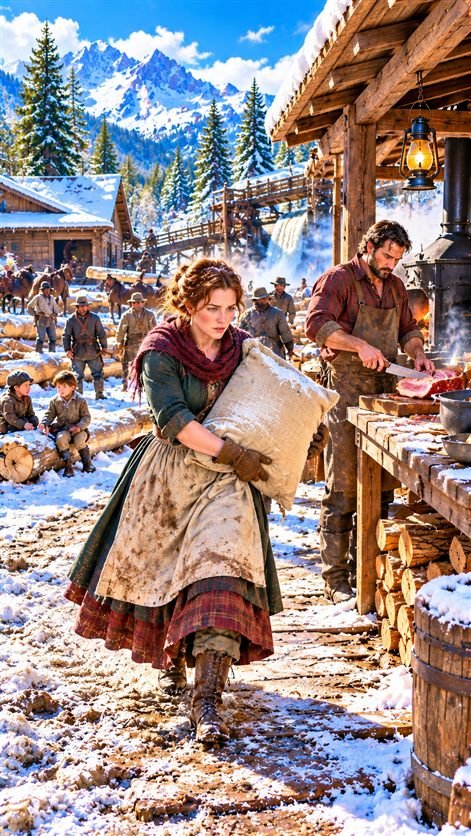
Amidst the rugged demands of camp life, small domestic comforts provided a vital anchor for their sanity. Rowena took it upon herself to harvest wild high-mountain plums and late-season apples from an abandoned orchard down the river valley before the frost ruined them completely. The crisp autumn air was alive with the hum of sluggish, cold-stiffened bees as she reached deep into the tangled briars, her fingers stained deep purple with juice as she dropped the heavy fruit into a wicker basket. Hauling the heavy baskets back up the steep trail alongside Emmett, who carried a freshly bagged deer carcass over his broad shoulders, they shared quiet, breathless observations about the valley’s changing seasons. Later that evening, in the warm haze of the cookshack, Rowena stood over a bubbling copper kettle, stirring down the crushed plums with brown sugar and wild honey while Emmett carved wooden pegs for the pantry shelves. The sweet, heavy steam rose into the timber rafters, sweetening the heavy air and masking the smell of wet sawdust. “If you keep making preserves this rich, the camp hands will expect pie three times a day, and we’ll run out of sugar before the river freezes,” Emmett remarked, a rare, dry smile touching his lips as he tested the strength of a freshly whittled peg. Rowena laughed softly, her eyes bright in the amber glow of the kerosene lamp. “Let them complain; a man who works twelve hours in the timber has earned enough sugar to sweeten his bitter disposition, Mr. Whitmore,” she replied, ladling a spoonful of hot plum jam onto a crust of fresh bread and handing it across the table to him. Emmett took the bread, his calloused fingers brushing hers, and for a long moment, neither of them spoke as they shared the simple, nourishing warmth of the hearthside.
The underlying tension of their legal and social estrangement, however, was never far beneath the surface. Late one evening, while the rest of the camp slept in their bunks, Emmett sat by the fading embers of the stove, sharpening his skinning knife on an oilstone with a steady, rasping rhythm. Rowena sat across from him, poring over the freight manifests from the previous spring, her brow furrowed in concentration as she checked the column totals against the tally marks on the warehouse wall. “Gable and his surveyors have been filing new boundary markers up by the upper timber claims,” Rowena said suddenly, her voice low so as not to wake the sleeping men in the loft. “The line they’re drawing cuts straight through our lower pasture and the eastern sawmill flume.” Emmett stopped his sharpening, the steel blade gleaming dully in the dim light. “Gable’s been trying to squeeze out independent operators along the river for six months, ever since the territorial rail syndicate backed his land-grant claims,” Emmett growled, his jaw tightening. “He thinks because your father’s name is on the old tax rolls as a defaulter, the whole valley is ripe for the picking.” Rowena looked up, her dark eyes flashing with fierce indignation. “My father made mistakes, Emmett, but he never sold out the communal water rights to a land speculator. There’s a discrepancy in these survey dates—the benchmark numbers don’t match the 1856 territorial plat.” Emmett leaned forward, resting his forearms on his knees, his rugged face catching the amber firelight. “Show me,” he murmured, rising from his stool and stepping around the table to stand directly behind her chair, leaning over her shoulder to inspect the ink-stained ledger page. The nearness of his broad chest and the clean scent of cedar and wood smoke enveloped her, making her breath catch in her throat as he pointed a thick, calloused finger at the disputed entry.
—
The fragile peace of the lumber camp shattered on a freezing Tuesday morning when a catastrophic flash flood, swollen by unseasonable mountain rains melting the early snowpack, came roaring down the gorge toward the sawmill. The icy torrent threatened to smash the timber flumes and sweep away the winter log booms before they could be secured. Rowena and Emmett bolted from the cookshack at dawn, the deafening roar of churning brown water and splintering pine echoing off the canyon walls. The local town councilmen, led by the prosperous and ruthless land speculator Gable, had ridden out from town to inspect the damage, loudly declaring that the camp was bankrupt and that the entire property would be immediately seized for non-payment of back taxes under the old Whitmore default. Amidst the chaos of rushing water, shouting teamsters, and snapping hawsers, Gable stood on the muddy riverbank with a thick roll of legal documents tucked under his arm, shouting for the workers to drop their tools and clear out. Rowena refused to yield. Utilizing her Keystone skill—her meticulous mastery of historical book-keeping, ledger-reading, and land survey benchmarks—she sprinted through the freezing mud to the camp office, tearing open the heavy iron-strapped strongbox that the town officials had ignored for years.
Inside the rusted strongbox lay the key to the entire mystery: the original, unrecorded land grant and boundary survey signed by the territorial governor in 1856, proving conclusively that the land on which the sawmill and water flume stood was deeded directly to the Whitmore family free and clear of any corporate liens. But as Rowena emerged from the office holding the brittle parchment aloft, Gable’s hired enforcers moved in to intercept her, attempting to snatch the document from her hands before she could read the survey coordinates aloud to the assembled camp. Emmett saw the threat instantly. Dropping the heavy iron chain he was using to anchor the log boom, he vaulted across the muddy gap between the riverbank and the boardwalk, intercepting Gable’s lead enforcer with a bone-jarring tackle that sent both men sprawling into the icy slush. “Back off, Gable! You’ve played your last crooked hand in this valley,” Emmett roared, hauling himself up from the mud with a bleeding lip and a fierce, dangerous light in his eyes. The assembled camp hands, witnessing Emmett’s defense of Rowena and the undeniable proof of the stolen land grant, instantly rallied behind their foreman, grabbing cant hooks and pitchforks to form an impenetrable wall between Gable’s men and the office door. In the swirling chaos of the river flood and the angry crowd, Rowena stood tall beside Emmett, her heart hammering against her ribs as she unfurled the yellowed parchment for all the townspeople to see.
With the immediate violence averted, the camp retreated into the comparative warmth of the cookshack, where the dripping wet men crowded around the trestle table while Rowena laid out the fragile 1856 survey map under the harsh glare of two kerosene lamps. The atmosphere was thick with the smell of wet wool, tobacco smoke, and boiling coffee as Emmett tended to a cut over his eye with a damp rag. Rowena stood beside him, her fingers steady as she pointed out the precise geological markers—the split granite boulder at the river bend and the iron benchmark driven into the cliffside—that Gable’s men had secretly shifted two hundred yards upstream to manufacture a fraudulent boundary violation. “Look at the notary stamp and the ink chemistry,” Rowena explained to the circle of skeptical townspeople and nervous council members who had crowded inside out of the freezing rain. “Gable’s copies use modern iron-gall ink that didn’t exist in the territory before 1870, whereas the original grant was registered with lamp-black ink that matches the governor’s personal seal.” Emmett watched her with a profound, unmasked tenderness, his rugged face softening as he listened to her brilliant, unassailable logic dismantle years of corporate corruption in a matter of minutes. The vulnerability of the hearthside replaced the storm’s fury; as the crowd slowly dispersed into the rainy night, muttering among themselves and casting uneasy glances at Gable’s retreating carriage, Emmett and Rowena were left alone in the quiet warmth of the cabin. Emmett reached out, his rough, calloused hand gently covering hers where it rested on the ancient parchment, his thumb tracing the ink-stained skin of her knuckles with reverent gentleness.