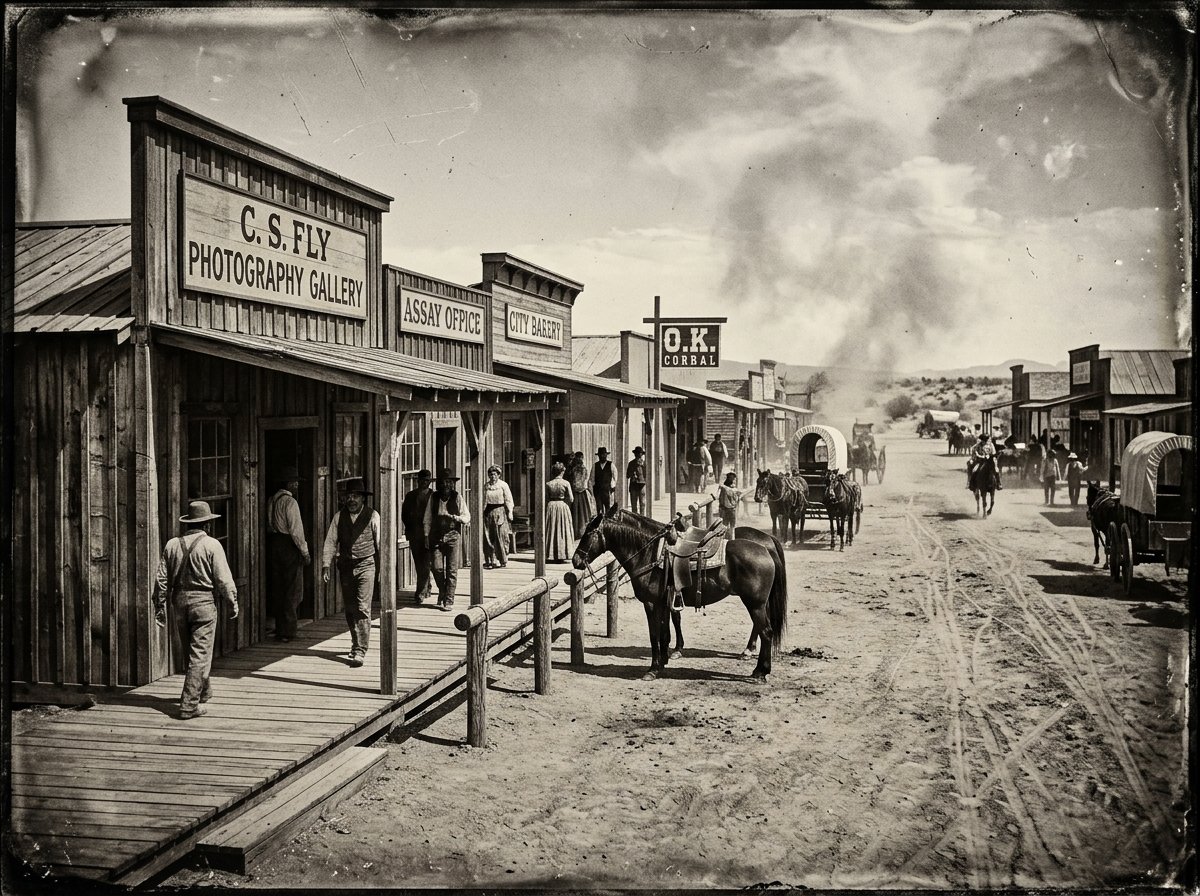
📜 Frontier Fast Facts: The Tombstone Shootout
Date & Time: Wednesday, October 26, 1881, at approximately 3:00 PM.
Exact Location: Narrow 18-foot vacant lot behind Harwood’s boarding house on Fremont Street (two doors west of 377 Fremont Street), Tombstone, Arizona Territory — not inside the O.K. Corral.
Participants: Town Marshal Virgil Earp, Assistant Marshal Morgan Earp, Special Policeman Wyatt Earp, and Doc Holliday vs. Billy Clanton, Frank McLaury, Tom McLaury, Ike Clanton, and Billy Claiborne.
Casualties: 3 men killed (Frank McLaury, Tom McLaury, Billy Clanton); 3 wounded (Virgil Earp, Morgan Earp, Doc Holliday). Ike Clanton and Billy Claiborne fled unharmed. Thirty shots fired in thirty seconds.
Few events in American frontier history have been as thoroughly romanticized, misunderstood, and distorted by Hollywood cinema as the deadly gunfight that erupted on a freezing, blustery Wednesday afternoon in Tombstone, Arizona Territory, on October 26, 1881. Popular culture portrays the conflict as a simplistic showdown between gallant, white-hatted lawmen and lawless frontier outlaws. In historical truth, the thirty-second gun battle was the violent climax of a bitter, multi-layered feud involving partisan politics, business competition, municipal gun ordinances, and personal animosities.
The Setting: Tombstone and the Cochise County Power Struggle
In the autumn of 1881, Tombstone was not a dusty cow town; it was a burgeoning silver mining boomtown of over seven thousand residents, boasting ice cream parlors, four daily newspapers, telephone lines, and grand hotels. Beneath the bustling commerce, a deep political and cultural fissure divided the populace into two hostile camps:
- The Town Faction (Lawmen & Merchants): Led by the Earp brothers, Mayor John Clum, and business leaders of the Citizens Safety League. Politically allied with the Republican Party, they favored federal civil authority, municipal gun control, and commercial stability.
- The Rural Cowboy Faction: Led by ranchers Newman Haynes “Old Man” Clanton, Ike and Billy Clanton, Frank and Tom McLaury, and Cochise County Sheriff Johnny Behan. Primarily Southern Democrats, they operated ranches along the San Pedro River, fiercely resisted municipal interference, and were suspected by town authorities of smuggling cattle across the Mexican border.
Tombstone had enacted City Ordinance No. 9, which strictly banned the carrying of deadly weapons within municipal limits. Anyone carrying firearms was legally required to check their weapons at a hotel, saloon, or the Marshal’s office upon entering town.
The Escalation: Threats, Liquor, and Fremont Street
On Tuesday night, October 25, tensions reached a boiling point. An intoxicated Ike Clanton engaged in a series of heated verbal altercations with Doc Holliday and Wyatt Earp in the Alhambra and Occidental saloons. The following morning, Ike armed himself with a Winchester rifle and six-shooter, roaming the streets looking for the Earps.
Town Marshal Virgil Earp snuck up behind Clanton, pistol-whipped him across the head, disarmed him, and dragged him before Justice of the Peace Wallace, where Ike was fined twenty-five dollars for violating the gun ordinance. Soon after, Wyatt Earp had an angry confrontation with Tom McLaury, striking McLaury across the face with his revolver.
By 2:30 PM, Billy Clanton and Frank McLaury rode into Tombstone to support their brothers, purchasing fresh cartridges at Spangenberg’s gun shop. Alarmed citizens informed Virgil Earp that the armed Cowboys were gathered in a narrow eighteen-foot lot between Harwood’s boarding house and Fly’s Photography Studio on Fremont Street.
Thirty Seconds of Fury
Virgil Earp, exercising his legal authority as Town Marshal, resolved to disarm the Cowboys. He deputized his brothers Wyatt and Morgan, and handed Doc Holliday a 10-gauge double-barreled Belgian coach gun under his long coat to avoid causing immediate panic in the streets. As the four men marched down Fourth Street and turned onto Fremont, County Sheriff Johnny Behan approached them, claiming: “Hold on, Earps, don’t go down there! I have already disarmed them!”
Virgil brushed past Behan and stepped into the narrow lot, standing only six feet away from the Clantons and McLaurys. Virgil raised his wooden cane in his right hand and commanded: “Boys, throw up your hands, I want your guns!”
Eyewitness testimony regarding who discharged the first shot was bitterly disputed during the subsequent inquest, but within seconds, deafening gunfire shattered the cold afternoon air. Thirty shots were fired in roughly thirty seconds:
- Ike Clanton, who was unarmed at the moment of the confrontation, rushed forward, grabbed Wyatt Earp’s coat, and begged for his life. Wyatt shoved him back, shouting, “Go to fighting or get away, Ike!” Clanton fled through Fly’s studio unharmed.
- Billy Claiborne bolted through the lot and escaped down the alleyway.
- Doc Holliday unleashed both barrels of buckshot into Tom McLaury’s chest beneath his horse’s armpit, mortally wounding him.
- Morgan Earp was shot through both shoulder blades by a bullet fired by Frank McLaury or Billy Clanton.
- Virgil Earp took a heavy slug through his right calf.
- Doc Holliday was grazed across the hip by a bullet from Frank McLaury.
- Frank McLaury and nineteen-year-old Billy Clanton fought with desperate fury, firing their revolvers from the ground until both were shot dead through the head and torso.
The Spicer Hearing and Aftermath
When the smoke cleared from Fremont Street, Tom McLaury, Frank McLaury, and young Billy Clanton lay dead or dying. Sheriff Behan arrested the Earps and Holliday for murder. During a month-long preliminary hearing before Justice Wells Spicer, dozens of witnesses gave conflicting testimony.
On November 30, 1881, Judge Spicer issued an exhaustive ruling, exonerating the Earps and Doc Holliday. Spicer concluded that while Virgil Earp had shown questionable judgment in deputizing Holliday, the lawmen were acting within their legal duty to enforce the town’s gun ordinance against armed, threatening individuals.
The feud did not end on Fremont Street. Two months later, Virgil Earp was ambushed from an abandoned building, his left arm shattered by buckshot. In March 1882, Morgan Earp was assassinated while playing billiards at Campbell & Hatch’s saloon. Wyatt Earp then launched his legendary, extrajudicial “Vendetta Ride,” hunting down Frank Stilwell, Curly Bill Brocius, and several other suspects, transforming a localized territorial tragedy into the most famous gunfight of the American West.
Historical Provenance & Archival Standards
Wild West Stories Historical Research Division • Primary Source Cross-Referenced
This historical monograph is compiled from digitized records preserved at the National Archives and Records Administration (NARA), the Library of Congress Prints and Photographs Division, and Western state historical registries. All dates, geographic coordinates, and legal proceedings have been verified against original 19th-century newspaper archives and territorial government registries.