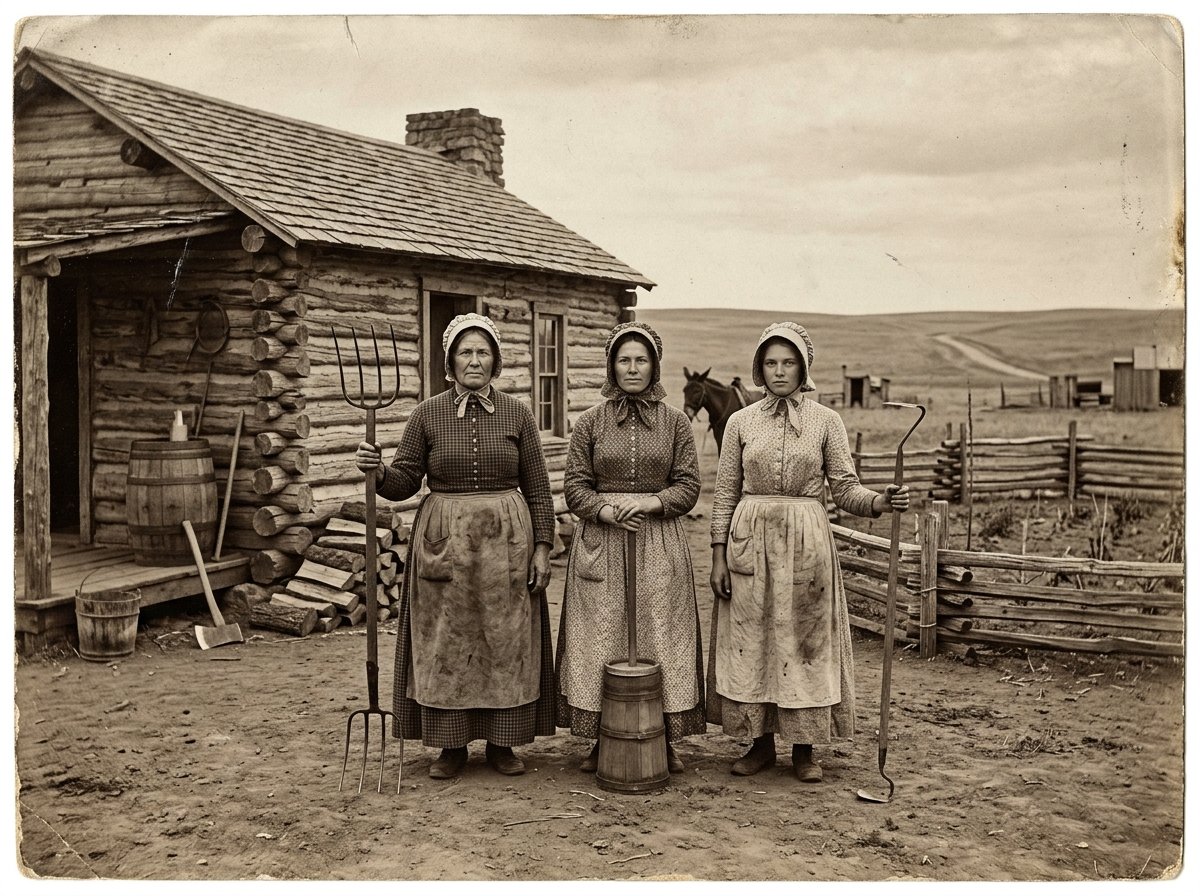
📜 Frontier Fast Facts: Women of the West
First State with Women’s Suffrage: Wyoming Territory (December 10, 1869)
Land Ownership: Over 12% of homestead claims in Colorado, Wyoming, and Nebraska were proved up by single women and widows under the Homestead Act.
Notable Trailblazers: Esther Hobart Morris (first female justice of the peace), Dr. Bethenia Owens-Adair, Clara Brown, Martha Canary, Rachel Calof.
Frontier Reality: Demanded equal physical partnership and economic agency, shattering rigid 19th-century Victorian gender spheres.
Traditional Hollywood cinema long portrayed women of the Old West in two simplistic caricatures: the helpless prairie maiden awaiting rescue or the hardened dancehall singer. Historical archival records, personal overland diaries, territorial court ledgers, and federal land patents tell a vastly different and far more inspiring story. On the harsh frontier, women were cattle ranchers, newspaper editors, pioneering physicians, mine owners, and civic leaders whose resilience forged modern American democracy.
The Shattering of Victorian Domestic Spheres
In the industrialized cities of the American East during the mid-to-late 19th century, society adhered strictly to the ideology known as the “Cult of True Womanhood.” This cultural doctrine dictated that a respectable woman belonged exclusively in the private domestic sphere, defined by piety, purity, submissiveness, and domesticity. Men alone were expected to navigate the public worlds of commerce, law, physical labor, and politics.
Crossing the Missouri River obliterated these artificial restrictions almost overnight. On the overland trails to Oregon, California, and Utah, survival required complete operational partnership. When prairie blizzards, swollen river crossings, or cholera outbreaks decimated wagon companies, women stepped into every leadership role. Diaries preserved in the National Archives reveal women driving heavy four-ox teams across mountain passes, wading waist-deep into rushing rivers to guide livestock, repairing broken wagon wheels with iron tire jacks, and hunting prairie game to stave off starvation.
Upon arrival at desolate homestead parcels in Nebraska, the Dakotas, and Kansas, the physical workload intensified. A pioneer woman’s daily routine included hauling hundred-pound water casks from distant creeks, cutting sod bricks to construct turf homes, planting dryland maize, butchering livestock, preserving hundreds of quarts of root vegetables, and standing guard against prairie fires. When illness or accidents claimed their husbands, pioneer widows rarely abandoned their claims. Instead, official territorial land dockets demonstrate that thousands of women proved up federal patents independently, establishing generational family ranches that remain active today.
Wyoming and the Birth of Equal Suffrage (1869)
It was neither the intellectual salons of Boston nor the political chambers of Washington, D.C., that first granted American women full constitutional rights to vote and hold public office; it was the raw, windswept frontier territory of Wyoming. On December 10, 1869, territorial governor John A. Campbell signed the landmark Woman Suffrage Bill into law, half a century before the 19th Amendment was ratified nationwide.
Wyoming lawmakers, led by legislators like William H. Bright, recognized that frontier society could not function without the physical and intellectual partnership of women. Soon after the law’s passage, women in Laramie were seated on grand and petit juries, deliberating criminal cases alongside men. In February 1870, Esther Hobart Morris was officially appointed Justice of the Peace in South Pass City, a rough gold-mining boomtown in Sweetwater County. Morris became the first female judge in the modern world, adjudicating seventy civil and criminal dockets over an eight-month tenure without a single ruling overturned on appeal.
Following Wyoming’s trailblazing precedent, Utah Territory granted equal franchise in 1870, Colorado followed in 1893, and Idaho in 1896. Long before the eastern establishment yielded to national suffrage protests, the American West had already proven that representative democracy flourished when women participated equally in governance.
Pioneering Doctors: Dr. Bethenia Owens-Adair
Healthcare on the frontier was primitive, hazardous, and frequently nonexistent. In this demanding environment, pioneer women took charge of territorial medicine, evolving from self-taught herbalists and midwives into fully licensed, groundbreaking surgical doctors. One of the most extraordinary figures of frontier medicine was Dr. Bethenia Owens-Adair.
Born in Missouri in 1840, Bethenia journeyed west along the Oregon Trail as an infant. Married at fourteen to an abusive husband, she divorced him at nineteen, supporting herself and her young son by washing clothes, picking blackberries, and operating a millinery shop in Roseburg, Oregon. Refusing to accept societal limits, she saved her meager earnings and enrolled at the Eclectic Medical College of Pennsylvania, graduating with medical honors in 1874. Facing intense skepticism from male colleagues, she later earned a second M.D. degree from the prestigious Jefferson Medical College.
Returning to the Pacific Northwest, Dr. Owens-Adair established a flourishing practice in Portland and Astoria, performing complex obstetrical operations, setting compound fractures from logging camps, and advocating for public sanitation reform. Her autobiography, Dr. Owens-Adair: Some of Her Life Experiences, stands today as an indispensable primary record of frontier medical perseverance.
Pioneer Entrepreneurs: Clara Brown and Commercial Ranches
Economic self-reliance was another defining hallmark of Western women. Among the most remarkable business figures in Rocky Mountain history was Clara Brown. Born into enslavement in Virginia around 1800, Clara endured the agonizing sale of her husband and four children at auction. After purchasing her own freedom in Missouri at age fifty-six, “Aunt Clara” signed on as a wagon-train cook for prospectors heading to the Colorado Gold Rush in 1859.
Arriving in the boomtown of Central City, Colorado, she established the town’s first commercial laundry, catering to rugged miners who paid in gold dust. Brown astutely invested her profits into mining deeds, real estate parcels, and government bonds, amassing a fortune exceeding $10,000 — a massive sum in the 1870s. She utilized her wealth as a private humanitarian fund, traveling back to the post-Civil War South to locate and finance the relocation of dozens of emancipated Black families, providing them with homes, vocational training, and land in the West.
In the livestock industry, women like Henrietta King oversaw the legendary King Ranch in South Texas following her husband’s death in 1885, expanding the enterprise into more than one million acres of deeded territory. In Wyoming, women registered their own cattle brands, negotiated rail shipping rates with Union Pacific agents, and led armed posses to protect their herds from rustlers.
The True Western Legacy
The women of the American frontier dismantled the Victorian myth of female frailty with every fence post they dug, every patient they healed, and every ballot they cast. In battling crippling droughts, prairie isolation, epidemics, and territorial lawlessness, they did not merely survive the Old West — they fundamentally forged its social, economic, and political institutions.
Historical Provenance & Archival Standards
Wild West Stories Historical Research Division • Primary Source Cross-Referenced
This historical monograph is compiled from digitized records preserved at the National Archives and Records Administration (NARA), the Library of Congress Prints and Photographs Division, and Western state historical registries. All dates, geographic coordinates, and legal proceedings have been verified against original 19th-century newspaper archives and territorial government registries.