📜 Frontier Fast Facts: Boomtowns to Ghost Towns
Major Mining Strikes: Comstock Lode, NV (1859); Black Hills, SD (1874); Tombstone, AZ (1877); Leadville, CO (1879); Klondike, Yukon (1896).
Comstock Production: Over $300 million in silver and gold extracted between 1860 and 1880, financing the Transcontinental Telegraph and Union Civil War treasury.
Demographic Velocity: Towns expanded from barren sagebrush gulches to cities of 20,000 residents in under six months, featuring opera houses, gas lamps, and daily stock exchanges.
The Inevitable Collapse: Depletion of high-grade ore, underground water flooding, and the federal Silver Purchase Act repeal of 1893 turned thriving metropolises into hollow ghost towns.
Across the windswept mountain passes of Nevada, the jagged pine gulches of South Dakota’s Black Hills, and the arid scrublands of southern Arizona stand the sun-bleached pine skeletons of frontier ghost towns. Their sagging saloon porches, rusted stamp mill flywheels, and collapsed mine portals are the silent remnants of the most explosive and volatile economic phenomenon in 19th-century American history: the Western mining boom.
The Anatomy of a Strike: From Solitary Discovery to Frenzied Rush
Every mining boomtown began with a single spark of luck. An individual prospector panning a creek gravel bar would spot coarse flakes of placer gold, or a weathered scout would shatter a quartz boulder to reveal glittering veins of silver chloride. Under frontier convention, a discovery could never remain secret. Within hours of an assay office certifying high-grade yields — often yielding thousands of dollars per ton — the word raced by telegraph, stagecoach, and word of mouth.
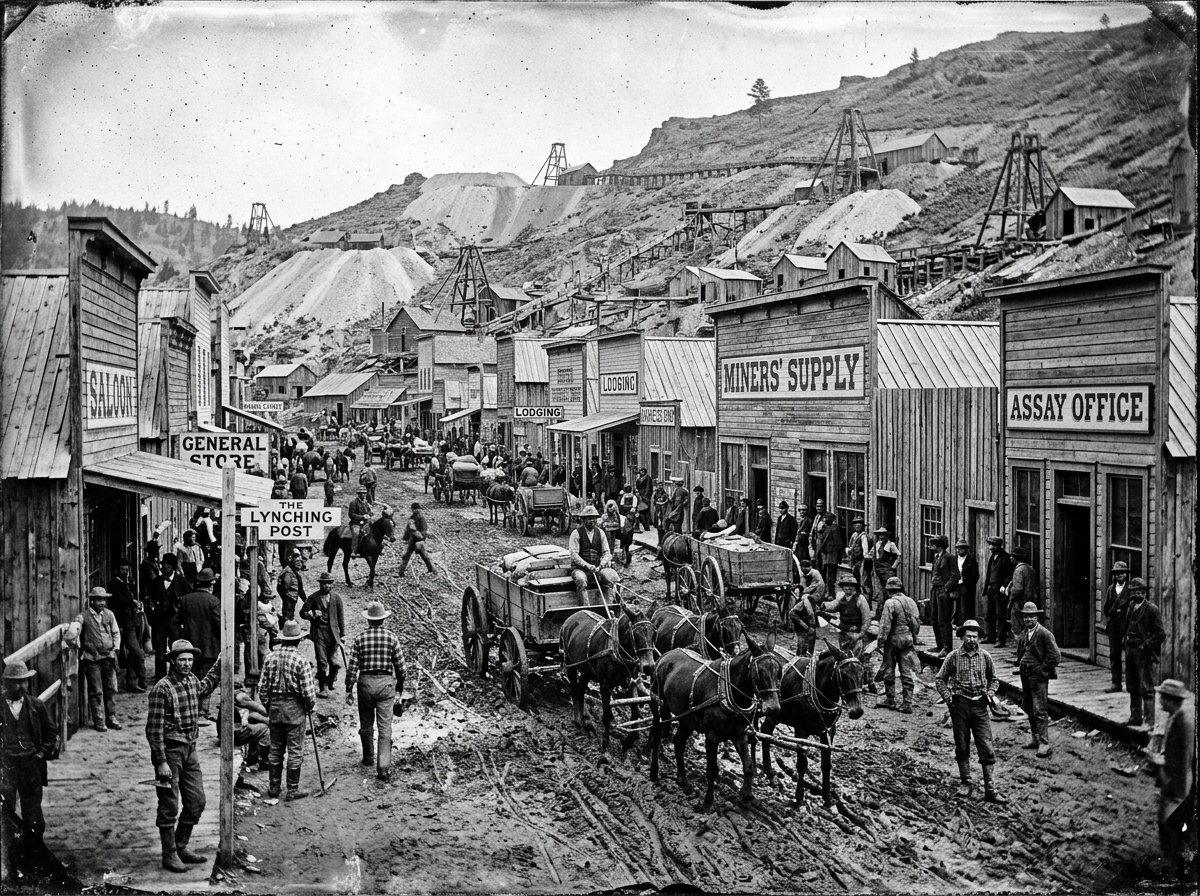
The ensuing stampede was instantaneous. Thousands of fortune seekers, unmoored veterans of the Civil War, European immigrants, and seasoned miners from Cornwall and California poured over the trails. In places like Deadwood, South Dakota, or Virginia City, Nevada, a wilderness ravine containing only pine timber and deer trails was transformed within ninety days into a dense tent city of ten thousand inhabitants. Canvas shanties gave way to two-story false-fronted wooden storefronts, lumber mills shrieked day and night, and freight wagons clogged muddy thoroughfares.
The Rise of Frontier Metropolises: Architecture and Infrastructure
Popular memory often envisions mining camps as crude collections of log cabins, but successful boomtowns evolved with breathtaking speed into sophisticated urban centers. When silver veins proved deep and lucrative, corporate investment flowed in from San Francisco, New York, and London. Immense capital transformed dirt-street encampments into modern industrial marvels.
In Virginia City, perched atop the immense wealth of the Comstock Lode, the municipal infrastructure rivaled eastern capitals. By the early 1870s, the city boasted piped municipal water systems, cast-iron gas street lamps, four daily newspapers (where a young Samuel Clemens adopted the pen name Mark Twain), and the lavish Piper’s Opera House, hosting international stars like Edwin Booth and Sarah Bernhardt. Luxury hotels served iced oysters freighted daily from San Francisco on beds of Sierra Nevada snow, alongside vintage French champagne.
Beneath the streets, an underground industrial empire operated around the clock. The Comstock mines penetrated more than three thousand feet into the earth, requiring radical engineering inventions: Philip Deidesheimer’s “square set” timbering system to prevent cave-ins, enormous steam-driven Cornish water pumps draining millions of gallons of scalding subterranean water daily, and compressed-air rock drills.
Social Dynamics, Lawlessness, and Vigilance
The explosive influx of young, unattached men combined with vast amounts of liquid wealth created an inherently turbulent social order. Commercial districts were dominated by saloons, gambling halls, and brothels that operated twenty-four hours a day. In the early months of a boom, municipal government was virtually nonexistent. Mining districts organized their own informal miners’ courts to adjudicate claim jumping, establish claim dimensions (typically 100 to 200 feet along the vein), and resolve disputes with swift, pragmatic justice.
Contrary to modern film mythology, gunfights were rarely glamorous street duels; they were abrupt, alcohol-fueled brawls or targeted ambushes. To establish basic civic stability, merchants and leading citizens frequently formed Committees of Vigilance. While these committees restored order in places like Bannack, Montana, and San Francisco, their extrajudicial executions and lack of due process highlighted the precarious boundary between law and frontier mob rule.
The Inevitable Collapse: The Economics of Ghost Towns
The fatal vulnerability of every boomtown lay in its singular economic foundation. Mining was an extractive industry with an unyielding natural expiration date. As shafts burrowed deeper, the costs of timbering, pumping boiling groundwater, and hauling ore to the surface escalated exponentially. Eventually, veins “pinched out” or low-grade ore could no longer cover the immense operational overhead.
Economic shocks delivered devastating blows. The Sherman Silver Purchase Act of 1890 had mandated that the federal government purchase 4.5 million ounces of silver monthly, artificially propping up Western silver mining. When President Grover Cleveland oversaw the act’s catastrophic repeal during the Panic of 1893, the market price of silver plummeted overnight. Hundreds of mines throughout Colorado, Nevada, and Arizona shut down their boilers in a single week.
The departure of a boomtown’s population was as rapid as its arrival. Miners packed their canvas sacks and departed for new strikes in the Coeur d’Alene, Cripple Creek, or the Klondike. Storekeepers boarded their windows, banks locked their vaults, and rail companies pulled up their spur lines. Left behind to the harsh desert sun and mountain snows were intact settlements — ghostly monuments to human ambition and the fleeting fortunes of the American frontier.
Historical Provenance & Archival Standards
Wild West Stories Historical Research Division • Primary Source Cross-Referenced
This historical monograph is compiled from digitized records preserved at the National Archives and Records Administration (NARA), the Library of Congress Prints and Photographs Division, and Western state historical registries. All dates, geographic coordinates, and legal proceedings have been verified against original 19th-century newspaper archives and territorial government registries.