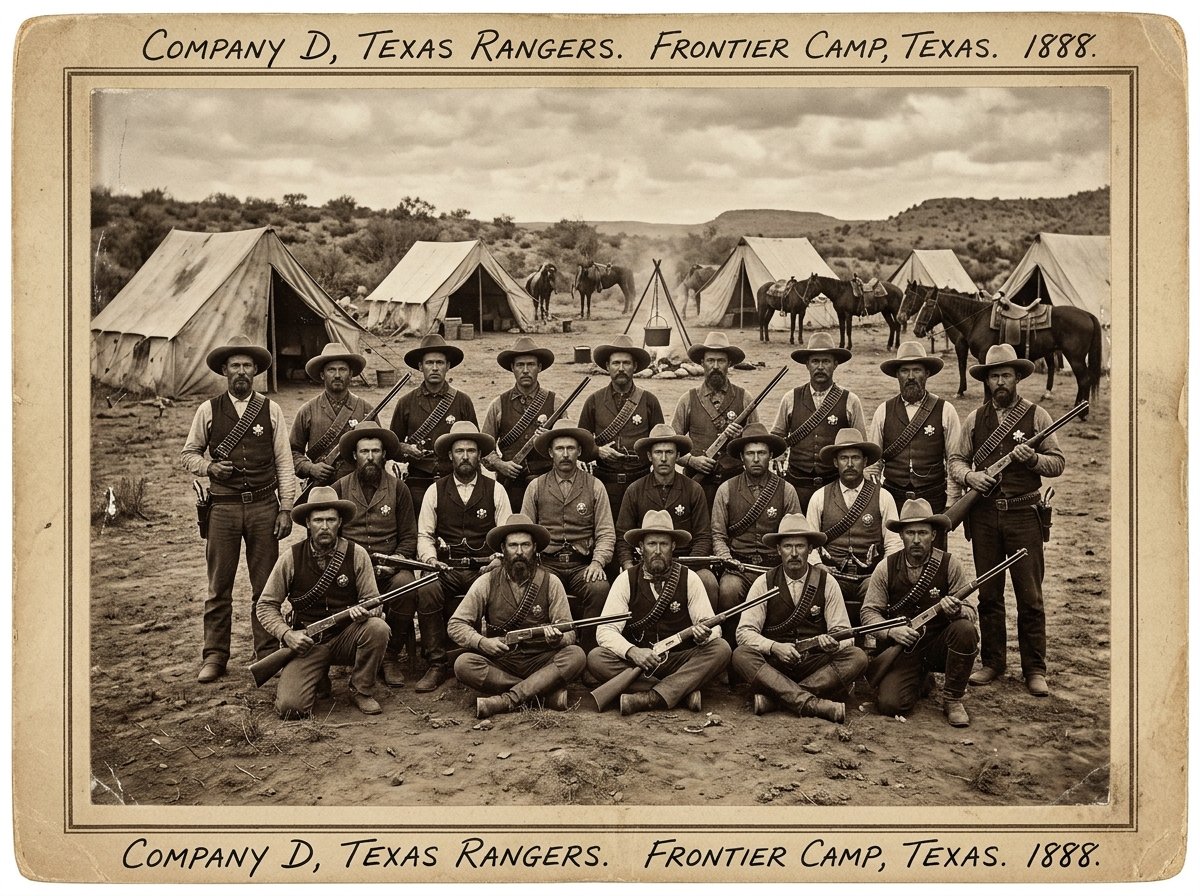
📜 Frontier Fast Facts: The Texas Rangers
Founding Year: 1823 (Created by “Father of Texas” Stephen F. Austin as a 10-man frontier defense force).
Tactical Innovation: First military/police unit to adopt Samuel Colt’s Paterson revolving pistol (1839–1844), revolutionizing mobile mounted warfare.
Legendary Frontier Captains: Jack Hays, “Rip” Ford, Leander McNelly, John B. Jones (Frontier Battalion commander).
Major Outlaw Captures: Hunted down and captured notorious train robber and killer Sam Bass (Round Rock, 1878) and arrested deadly gunfighter John Wesley Hardin (1877).
No law enforcement organization in American history has captured the popular imagination quite like the Texas Rangers. Immortalized in pulp Westerns, radio serials, and cinematic lore as solitary, white-hatted defenders of frontier justice, the historical reality of the Texas Rangers is infinitely more complex, politically entangled, and tactically groundbreaking. Operating neither as conventional municipal police nor as a standard military army, the Rangers were a uniquely adaptable paramilitary force forged on the violent perimeter of the southwestern frontier.
Origins in Austin’s Colony (1823–1836)
The genesis of the Rangers dates back to the summer of 1823, when Stephen F. Austin received permission from the Mexican government to settle three hundred families in colonial Texas. Facing constant raids from native Comanche and Karankawa bands on isolated settlements, Austin employed ten seasoned woodsmen to “range” across the wilderness frontiers to protect colonists. These initial volunteer scouts were not issued uniforms, badges, or government rations; each man provided his own horse, rifle, ammunition, and rations, receiving fifteen dollars a month paid from colonization subscriptions.
During the Texas Revolution of 1835–1836, the Rangers served primarily as couriers, rear-guard scouts, and frontier sentinels, guiding civilian families fleeing Santa Anna’s invading Mexican armies in the frantic evacuation known as the “Runaway Scrape.” When Texas emerged as an independent republic in 1836, President Mirabeau B. Lamar expanded the Rangers into a formal frontier defense force tasked with patrolling hundreds of miles of unmapped borderlands.
The Revolver Revolution: Jack Hays and the Colt Paterson
The defining tactical breakthrough in Texas Ranger history occurred in the early 1840s under the command of Captain John Coffee “Jack” Hays. Patrolling the Edwards Plateau and Nueces Strip, Hays and his men faced the Comanche — arguably the finest light cavalry warriors in world history. Mounted Comanche warriors could discharge twenty arrows a minute while riding at full gallop, while a Ranger armed with a single-shot muzzleloading Kentucky rifle or smoothbore musket had to dismount, stand stationary, and spend forty-five seconds reloading powder and ball.
The technological balance shifted radically when Captain Hays acquired a shipment of Samuel Colt’s newly patented five-shot Paterson revolving pistols in 1839. Hays trained his men to fire the revolvers accurately from the saddle at a dead gallop. The effectiveness of this mobile firepower was demonstrated decisively at the Battle of Walker’s Creek in June 1844. Hays and fourteen Rangers confronted an estimated eighty Comanche warriors. Instead of dismounting to form a defensive circle, the Rangers charged on horseback, continuously discharging revolvers into the fray. The encounter proved a turning point in frontier cavalry tactics, cementing Samuel Colt’s commercial fortunes and creating the blueprint for mounted law enforcement.
The Frontier Battalion and Outlaw Suppression (1874–1880s)
Following the chaos of the Civil War and Reconstruction, lawlessness engulfed post-war Texas. Bands of cattle rustlers, train bandits, and violent feuding families turned whole counties into armed fortresses. In May 1874, the Texas legislature formally reestablished the organization by creating the Frontier Battalion, authorized with six companies of seventy-five Rangers under the command of Major John B. Jones.
Major Jones instituted strict military discipline, detailed written muster rolls, and tactical reconnaissance. Between 1874 and 1881, the Frontier Battalion engaged in scores of skirmishes with hostiles and arrested thousands of outlaws. Two legendary operations stand out in territorial annals:
- The Pursuit of John Wesley Hardin (1877): Hardin, who claimed to have killed more than forty men, fled Texas for Florida under an alias. Texas Ranger Lieutenant John B. Armstrong tracked Hardin across three states, boarded a passenger train in Pensacola, Florida, and arrested Hardin at gunpoint after a desperate struggle in which an accomplice was shot dead.
- The Showdown at Round Rock (1878): Notorious train robber Sam Bass plotted to rob the Williamson County Bank in Round Rock, Texas. Forewarned by an informant, a detachment of Rangers led by Captain Lee Hall ambushed the Bass gang on the town’s main street on July 19, 1878. Bass was fatally wounded in the furious gun battle, ending his reign of terror across north Texas.
Controversies and the Complex Historical Legacy
An honest historical assessment of the Texas Rangers must also address their darker legacy. Operating on the volatile Rio Grande borderlands, especially under Special Force commander Leander McNelly in the 1870s, Rangers frequently acted as judge, jury, and executioner. Border raids into sovereign Mexican territory, summary executions of cattle thieves without trial, and racial intimidation of Tejano landowners generated bitter resentment that echoed through south Texas for generations.
The Rangers’ transformation from an irregular, hard-riding frontier scout force into the modern, forensic criminal investigation division of the Texas Department of Public Safety (established in 1935) reflects the broader evolution of the American West — from raw frontier violence to institutional constitutional order.
Historical Provenance & Archival Standards
Wild West Stories Historical Research Division • Primary Source Cross-Referenced
This historical monograph is compiled from digitized records preserved at the National Archives and Records Administration (NARA), the Library of Congress Prints and Photographs Division, and Western state historical registries. All dates, geographic coordinates, and legal proceedings have been verified against original 19th-century newspaper archives and territorial government registries.