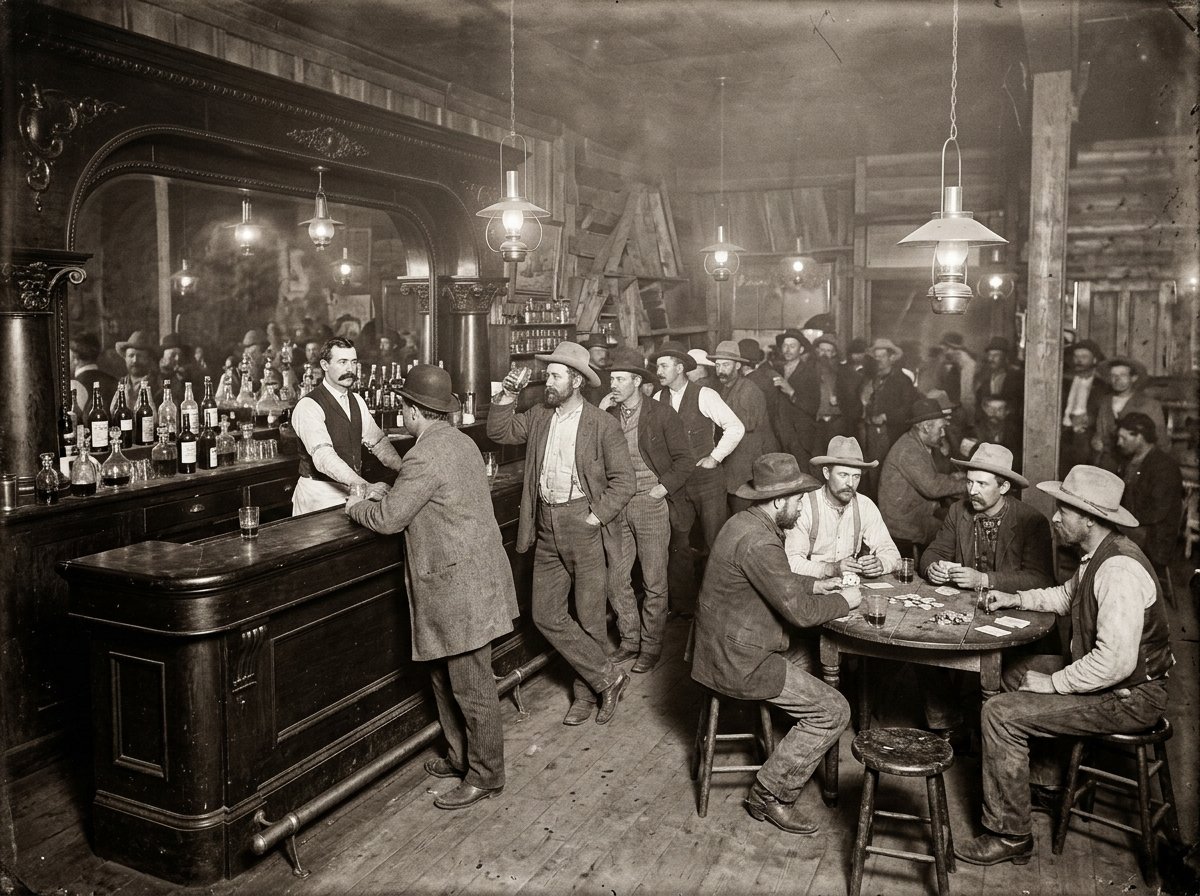
📜 Frontier Fast Facts: The Frontier Saloon
Primary Function: Not merely a drinking parlor, but the civic town hall, bank, post office, courtroom, and polling station of early boomtowns.
Standard Beverage Economics: Whiskey (“Tanglefoot” or “Forty-Rod”) cost 25 cents (two bits) per glass, often served with a free hot lunch counter to keep miners drinking.
Gambling Tables: Faro was the undisputed king of Western card games (played in over 80% of saloons), followed by Three-Card Monte, Chuck-a-Luck, and Draw Poker.
Architectural Reality: Very few saloons possessed the iconic swinging batwing doors and massive imported mahogany bars of Hollywood lore until late-period railroad hubs developed.
No architectural symbol of the American frontier has been more standardized, romanticized, and distorted by popular media than the Old West saloon. In Hollywood cinema, every frontier watering hole is depicted identically: swinging louvered batwing doors, a lavish mahogany backbar adorned with European plate-glass mirrors, piano players ducking under stools during obligatory brawls, and gunfighters shooting whiskey bottles off the bar. Historical municipal licenses, tax assessments, and eyewitness pioneer accounts reveal an institution that was fundamentally different — and infinitely more crucial to frontier survival.
The Evolution from Canvas Tent to Gilded Palace
In the earliest days of any frontier settlement, long before the arrival of sawn timber or glass window panes, the first commercial structure erected was invariably a drinking establishment. In mining camps and railroad construction hubs, initial saloons were crude affairs consisting of an unbleached canvas wall-tent stretched over cottonwood poles. The “bar” was nothing more than a rough pine plank balanced across two empty whiskey barrels.
Beverages were primitive and hazardous. Standard frontier whiskey — known colloquially as “tanglefoot,” “forty-rod,” or “coffin varnish” — was frequently concocted by unscrupulous operators who diluted raw grain alcohol with river water, adding tobacco juice for color, burnt sugar for flavor, and sulfuric acid or red pepper to provide an artificial “bite.”
As settlements stabilized and railroads arrived, saloons underwent an astonishing architectural transformation. In prosperous hubs like Cheyenne, Leadville, and Tombstone, grand establishments like the Oriental, the Bird Cage, or the Crystal Palace spared no expense. Heavy bars carved from Appalachian black walnut or Honduras mahogany were hauled over mountain passes by multi-ox freight wagons. Massive French crystal chandeliers hung from embossed tin ceilings, while opulent backbar mirrors — shipped around Cape Horn to San Francisco — reflected rows of imported Kentucky bourbons, Scotch whiskies, and iced lager beers brewed locally by German immigrants.
The True Social Epicenter: Civic, Financial, and Legal Hub
The fundamental reason saloons proliferated in such astonishing numbers — Tombstone, Arizona, supported over one hundred licensed liquor establishments for a population of roughly seven thousand in 1881 — was their indispensable civic utility. Before frontier municipalities constructed courthouses, churches, or fraternal halls, the saloon served as the universal public gathering space.
Frontier judges and circuit magistrates regularly held official court hearings across saloon tables. Juries deliberated in back poker rooms while spectators purchased beer, and coroners conducted autopsies on green-felt billiard tables. Saloons served as unchartered banks; miners arriving from isolated claims deposited heavy leather pokes of gold dust into the saloonkeeper’s fireproof safe, trusting the proprietor’s honor more than distant eastern banking corporations.
Saloons were also the primary news exchanges of the West. Teamsters, stage drivers, and traveling drummers shared intelligence regarding Indian movements, cattle market prices, and mining strikes over beer. During elections, saloons functioned as polling precincts, with rival political factions buying drinks for prospective voters in a raucous atmosphere of territorial democracy.
The Gambling Phenomenon: Faro vs. Poker
While cinematic representations almost exclusively feature draw poker, historical records establish that Faro was the undisputed king of frontier gambling. Originating in 18th-century France, Faro was favored by miners and cowboys because of its relatively low house percentage (around 2 to 3%) and fast-paced action.
Played against a green baize layout featuring representations of the thirteen ranks of cards, players bet on which card would win or lose as the dealer drew them from a silver spring-loaded “dealing box.” Faro required a dedicated “casekeeper” who tracked drawn cards on an abacus-like wooden frame to prevent cheating. Professional gamblers like Doc Holliday, Luke Short, and Wyatt Earp operated Faro tables in prominent saloons, earning substantial livings as percentage dealers rather than outlaw desperados.
The Social Protocol and Realities of Frontier Drinking
Far from a continuous brawl, life inside an Old West saloon was governed by a strict, unwritten code of frontier etiquette. To refuse a drink when invited was considered a grave personal insult, capable of sparking lethal altercations. Conversely, men of vastly different social stations — Harvard-educated mining engineers, illiterate mule skinners, and foreign immigrant laborers — stood shoulder-to-shoulder along the brass footrail, bonded by the democratic leveler of the frontier bar.
The iconic “free lunch” was another defining feature of the late 19th-century saloon. For the price of a single five-cent beer or a two-bit whiskey, patrons were entitled to partake freely from a buffet counter loaded with hard-boiled eggs, salted ham, pickled herring, and rye bread. The heavily salted offerings were deliberately calculated to stimulate relentless thirst, ensuring that customers spent far more on alcohol than the proprietor expended on food.
As the frontier closed in the 1890s, the saloon faced relentless pressure from municipal reform movements and the rising tide of the Women’s Christian Temperance Union (WCTU). Nevertheless, the historical saloon remains an extraordinary testament to the human need for community, commerce, and connection in the untamed wilderness of the American West.
Historical Provenance & Archival Standards
Wild West Stories Historical Research Division • Primary Source Cross-Referenced
This historical monograph is compiled from digitized records preserved at the National Archives and Records Administration (NARA), the Library of Congress Prints and Photographs Division, and Western state historical registries. All dates, geographic coordinates, and legal proceedings have been verified against original 19th-century newspaper archives and territorial government registries.