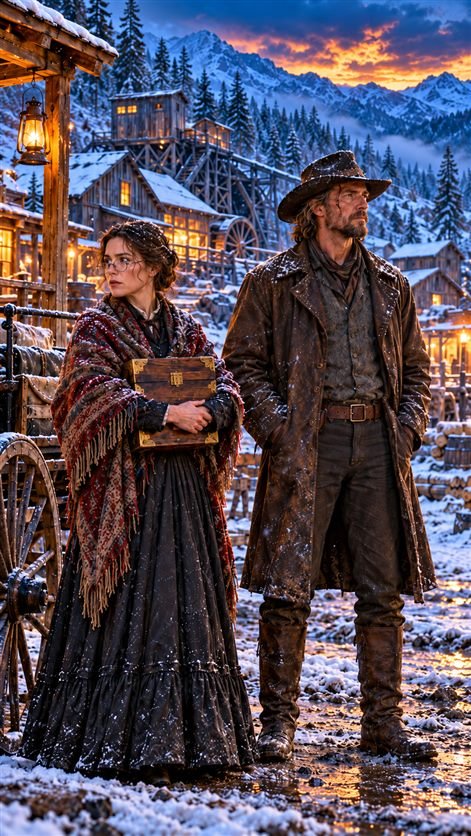
Argyle stood up slowly, his heavy silver watch-chain swinging against his waistcoat. He did not touch the book at once; he looked down at it with his head tilted slightly to the left, as a man looks at a dog that might be rabid.
“Where did you get that?” Argyle asked.
“In the powder-house at the upper quarry,” Lavinia said, using the exact flat tone Cutler had taught her on the walk down the hill. “Where it was left by the man you paid fifty dollars in seventy-two to move the section stakes sixty feet to the east.”
The clerk reached out a timid, ink-stained finger and touched the corner of the sheepskin cover as though he expected it to bite. “If this book was not in the county archives—”
“It was in the custody of a sworn deputy surveyor,” Cutler put in from the doorway, his voice dropping into that low, flat chest-register that commanded attention without shouting. “And the entries correspond to the grading vouchers in the territorial road ledger for the same month. Mr. Argyle can explain to the district judge this afternoon why his signature appears beside payments for clearing land he didn’t own.”
Argyle’s face did not turn red; it went a hard, mottled gray around the edges of his beard. He looked from Lavinia to the mason, then back to the clerk with a thin, dry smile that had no humor in it. “You’re a pair of fools playing with papers you don’t understand. That mill site’s going for taxes by Saturday night whether you have a surveyor’s diary or a pack of tarot cards.”
“The taxes for seventy-six and seven were paid in full yesterday morning by draft on the Denver National Bank,” Lavinia said. She did not look at Argyle; she looked straight at the clerk’s ink-bottle. “My uncle’s estate is solvent. And the mill race is closed.”
She turned on her heel before Argyle could frame his answer, her heavy boots clicking sharply against the pine floor. Cutler followed her out into the cold mountain air, where the first fine grains of the evening sleet were beginning to slant across the gray fronts of the saloons.
They walked thirty paces down the board sidewalk toward the mercantile store before either of them spoke. The wind was coming down the gulch in long, whistling gusts that smelled of pine smoke and wet horse blankets.
“You shouldn’t have mentioned the Denver draft,” Cutler said, stopping by the hitching post where his buckboard was tied. “Argyle has friends at the bank in Pueblo. He’ll find out by tomorrow whose name is on the second signature.”
“My name is on it,” Lavinia said, pulling her woolen shawl tighter across her breast as a gust of sleet caught her across the spectacles. “I sold the three boxes of dried alpine specimens to the Natural History Museum in Cambridge. They paid in advance.”
Cutler looked down at her for a long moment, his weathered face entirely expressionless save for a slight, crooked twitch at the corner of his left mustache. “Cambridge,” he muttered, shaking his head. “They’ll probably boil your gentians and put them in tea.”
“They’ll mount them on rag paper and keep them in cedar drawers where nobody can drop drill-bits on them,” she retorted, though her mouth was twitching too with a small, reluctant amusement she could not quite suppress.
“Well,” Cutler said, untying the off-side rein and checking the girth on the gray gelding. “The roof’s mended, the tax is paid, and Argyle has his tail in a crack until the judge finishes his whiskey. Do you want a lift up the gulch, or are you walking back to count your beetles?”
Lavinia looked at the mud ruts of the road leading up toward the dark timberline where the mill stood like a gray skeleton against the snowy shoulder of the peak. Her boots were soaked through, her fingers were stiff with cold, and she had four miles of steady uphill climbing ahead of her before she could touch a hot tin of tea.
“My boots are too heavy for your buckboard,” she said, but she took two steps toward the near wheel anyway.
“They’re no heavier than the stones I’ve been hauling since sunrise,” Cutler said, reaching down a broad, calloused hand that looked as though it could lift a corner of the courthouse. “Get in, Miss Prescott. The wind’s coming round from the north, and if we don’t get those pennyroyal boxes up off the dirt floor before dark, you’ll have nothing to sell to Boston by morning.”
The frost on the sawmill’s south window had the flat, fern-like pattern of a December hard freeze, though it was only late October and the yellow aspens still clung to their dead leaves in the lower timber. Inside the office, the air smelled of stale tallow, roasted chicory, and the sharp, clean bite of wet cedar shavings that Asa Cutler had planed off the new doorsill before the light failed.
Lavinia Prescott did not look up from her sorting tray. She had seventeen specimens of *Saxifraga* laid out upon sheets of blotting paper, each one weighted down with a square of lead pipe she had salvaged from the old plumbing behind the assay shop.
“If you plane that tongue another eighth,” she said, her voice dropping into its usual dry cadence as Cutler’s shoulder brushed the door-frame, “the latch won’t catch when the frost swells the jamb.”
“The latch will catch,” Cutler said, laying a small bundle of tallow-dipped matches and a bundle of dried pine kindling beside the stove. “I’m cutting it six per cent wide because of the damp coming off the race. A dry board in Silverton is a liar before November.”
He was not wearing his coat, and his gray flannel sleeves were rolled to the elbow, showing the thick, corded muscles of forearms that had spent twenty years swinging a nine-pound mall against Colorado granite. He moved with that deliberate, unhurried economy that made everything he did look as though it had been settled by committee three weeks prior.
“Argyle was at the livery stable an hour ago,” Cutler added, pulling a tin mug from the shelf and filling it with lukewarm tea from the back of the stove. “He told the stage agent that the title transfer from seventy-two was only held up because the clerk misread the range numbers on the patent.”
Lavinia picked up a pair of brass tweezers and gently shifted a saxifraga root four millimeters to the left. “The clerk didn’t misread anything. Argyle spent two hours behind closed doors with the judge this morning, and now the judge thinks the whole section belongs to the railway syndicate.”
“The judge thinks whatever Argyle pays him to think until the circuit marshal gets back from Gunnison,” Cutler said, blowing into his tin mug. “That’s why I’m finishing this door tonight. If Argyle sends his men up here with a sheriff’s writ before the snow sets in on Red Mountain, we want something heavier than a cedar latch to keep them out of the assay books.”
Lavinia stopped her tweezers. She looked across the narrow table at him, her gray eyes sharp and clear behind the mended spectacles. “You don’t have to carry this timber, Asa. The mill is my uncle’s estate, and if the court decides to sell the water-rights to the railway, I can pack my collection down to Durango and set up a drying shed behind the apothecary.”
“You couldn’t dry a cabbage in Durango without three months of vinegar-mould and half the lizards in the county crawling into your boxes,” Cutler said, taking a slow sip of his tea. “Besides, I didn’t haul six hundred feet of seasoned fir up thirty miles of switchbacks just to watch you pack beetles into a trunk because some lawyer from Denver wears a cleaner shirt than the rest of us.”
“It isn’t about his shirt,” she said, her fingers tightening slightly around the brass handle of the tweezers. “It’s about whether I spend the next ten years paying off my uncle’s debts to a man who thinks every acre of timber in the county is his private ledger.”
“Your uncle’s debts were settled when you signed that draft for Cambridge,” Cutler said simply. “The rest of it is just Argyle trying to see how much gravel he can throw in the ditch before someone stops him.”
He set his mug down upon the corner of the map-chest and picked up a broad-axe, testing its edge with the ball of his thumb before beginning to notch the mortise for the upper hinge. The rhythmic *chink-thok* of the iron against the seasoned pine filled the small room with a steady, physical pulse that seemed to push the cold mountain night back through the log walls.
For twenty minutes neither of them spoke. Lavinia worked methodically through her saxifraga bundles, her square-tipped fingers moving with the quiet, practiced care of a woman who had spent half her life counting petals and measuring root-nodes. Yet every time the axe bit into the timber with that low, solid vibration, her shoulders lifted slightly, as though she were keeping time to a tune she had never quite learned to sing.
The relationship between them had never had a beginning that either could name. They had lived three miles apart in the same high gulch for four seasons—she bent over her press frames with her ink-stained fingers and her botanical manuals; he moving from one stone foundation or timber trestle to the next with his measuring chain and his mule team. They had shared salt pork at the stage station, lent each other dry flour during the big May blizzard, and once—when a team of freighters had run their wagon into her drying shed—had spent twelve hours together in the dark shoring up the back wall with three jacks and a great deal of unprincipled swearing.
There had been no courtship, no formal calls, and certainly no whispered declarations by firelight. When Cutler wanted to see her, he simply walked up the trail with a bundle of shingles or a handful of dried mountain gentians he had found near the timberline; when Lavinia wanted him to stop talking about bridge-strains, she told him his arithmetic was three inches off on the plumb-line.
“My cousin writes from St. Louis,” Lavinia said suddenly, breaking the rhythm of the axe.

Caleb Sterling is an American frontier fiction writer and Old West history researcher based near Sheridan, Wyoming. Dedicated to authentic 19th-century pioneer lore, trail diaries, and homestead sagas, he has penned over 240 serialized tales celebrating the resilience, romance, and untamed spirit of the American frontier.