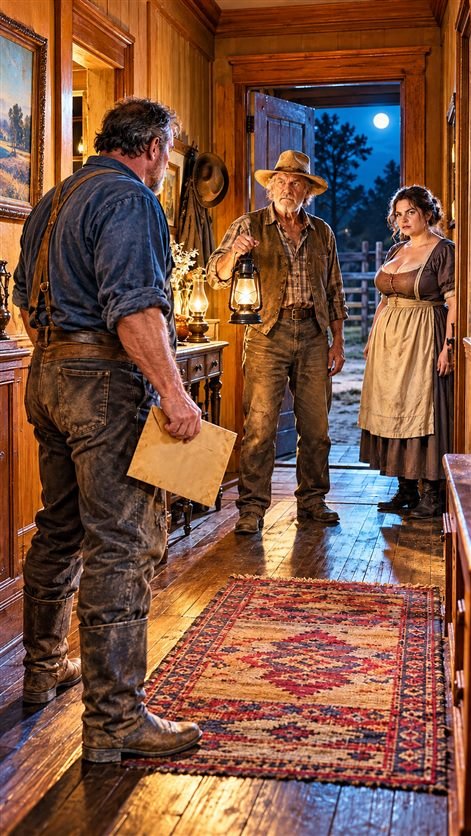
The damp earth beneath the stranger’s bleeding fingers smelled faintly of iron and long-buried rain, matching the cold dread twisting in Walter’s chest. Those roots were never meant to see the Texas sun again, yet here they were, clawing their way into his soil.
The whitewashed ranch house sat against the pale horizon like a bleached skull, its red roof catching the first violent copper streak of dawn. Walter Harrison reined in his bay gelding, Buck, as the morning chill bit through his heavy wool jacket. Three years had passed since the cancer had whittled Margaret down to a whisper, leaving behind a silence so absolute that it felt structural, as though the walls and floorboards were holding it up. At fifty-eight, Walter possessed the thick, calloused hands of a man who had wrestled cattle and broken horses his entire life, but his eyes were flat and gray, drained of any expectation that the world might offer a pleasant surprise. Yet here, on a forgotten patch of alkaline ground where nothing had grown since the drought of nineteen-eighty-four, a young woman was kneeling in the dirt. Her hands were raw and stained with black loam, her fingernails packed with the stubborn clay of the eastern boundary. Beside her, a girl of about eight stood frozen, clutching several olive saplings wrapped in water-soaked burlap, while a younger boy used a broken mesquite branch to jab furiously at a stubborn clod of earth. Walter watched them for a heartbeat, his pulse ticking a slow, heavy rhythm in his ears. He should have shouted, should have spurred Buck forward and driven them off with the casual authority of a man protecting his deeded acres. Instead, he pulled the gelding to a halt just ten paces away, letting the crunch of gravel under hoof announce his arrival. The little girl gasped, dropping a scrap of cloth, and clutched at the woman’s faded apron. Mom, she whispered, her voice trembling in the still air, there’s a man. The woman rose with a slow, deliberate grace, wiping her palms on her apron without taking her eyes off Walter’s weather-beaten face. Good morning, sir, she said, her voice steady and surprisingly deep. Walter stared down from the saddle, noting the sharp line of her jaw and the stubborn set of her mouth, features that seemed uncomfortably familiar. What are you doing on my land, he asked, his tone flat and warning. Planting olive trees, she replied. This land belongs to someone, Walter said, leaning forward. I know. Walter’s eyes narrowed, searching her face for fear or defiance and finding only an exhausted sort of stubbornness. What is your name, he demanded. Emily Carter. The surname struck him like a stray pebble kicked up by a galloping hoof. Carter. He had heard it, had read it, or perhaps dreamed it during those long, sleepless nights when the wind howled across the plains. Where did you come from, he asked, his fingers tightening on the leather reins. Oakridge, she answered, tilting her chin up. There was nothing left for us there. And the children’s father, Walter asked, watching her shoulders stiffen. Emily’s face hardened into something cold and impenetrable. There is no father. Walter dismounted, the soft thud of his boots against the dirt startling the little boy, who dropped his stick and retreated behind his mother’s skirt. Walter could not explain his own hesitation. He could have whistled for Samuel, could have had the trio escorted off the property before the coffee was cold on the stove. Instead, he walked past them and knelt beside the hole Emily had dug, reaching out to touch one of the saplings. These are not ordinary olive trees, he murmured, rubbing a leaf between his thumb and forefinger. Emily stared at him in sudden, sharp surprise, her guard slipping for a fraction of a second. No, she said. They are an old variety. Hardly anyone recognizes them anymore. Where did you get them, Walter asked, looking up from the dirt into her eyes. My grandmother cared for them all her life, she said softly. Then my mother. Now they are mine. The little girl stepped closer, her wide eyes reflecting an unbearable vulnerability. Are you the owner of all this, she asked. Yes, Walter answered. Are you going to make us leave, she whispered. Walter looked from the child to Emily, and then down at the fragile roots resting in soil that every rancher within fifty miles knew was cursed. I do not know yet, he said. He mounted Buck without another word and rode back toward the ranch house, but the girl’s question seemed to burrow into his skull, keeping pace with every hoofbeat. At the ranch gate, Samuel was leaning against the weathered fence post, chewing on a piece of straw and looking as ancient and permanent as the cedar fence rails. You saw her, the foreman said before Walter had even swung down from the saddle. I did, Walter replied, handing the reins to the older man. She has no right to be there, Samuel said, spitting the straw into the dust. Say the word, and I will speak to the sheriff. No, Walter said. Samuel froze, his hand halfway to Buck’s bridle. Sir? Do not remove her, Walter said, walking past him toward the porch. The foreman’s expression darkened, shifting from routine efficiency to something approaching unease. Mr. Harrison, that hollow is not just another piece of land. Walter stopped on the third wooden step and turned back slowly. What does that mean, he asked. Samuel glanced nervously toward the eastern fields, where the sun was finally clearing the distant line of cottonwoods. There is old history buried there, the foreman muttered. Then stop speaking in riddles, Walter snapped, his patience wearing thin. When you find the courage to tell me the truth, come to my office. That day dragged like a wounded animal. Walter tried to attend to the endless ledger work, tried to inspect the new fencing wire in the northern pasture, tried to focus on the branding tallies, but every time he closed his eyes, he saw Emily’s muddy hands and the desperate, defiant set of her jaw. The bed where Margaret had spent her final agonizing months felt larger and colder than ever that evening. He lay staring at the water-stained plaster of the ceiling, listening to the house settle and creak against the night wind. He kept seeing Emily’s face, the children’s frightened eyes, and those impossible trees that defied every law of West Texas agriculture. But the name nagged at him, a splinter in the back of his mind that he could not reach or ignore. Carter. Where had he heard that name before. Sometime past midnight, when the wind died down and the silence of the ranch pressed against the windowpanes like a physical weight, Walter sat bolt upright. The memory hit him with the force of a physical blow. He remembered the old county records office in Fort Stockton, remembered a dusty afternoon twenty years ago before he had even met Margaret, when an old land dispute had brought him searching through probate files. He remembered a name mentioned in a bitter, forgotten lawsuit, a name tied to a parcel of land that had supposedly been cleared and abandoned. His heart began to hammer against his ribs, heavy and erratic. Walter threw off the heavy patchwork quilt, swung his legs out of bed, and walked barefoot down the cold hallway into his downstairs office. The room smelled of old paper, leather, and stale tobacco. He crossed directly to his heavy oak desk, dropped to one knee, and pulled at the bottom drawer. It was locked, the brass key hanging from a hook inside the grandfather clock in the hall. He retrieved the key with trembling fingers, slid it into the brass escutcheon, and turned it with a sharp click. Beneath a stack of yellowed grazing leases and veterinary receipts lay a flat, faded manila envelope tied with a length of faded pink ribbon. In Margaret’s delicate, sloping handwriting, three words were written across the front. Do not open. Walter’s breath hitched. He had promised her, three days before she died when her voice was nothing more than a dry rustle of paper, that he would never pry into the past she had left behind in East Texas. He had honored that promise for three long years. But tonight, the name Carter was echoing in the empty rooms of his mind like a church bell tolled in an empty town. His hands shook as he untied the ribbon and slid the contents out onto the desk. A half-dozen old photographs slipped onto the blotter, along with a thick sheaf of legal papers and a handwritten letter bearing a date from thirty years ago. The first sentence of the letter made the blood drain from Walter’s face, leaving him dizzy and cold. My dearest Margaret, the neat cursive began, I am writing this from the hospital in Tyler, knowing I have only weeks left to make things right before the fever takes what the courts left behind. Walter’s eyes raced down the page, skipping past the rambling apologies and the bitter accusations against a local judge who had taken bribes to rewrite a title deed. Then he saw the names. The land on the eastern creek, the very hollow where nothing was supposed to grow, had not been Walter’s inheritance at all. It had been illegally seized during the county consolidation of nineteen-seventy-two, stripped away from a young couple who had tried to farm the barren strip using an old family strain of drought-resistant olive trees brought over from the Mediterranean generations before. The man who had engineered the seizure, acting through a corrupt proxy, was Walter’s own uncle, a man who had left the ranch to Walter upon his death. And the legal owner who had been driven off the land at gunpoint, whose husband had died of exposure during the brutal winter eviction while she was six months pregnant with a little girl named Martha, was a woman whose maiden name had been Carter. Walter stared at the photographs, his vision blurring. The young woman in the faded polaroids had Emily’s eyes. The same sharp chin, the same stubborn set of the jaw, the same quiet defiance that refused to break under the weight of poverty and loss. Emily was not a trespasser. She was the rightful granddaughter of the people Walter’s family had ruined, returning to claim the only piece of earth her mother had ever known. But that realization, stunning and sickening as it was, did not explain the entire letter. Walter’s trembling fingers turned the final page over, reading the hurried postscript scrawled in the margins by Margaret’s own hand, written years later after she had married Walter and discovered the truth locked in the ranch safe. She didn’t just inherit the land, Margaret had written in ink that had faded to a bruised purple. She inherited something else. Something Samuel tried to hide from you because he helped my uncle burn the cabin down. Walter froze, the breath catching in his throat. He looked up from the desk just as a heavy knock sounded on the front door, echoing through the silent house like a gunshot. He stood up slowly, the papers clutched in his stiff fingers, and walked out into the dark hallway. Samuel was standing on the porch, illuminated by the amber glow of the outdoor security light, holding a heavy iron lantern that cast long, grotesque shadows across the warped floorboards. You found the envelope, the old foreman said quietly, his voice devoid of surprise. Walter opened the front door, the night air rushing in to chill his sweat-drenched skin. You knew, Walter said, his voice dropping to a harsh whisper. You were there when they took it. I was a young man, Samuel said, stepping across the threshold without waiting for an invitation. I did what your uncle told me to do. We all did what we were told in those days. Walter raised the papers, his hand shaking so violently that the pages rattled like dry leaves. She came back for the trees, didn’t she. She came back because her grandmother hid something else under the roots of those olives before the cabin was burned to the ground. Samuel looked away, staring down at the floorboards between them. Not a box of money, Walter. Not papers. He swallowed hard, his weathered throat working convulsively. It was your first wife’s sister, Walter. Margaret’s older sister, the one your uncle swore died of the scarlet fever in nineteen-eighty. They didn’t die of fever. They were hidden away, declared dead by a judge who wanted the title clear, and handed over to the Carter family to raise in secret across the county line so nobody would ever come asking questions about who really owned the Harrison estate. Walter stood paralyzed, the letters slipping from his slack fingers to scatter across the floor. The front door drifted open a fraction wider, letting in the smell of damp earth and the distant, rustling whisper of olive leaves stirring in the darkness of the eastern hollow.