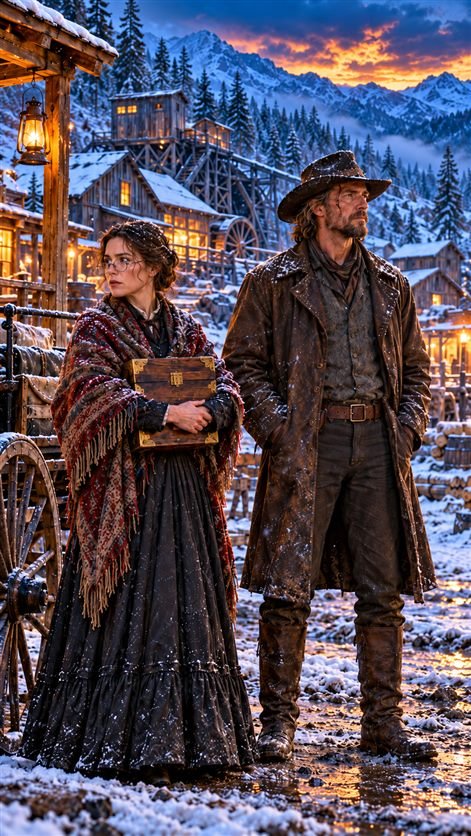
The cedar boxes on the wash-bench smelled of damp cedar and pressed mountain pennyroyal, a scent Lavinia Prescott had spent three hours cataloging before the midday mule train blocked the alley. She did not look up when the heavy boots creaked upon the dry willow boards of the porch, because she already knew from the rhythmic scrape of the left iron heel that it was the stone-mason Cutler, who walked as though every step were an arbitration between the earth and his own ankles.
“If those roots are damp,” Cutler said, without taking off his wool cap, “they will mildew before you reach the assay office, and then the botanical society in Denver will think Silverton sends nothing but swamp trash.”
Lavinia closed her lead pencil into the fold of her ledger and finally raised her chin, her heavy spectacles sliding an eighth of an inch down a nose made slightly shiny by mountain sun and kitchen grease. “The pennyroyal is dry to the second joint, Mr. Cutler, which is three parts drier than the timber you laid for the church foundations last November.”
“That timber seasoned in six days of rain,” Asa Cutler replied, setting a small gray parcel wrapped in oilskin upon the corner of the work-table among her dried gentian roots. “The roof hasn’t leaked a drop upon the collection plate, which is more than can be said for your uncle’s old strongbox beneath the floorboards of the mill office.”
That strongbox—or rather the absence of any valid probate entry corresponding to the contents Lavinia had dragged from the joists three nights ago—was the reason she had not slept a full eight hours since the snow melted off the lower trail. She was thirty-two, an age in San Juan County where a woman who lived alone with four hundred pressed botanical specimens and two hundred pounds of salt pork was generally assumed to be either simple or waiting for an inheritance that had already been spent in the saloons of Animas Forks.
“The strongbox,” Lavinia said, her voice dropping into that flat, level register she used when she wished people would go away, “contained three deeds written on butcher’s paper and a receipt for lime that was settled sixteen years before you were out of your indentures.”
“It also contained a memorandum regarding the north flume water-rights,” Cutler said, pulling a folding rule from his pocket and snapping it once against his thigh. “And the county commissioners are holding a special session tomorrow morning to decide whether your uncle’s estate owes three hundred dollars in back ditch-fees or whether the whole mill site reverts to the bank.”
He stood looking down at her with that slightly narrow, unblinking stillness of men who spent their days staring at granite faces to find the natural bed. He was not a small man, though his coat hung from his shoulder-blades with the lean efficiency of a tool well-worn by weather; his hands, when he laid them flat upon the edge of her table to steady himself against the cabin’s afternoon settling, showed the broad, white-scarred knuckles of a stonemason who had once dropped a lintel upon his own thumb and never quite learned to favor it.
“They can hold their session in the middle of Main Street for all I care,” Lavinia said, though her thumb began a nervous, rhythmic twitch against the corner of her tin inkstand. “I have sixteen plates of the *Gentiana calycosa* to press before the mail-rider leaves on Thursday, and I am not walking down to the courthouse to argue with Mr. Argyle about ditch-fees that were paid in cordwood when Grant was in his first term.”
“Argyle isn’t waiting for cordwood,” Cutler said quietly. “He wants the timber-rights to the whole ravine above the sawmill. And he has a witness who swears your uncle signed away the tail-water in seventy-four.”
Lavinia looked at the oilskin parcel he had laid upon her table. Her fingers, which were broad and square-tipped like her father’s, hovered above the twine for a long moment before she untied it with a single impatient jerk. Inside lay a small octavo memorandum book bound in sheepskin, its edges stained with grease and dark rust that looked very much like old ink left too long in a damp pocket.
“Where did you find this?” she asked.
“In the pocket of an old surveyor’s coat hanging behind the door of the powder-house at the upper quarry,” Cutler said. “The man who wore it left for Leadville two winters ago without paying his board at the hotel. The landlady gave it to me to wrap some drill bits in.”
Lavinia opened the sheepskin cover. The handwriting was not her uncle’s heavy, blunt script; it was the delicate, sloping copperplate of a man who used a crow-quill and thought twice before every figure. The entries were dates, yardages of sawn spruce, and sums paid in gold dust to a man named Argyle—not for water-rights, but for the quiet removal of boundary stakes along the lower creek three weeks before the survey of eighteen-seventy-two.
She looked up, her gray eyes widening behind her spectacles with a mixture of sharp triumph and profound, uncomfortable dread. “This is why Argyle wants the mill site cleared before the circuit judge arrives.”
“It’s why he’s been buying up the county warrants on the cheap,” Cutler said. He pulled a small cedar shaving from his coat cuff and tossed it into the empty stove. “If you hand that book to the commissioners tomorrow, you’ll break his title to the whole lower bench. But if you do it by yourself, without an attorney who knows how to phrase the petition, Argyle will have you cited for possessing stolen records from the old mining board before the sun goes over the ridge.”
“I don’t need an attorney,” Lavinia said, her chin coming up with a stubborn little jerk that had more pride in it than common sense. “I have the surveyor’s field notes from sixty-nine in the trunk under my bed.”
“Field notes don’t talk back to a judge who’s three days behind on his whiskey and owes Argyle for two wagonloads of foundation stone,” Cutler said. He did not raise his voice; he spoke with the flat, immovable certainty of a man measuring granite for a pier that had to hold against spring ice. “You’re thinking like a woman who presses flowers in blotting paper, Miss Prescott. You think if the facts are flat and dry, everyone has to look at them.”
“And you,” Lavinia retorted, feeling the hot blood rise uncomfortably beneath the skin of her cheekbones, “are thinking like a mason who believes nothing is true unless it weighs four tons and takes three men with crowbars to shift.”
The silence that followed was not the comfortable silence of two people who had nothing to say to each other; it was the tight, charged stillness of a mountain pasture five minutes before an afternoon squall drops out of the timberline. Cutler did not move his hands from the table. His gaze drifted from her face down to the heap of pennyroyal roots, then back to her eyes with a curious, unhurried appraisal that made her want to sweep the whole lot of papers into the coal scuttle.
“I have a double-jack and two wedges in the back of my buckboard,” he said presently. “If we’re going down to the recorder’s office before the district judge opens court tomorrow, we’ll need to lock those boxes up properly. The rain’s coming over the divide by midnight, and your roof has three shingles missing above the corner where you keep the ink.”
“My roof is my own concern,” she said, though her heart gave an awkward, unlooked-for thud against her ribs.
“Your roof is part of the mill property Argyle is trying to attach,” Cutler said, turning toward the door. “I’ll be back with the ladder at four o’clock. Don’t go wetting those roots until I’ve nailed down the flashing, or you’ll have mold in the whole collection before Friday.”
He went out without another word, his heavy boots making the porch boards groan in a slow, descending scale that seemed to leave the little cabin strangely empty, save for the smell of damp cedar and the small sheepskin book lying open between her ledgers like an uninvited guest who had come to stay for the winter.
*
The circuit court clerk’s office smelled of stale tobacco, wet wool, and the particular vinegar-and-glue scent of sheepskin bindings that had been kept too long in a cellar without ventilation. Through the high, unwashed window that looked out upon the stage depot, Lavinia could see the gray slush of Main Street turning into yellow ruts under the wheels of the Leadville freight wagons.
Mr. Argyle was sitting upon a cane-bottomed chair near the cast-iron stove, his thumbs tucked into the armholes of a plaid waistcoat that looked remarkably clean for a man who owned three contested timber claims and a half-share in the smelting works. He did not look at Lavinia when she came in, but he nodded twice to the clerk, a young man with ink-stained cuffs and an expression of permanent, nervous exhaustion.
“Miss Prescott,” Argyle said, his voice smooth as creek-washed quartz. “I trust you brought the key to the lower tail-race gate. The spring run-off won’t wait for probate court, and the mill’s been idle two years too long as it is.”
“The gate stays shut until the survey of seventy-two is entered into the record,” Lavinia said. Her voice was steady, though her hands were locked so tightly inside her knitted wool mittens that the knuckles ached.
Asa Cutler stood just behind her right shoulder, his tall, narrow frame leaning against the rough-plastered wall with his arms folded inside his leather coat. He wore a clean flannel shirt that smelled faintly of laundry lye, and his hair was still damp from the horse trough where he had scrubbed the granite dust from his neck before coming down the hill. He said nothing, but his presence filled the small room like an extra tier of masonry.
The clerk looked up from his desk, blinking through round spectacles that had one lens mended with black thread. “Miss Prescott, the commissioners have already certified Mr. Argyle’s patent on the lower bench. Without a registered counter-claim filed before the first Monday of the term—”
“Here is the counter-claim,” Lavinia said. She laid the sheepskin memorandum book upon the scarred pine counter, followed by the surveyor’s field notes from sixty-nine and three loose sheets of certified tax receipts she had spent all night copying by the light of a tallow dip.

Caleb Sterling is an American frontier fiction writer and Old West history researcher based near Sheridan, Wyoming. Dedicated to authentic 19th-century pioneer lore, trail diaries, and homestead sagas, he has penned over 240 serialized tales celebrating the resilience, romance, and untamed spirit of the American frontier.