Cutler paused, the broad-axe resting against his knee, its bright steel grey in the lamplight. “What does he say?”
“He says the botanical chair at the college is looking for someone to catalog the flora of the middle territories. He says they provide a brick building with glass windows that don’t rattle when the wind comes off the river.”
Cutler looked at the blade of his axe for a long moment, then shifted it to his left hand. “Are you going?”
“The windows don’t have drafts,” she said, her voice dropping into that light, defensive irony she used whenever the future looked too large for the room. “And they have a coal furnace that works without someone having to haul juniper knots out of the gulch at five o’clock in the morning.”
“St. Louis is a long way from forty-thousand pressed weeds,” Cutler said quietly.
“They have weeds in Missouri, Asa. Probably more than we have here.”
“Not the same kind,” he said, and for the first time there was a distinct, dry edge to his tone. “You won’t find *Gentiana calycosa* growing out of thirty feet of granite gravel between two snowslides. You’ll find things that look like cabbage leaves and smell like river mud.”
“I am thirty-two years old,” she said, her chin coming up with a small, defiant jerk. “I have spent twelve years drying plants that nobody in Silverton looks at except to see if they can wrap butter in them.”
“Your uncle looked at them,” Cutler said.
“My uncle used my blotting paper to weigh down his tobacco tins.”
Cutler laid the axe down upon the bench with a soft, dull thud. He walked across the room, his tall frame seeming to fill the narrow aisle between the map-chest and the work-table, and stood looking down at her until she was forced to raise her head and meet his eyes. His face was weathered to the color of harness leather, and the small scar above his left eyebrow—the one he had got when the derrick chain snapped at the lime kiln—gave him a slightly lopsided, inquiring look that was entirely devoid of malice.
“You aren’t going to St. Louis, Lavinia,” he said.
“How do you know where I’m going?”
“Because you haven’t bought your ticket at the stage office, and you still haven’t finished pressing those saxifraga roots from the upper slide.”
“I could buy the ticket tomorrow.”
“You could,” he agreed, leaning both palms upon the edge of her table until the lead pipe weights rattled against the tin trays. “And you could leave the mill to Argyle and the railway. But you won’t.”
“Why not?”
“Because if you did, who would tell me my timbering is six per cent too wide for the frost?”
The silence that came then was different from the silence of the axe. It was very quiet in the mill office; outside, the sleet had turned to fine, dry snow that hissed softly against the greased paper of the window-panes. Lavinia looked down at her ink-stained fingers, her thumb tracing the hard, flat line of the wooden table where her father had carved his initials thirty years before.
She did not reach out for his hand, and he did not touch her hair. He simply stood there, six feet two inches of gray flannel and granite dust, waiting with the same immovable patience he gave to a foundation pier before the mortar had set.
“The commissioners meet at nine,” she said softly.
“I know,” Cutler said. “I’ve got the buckboard greased and the gray has his winter shoes on. We’ll be at the courthouse before Argyle finishes his first cigar.”
*
The district courtroom was crowded with men who had come in from the claims to escape the sleet—shovellers from the mill, freighters with sheepskin collars white with rime, and three members of the town council who smelled strongly of wet wool and cheap rye.
Argyle was already there, sitting beside the clerk’s high desk with a sheaf of blue-backed legal forms spread out before him like cards on a green cloth. When Lavinia and the mason walked through the double doors, the room went very quiet in that particular way mountain rooms went quiet when someone brought in an unexploded powder-can.
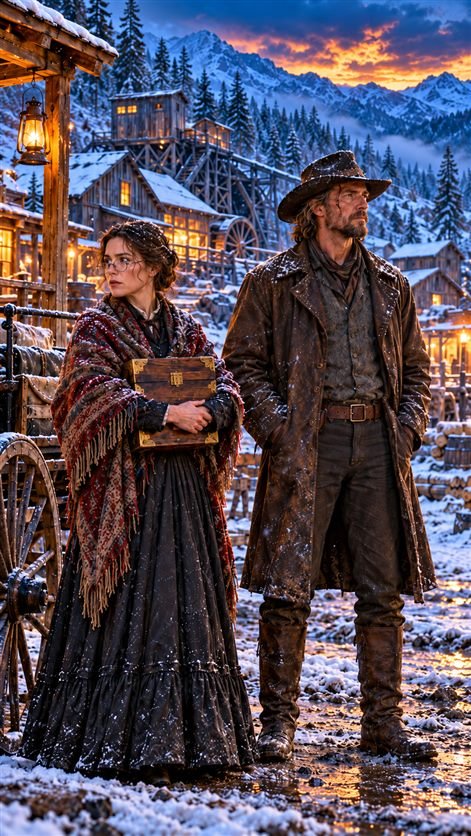
Lavinia walked straight to the clerk’s rail, her woolen shawl pinned tightly across her breast, carrying not the sheepskin book this time, but a small, heavy box made of seasoned walnut with brass corners.
“Mr. Clerk,” she said, her voice carrying clearly to the back benches where the freighters sat. “I am here to enter the complete survey of the upper water-rights as recorded by my uncle in eighteen-sixty-eight, together with the receipts for the redemption of the mill-site taxes dated yesterday morning.”
Argyle stood up, his face dark. “Your Honor, those documents have already been examined by the county surveyor and found to be—”
“The county surveyor is currently three sheets to the wind in the Gold Nugget saloon,” Cutler said from behind her, his voice dropping into its flat, stone-mason register that seemed to turn the air several degrees colder. “And these documents have been checked against the territorial road ledger by three separate taxpayers who don’t own shares in his railway syndicate.”
The judge, a heavy-jowled man named Vance who had spent forty years riding circuit through three territories and had never yet seen a title that couldn’t be improved by an extra signature, looked down over his spectacles at the walnut box.
“Miss Prescott,” Vance said, rubbing his chin with a thumb that smelled of tobacco. “Is this the same matter as the petition regarding the lower flume?”
“It is the matter of the whole property, Your Honor,” Lavinia said. She did not look at Argyle; she looked directly at the oil-lamp hanging from the center beam above the judge’s head. “My uncle built the sawmill with his own timber and his own credit. He did not sell the tail-water to Mr. Argyle, and he did not mortgage the bench to the railway.”
She opened the walnut box. Inside lay three bundles of documents tied with faded pink ribbon, alongside a small, perfectly preserved specimen of *Gentiana calycosa* pressed between two sheets of blue ledger paper twenty years before.
Argyle opened his mouth to speak, looked once at Asa Cutler’s broad shoulders leaning against the oak paneling near the door, and then sat back down upon his cane-bottomed chair, very slowly, as a man sits when he realizes his horse has stepped into a badger hole.
The settlement, when it was finally written out upon three sheets of yellow foolscap two hours later, was not the sweeping victory the miners in the back row had hoped for, nor was it the clean sweep Argyle had planned. The county retained the right-of-way for the lower wagon road; the railway took a narrow strip twenty feet wide along the gulch for their switch-track; and the sawmill remained Lavinia Prescott’s, subject to thirty dollars a year in municipal water fees and an explicit, handwritten clause in the margin stating that the upper timber-rights were private property not subject to assessment by the mining board.
By noon the snow had stopped, leaving the peaks above Silverton a blinding, hard white against a sky the color of blue tin.
They walked back up the trail together, the gray gelding pulling the buckboard at a slow, steady walk through four inches of fresh powder that muffled the sound of the iron tires. Cutler walked beside the near wheel, his hand resting lightly upon the harness-strap, while Lavinia sat upon the wooden bench with the walnut box between her knees.
“You realize,” Cutler said as they passed the old blacksmith shop where the slag-heap smoked faintly in the cold air, “that you’ll have to haul your own timber down from the upper bench now that the railway owns the lower siding.”
“I have my own mules,” Lavinia said.
“Your mules are twelve years old and walk like they’re carrying lead plate.”
“They walk well enough to reach the timberline,” she retorted. “And they don’t stop every hundred yards to argue about whether the foundation is plumb.”
Cutler did not answer at once. He led the horse around a drift of wet snow that had slid off the roof of the powder-house, his boots crunching rhythmically into the crust. When they reached the gate of the mill yard, he stopped the gelding, unlatched the rough cedar boards, and swung them wide before turning back to look at her.
The sun was dropping behind the western ridge now, throwing long, violet shadows across the sawdust piles and the gray cedar shingles of the roof. The air was so cold that every breath came out in a small, white puff of steam that vanished before it reached the pines.
“The roof’s dry,” Cutler said, nodding up toward the corner where he had nailed the flashing the day before. “And the tea is in your tin. Do you want me to bring the sawhorse up from the shop tomorrow, or are you going to start on those saxifraga roots first?”
Lavinia looked down at the walnut box in her lap, then out across the white gulch where the smoke from the town below was beginning to rise in thin, straight blue lines against the darkening timber. Her mittened fingers traced the brass corner of the box once, twice, before she lifted her head.
“Start the sawhorse at eight, Asa,” she said, her voice dropping into its most practical, level register. “If we don’t have the new framing up before the real snow comes down from the pass, the whole porch will be in the creek by New Year’s.”
She did not wait for him to help her down; she stepped over the wheel of the buckboard herself, her boots sinking two inches into the clean mountain snow, and walked toward the cabin door with the box hugged tight against her ribs. Cutler stood by the gelding’s head for a moment, watching her go with that slow, crooked twitch at the corner of his mustache, before he picked up the reins and turned the team toward the lower shed.

Caleb Sterling is an American frontier fiction writer and Old West history researcher based near Sheridan, Wyoming. Dedicated to authentic 19th-century pioneer lore, trail diaries, and homestead sagas, he has penned over 240 serialized tales celebrating the resilience, romance, and untamed spirit of the American frontier.