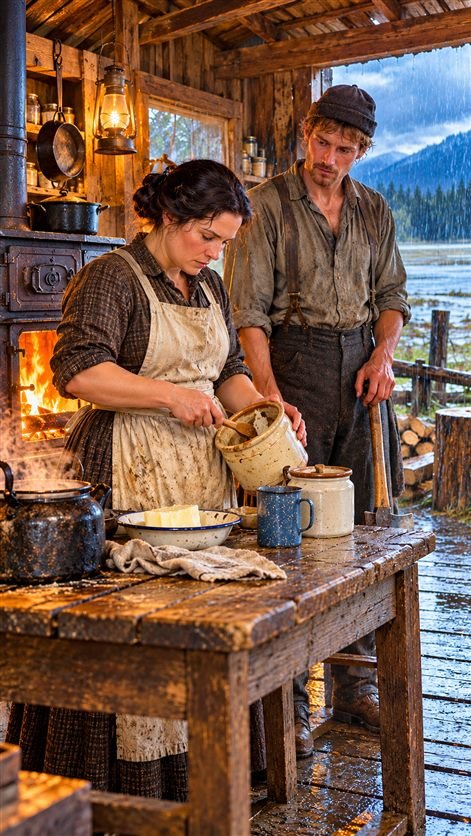
“There is no sense putting grease on a wedge that’s already swimming in bay water,” Caroline Bell said.
She did not look up from the small earthenware crock she was scraping with a wooden spatula, though she knew George Reynolds had stopped his adze mid-stroke three paces away. The sound of the tool dying in the pine timber was flat—just the wet, heavy thud of cold steel against green cedar.
The cook-shed smelled of woodsmoke, wet wool, and the sharp, vinegar tang of salt-risen dough souring in its crock by the iron stove. Outside, the Samish tide was turning, dragging grey-green weed across the mud flats and leaving the pilings of the timber pier sucking at the air with a wet, wet cough. It was late October of 1882, and the rain had settled into a steady, gray wool that seemed to have no beginning and no intention of stopping before Christmas.
Caroline was twenty-nine, built low and solid as a bulkhead timber, with dark hair pulled back so tight her temples ached when the nor’easter blew down the sound. She was not a woman given to sudden gestures or sharp speeches, mostly because her tongue had a habit of sticking to the roof of her mouth whenever an audience grew larger than a sheep-dog. Her hands, red-knuckled from lye-soap and cold brine, scraped the crock clean and dropped the gray crust into the slop-pail with a hollow clatter.
George Reynolds stood by the doorway, his tall, narrow frame slightly bowed as if he were perpetually ducking under low lintels. He was thirty-two, though he looked forty through the gray granite dust that settled permanently into the creases around his eyes and mouth. His skin had the blue-white pallor of men who spent their lives beneath dripping overhangs and slate ledges. He had come up from Chuckanut Bay three weeks ago with three pack-mules, a box of black powder, and a government contract for twelve hundred feet of squared ashlar to face the new federal wharf at Port Townsend.
“Grease isn’t for the water,” George said. His voice was thin and raspy, like dry grass being dragged over gravel. He didn’t drop his adze; he rested the poll against his thigh, his long fingers black with grease and iron scale. “Grease is for the pinch. If the feather doesn’t slide when the wedge goes home, the stone splits diagonal. Then your twelve-hundred-foot wharf has a crooked tooth.”
“The stone’s already diagonal,” Caroline said. She wiped her hands on her apron—coarse unbleached crash that smelled of salt-fish and damp starch. “You didn’t look at the bed-grain when you set the wedges this morning. You looked at the color. You wanted the blue tint because the inspector likes blue.”
George didn’t argue. That was his most aggravating quality, to Caroline’s mind. A man who shouted could be answered with a sharper shout, but George simply stood there, his long arms dangling, his small, gray-blue eyes fixed somewhere past her ear on the stack of salt-herring barrels by the door. His hair was the color of unwashed fleece, greasy and thick, sticking out from beneath a wool cap that had lost its crown three winters back.
“The blue holds the weight,” he murmured.
“The blue holds a frost-crack,” Caroline said, turning to the kettle. “My uncle lost a whole pier-head at Whidbey doing that in seventy-eight. You get salt in those vertical seams when the tide’s high, and the first hard freeze in November turns your ashlar into gravel. You might as well build the wharf out of dried mud and whale-bone.”
She poured boiling water from the kettle into a tin pot filled with roasted chicory and dandelion root. The steam rose thick and dark, smelling of scorched earth and old roots. She set two chipped ironstone mugs on the deal table between them.
The cook-shed was the only dry place within four miles of the Samish tidal flats. It sat on cedar skids just above the reach of the king tides, anchored to the mud by four heavy chains slung around cedar stumps. Around it lay the quarry camp: six canvas wall-tents grown black with mold, a smithy lean-to where the bellows wheezed like an old horse with the heaves, and the long, sloping bank where forty tons of rough-cut Chuckanut sandstone and blue granite waited for the scows.
George walked over to the table, his heavy boots sounding like flat-irons on the puncheon floor. He didn’t sit; he hooked his thumbs in his belt and looked down into his tin.
“The inspector’s coming down on the Friday steamer,” he said.
“Let him come. He can sleep in the wet tent with the mules.”
“He wants the first three courses squared and loaded by Monday.”
“Then he’d better bring a crew of Cornishmen with him,” Caroline said, taking her own mug and blowing across the dark scum on top. “Because you and your three boys have spent four days skinning the moss off a boulder that’s cracked right through the middle. You’re shipping rubble to Port Townsend, George. The government won’t take it for a ballast-heap, let alone a wharf.”
She watched him over the rim of her tin. His right shoulder was slightly higher than the left—the mark of ten years swinging a sixteen-pound sledge in the damp drifts of the Idaho silver-leads before he came west to cut stone. He wasn’t a bad man, but he had that singular, narrow stubbornness common to men who believed that if they hit a thing hard enough and often enough, the world would eventually break the way they wanted.
“I need that contract,” George said quietly.
It was the first time he had admitted it so plainly. Usually he spoke of the stone as if it were a natural law—something that existed entirely apart from flour-sacks, mule-feed, and the eighty dollars he owed the blacksmith at Bellingham for shoeing the team.
“Everybody needs something,” Caroline said, her voice softening just enough to lose its edge. “The bay needs its mud left alone, for one thing. You dredge out that spit to get your scows in at low water, and the first winter blow will wash my grandfather’s vegetable patch right out into the sound.”
“Your grandfather’s garden is three feet of sand and dock-weeds.”
“It’s onions,” she corrected. “And they’re substantial onions.”
George let out a short, dry sound that might have been a laugh if it had any air behind it. He reached out, his hand—broad-palmed, the skin stained yellow-brown from alder-bark and gunpowder—and picked up his tin. His fingers brushed the rough earthenware of the sugar jar she had just set down. He didn’t pull his hand back immediately; he let it rest there for a second, the heat of the chicory rising between them.
“You’ve got flour on your cheek,” he said.
Caroline raised the back of her wrist and smeared it across her skin, only to feel the dry white dust smear wider.
“Leave it,” she muttered, turning back to the stove. “It matches the weather.”
By Thursday the rain had turned to sleet, fine and hard as sifted sugar, blowing sideways off the Canadian gulf. The wind came up with the ebb, rattling the canvas of the cook-shed until the grease-paper in the windows bulged inward like sails.
Caroline spent the morning splitting salt-cod and packing it into firkins with layers of coarse grey salt from the San Juan scows. Her hands were numb by ten o’clock, the salt biting into the small skin-cracks around her thumbs until every movement felt like a needle-prick. She worked by the light of a single lard-lamp that hissed and sputtered whenever a draft came up through the floorboards.