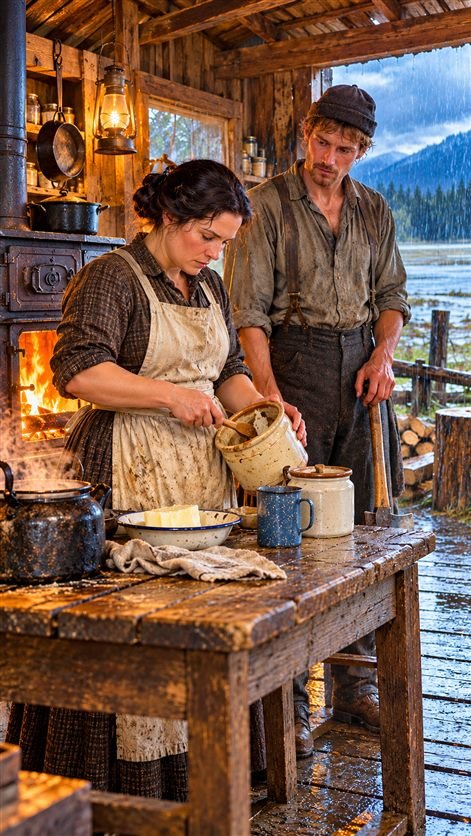
She was kneeling on a cedar plank by the third course, packing wet clay and shingle-chips into the back-joints of the stone to keep the wash from sucking the mortar out when the tide came up, when George dropped his iron bar with a hollow *clank* against the shingle.
“Come here,” he said.
She didn’t look up right away. She was trying to wedge a flat piece of slate into a vertical gap that refused to plumb. “If this stone slips while I’m standing up, I’m going to throw this hammer at your head.”
“Just come here.”
She wiped her palms on her moleskins, stood up with a low grunt of effort, and walked the three paces over to where he stood by the end of the new wall.
The breakwater curved out into the gray salt-water like the flank of a sleeping horse. Beyond it, the Samish flats stretched away toward the pale smudge of the Chuckanut hills, empty and gray under the low scud of the clouds. But inside the arm of the stone, where the tide was already pooling in the lee of the cedar pilings, the water had cleared. The gray silt had settled out against the granite facing, leaving a four-inch mirror of still, dark brine that reflected the dull zinc of the sky and the sharp, black lines of the pilings.
“Look down there,” George said. He was pointing with his heavy adze-handle into the pool.
Caroline leaned over, her dark hair falling forward across her cheek. Down in the clear water, right against the base of the new granite course, a small school of silver-sided shiners hung motionless in the green-gray current, their tiny gills pulsing against the current. Beyond them, half-buried in the clean sand that had drifted in behind the breakwater, a clump of wild celery was putting out a pale, new green shoot despite the November frost.
“They’ve got a back-water,” George said softly. “The tide can’t scour them out when the nor’easter blows.”
Caroline stood up slowly. She looked from the pool to George’s face. The granite dust was thick in his eyebrows today, and his lips were chapped red by the salt wind, but there was a quiet, settled look about his mouth that she hadn’t seen since he first walked into the camp three weeks ago with his mules and his federal blueprints.
“It’s not twelve hundred feet of ashlar,” she said, her voice dropping into that dry register that usually signaled an argument. “It won’t impress the senator in Port Townsend.”
“The senator can stay in Port Townsend,” George said. He laid the adze down across the top of the wall, his hands coming out flat and empty at his sides. “The wharf’s too big for this bay anyway. It’d draw too much draft. The scows would run aground every time the moon went low.”
“You’re just saying that because you didn’t want to buy the extra powder.”
“I’m saying it because my back hurts,” he said, and for the first time she heard a genuine, lighthearted warmth in his raspy voice. He reached into his coat pocket, pulled out a small, dried apple he had been carrying since breakfast, and split it precisely in half with his thumbnail, offering the smaller piece to her on the flat of his palm.
Caroline looked at the apple, then up at his eyes. The wind caught a loose strand of her dark hair and blew it across her mouth; she didn’t brush it away.
“You’re an irritating man, George Reynolds,” she said, but she took the apple from his palm, her fingers deliberately brushing the rough, calloused skin of his thumb as she did so.
“I’ve been told that as far east as Boise,” he said.
The winter settled in two weeks later, not with a roar of blizzards like the reports from the Idaho passes, but with the quiet, gray persistence of the Puget Sound damp—the kind of cold that doesn’t freeze your hair so much as it gets inside your marrow and stays there until spring.
The cook-shed had a new stone foundation now—three courses of solid Chuckanut granite laid dry and chinked with moss and clay by George’s own hands during the three days the weather held fair. The floor didn’t shake when the tide came up under the pilings anymore, and the door shut tight enough to keep out the salt spray.
By December they had reached an arrangement that nobody in the Samish settlement ever quite found the words to name. Caroline still kept the books, and she still told George when he was cutting his stone too thin for the winter load, but her flour-crock was no longer half-empty by Tuesday, and there were two extra pairs of heavy wool socks drying on the string above the stove every night.
They didn’t talk much about the future, mostly because neither of them had much use for a future that couldn’t be reached with a hand-jack and a mule-team. But on Sundays, when the tide was out and the Samish flats lay bare and black under a rare, watery sun, they would walk out together along the top of the new stone wall as far as the outer piling, their boots crunching on the frozen kelp.
One Sunday, as they stood looking out toward the blue hump of Samish Island where the ferry crossed twice a week, George reached down and took her hand. He didn’t ask permission, and he didn’t squeeze it until her knuckles cracked the way he did when he was handling timber. He simply slid his palm against hers—his skin dry and warm from the stove, hers slightly rough from the salt-cod—and held it there, loose and steady, while the tide began its slow, gray crawl back across the mud.
“The council wants us to take the contract for the south slip come March,” he said quietly, his eyes fixed on a lonely white gull banking low over the kelp beds.
Caroline didn’t pull her hand away. She kept her gaze on the horizon, where the gray water met the gray sky in a clean, sharp line that didn’t need any stone to hold it up.
“Tell them we’ll take it,” she said, her voice as flat and level as the salt-marsh. “On condition that we use the local granite and you let me keep the accounts.”
George turned his head and looked at her then, a slow, crinkled grin breaking through the granite dust around his mouth.
“They won’t like the accounts part,” he said. “They know you charge too much for salt.”
“Then they can build their own wharf,” Caroline said. She squeezed his fingers once—short and hard, the way she tested a wedge before driving it home—and then turned her face toward the camp, where the chimney of the cook-shed was beginning to send a thin, straight plume of blue alder-smoke up into the gray Dalles air. “Come on. The coffee’s boiled down to tar, and Jimmy’s left the back gate open for the mules again.”
They walked back side by side along the top of the gray stone wall, their boots falling in the same slow, heavy rhythm, leaving no mark behind them that the next tide wouldn’t smooth clean away into the Samish mud.

Caleb Sterling is an American frontier fiction writer and Old West history researcher based near Sheridan, Wyoming. Dedicated to authentic 19th-century pioneer lore, trail diaries, and homestead sagas, he has penned over 240 serialized tales celebrating the resilience, romance, and untamed spirit of the American frontier.