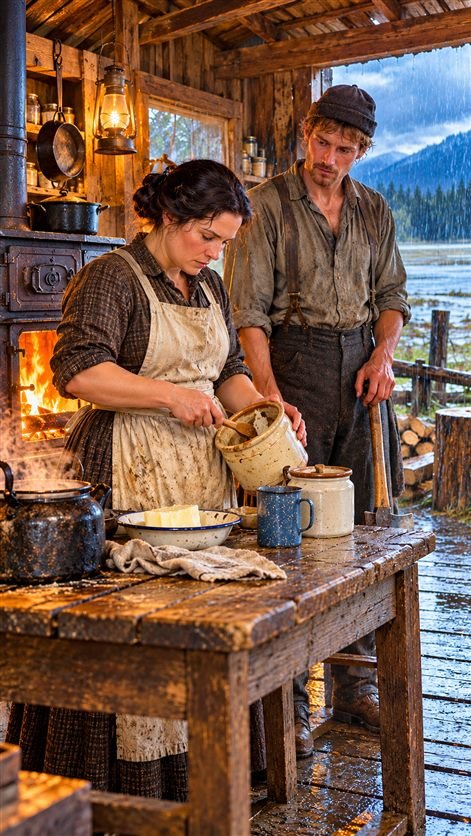
The door banged open without a knock. It wasn’t George; it was young Jimmy Hauer, the teamster’s boy, his wool coat frozen stiff at the skirts and his face the color of skimmed milk.
“Mis’ Bell,” he shouted over the roar of the wind in the stove-pipe. “You better come down to the landing. Reynolds is laying the jacks under the big gray piece.”
Caroline didn’t stop to wipe her hands. She snatched her heavy wool shawl from the peg—a dark, grease-stained blanket pinned with an iron brooch—and wrapped it twice around her throat before following the boy out into the gray churn of the yard.
The cold hit her like a wet leather strap across the chest. The wind off the flats carried the smell of rotting kelp and freezing salt-water. Down at the lower skids, where the mud froze into sharp, glass-like ridges between the ruts, George and his two remaining hands were working around the four-ton granite block they had spent the week dragging from the upper shelf.
The stone sat on two oak rollers greased with mutton tallow, but one of the rollers had slewed sideways in the frozen muck. The granite mass—six feet long and heavy as an iron safe—hung half-off the timber ways, canted at an ugly twenty-degree angle toward the salt channel where the tide was beginning to back up into the marsh.
George was down in the gap between the stone and the frozen bank, his shoulder jammed against the oak roller, his face pressed directly against the wet, gray granite. He wasn’t shouting; he was making a low, rhythmic grunting sound with every breath, his long body strained so hard the muscles in his neck stood out like whipcords under the wool of his shirt.
“He’s going to break his spine,” the boy yelled, dancing back and forth in the sleet. “The jack’s slipped the tooth!”
Caroline didn’t wait to think. She knew as much about stone-rigging as any man on the sound—her father had run the ballast-quarry at Steilacoom before the rails went in. She grabbed a six-foot iron-shod cant-hook from the rack by the smithy, her boots crunching into the frozen mud as she ran down the slope.
“George!” she screamed. “Get your leg out from under that bolster!”
He didn’t move. His boots were wedged deep in the mire, and the four tons of blue granite were settling another inch as the frozen crust beneath the downhill roller gave way. The stone groaned—that dull, sickening crunch of mineral meeting mineral under unbearable stress.
Caroline didn’t try to lift. She knew better than to pit her three hundred pounds of bone and muscle against four tons of Chuckanut granite. Instead, she jammed the iron toe of the cant-hook deep into the frozen mud beneath the slewed roller, threw her whole weight onto the ash pole, and threw her hips against the timber.
The lever bit. The oak roller gave a sharp, pistol-crack snap as the grain took the strain, then rolled six inches sideways with a shriek of iron against iron.
The granite shifted, dropping six inches straight down into the gravel bed with a dull thud that shook the fillings in Caroline’s teeth.
For a second, nobody moved. The sleet hissed against their wet coats.
George scrambled backward out of the gap like a dog coming out of a brush-pile, his breath coming in long, ragged wheezes. He landed flat on his back in the slush, his hat gone, his pale hair plastered to his forehead with gray mud and sweat.
Caroline stood over him, leaning on the cant-hook, her chest heaving beneath the heavy shawl. Her hands were shaking now that the work was done—not from fear, but from the sudden, bitter cold rushing into her veins.
“You are,” she said, her voice shaking with a cold fury that had nothing to do with the weather, “the most bone-headed, pig-headed, illiterate mule-skinner that ever walked out of the Idaho hills.”
George didn’t get up immediately. He lay flat in the mud, staring up at her through the gray sleet, his chest rising and falling in great, shuddering gasps. Slowly, a strange, crooked grin broke through the mud and granite dust on his face—not a pleasant grin, but the cracked, tired smile of a man who has just discovered he still has all his teeth.
“The roller held,” he rasped.
“The roller is split right down the core,” Caroline snapped, throwing the cant-hook down into the mud. “And so is your head, if you think I’m coming down here to pull you out from under a government pier-stone every time you miscalculate a grade.”
She turned on her heel and started back toward the cook-shed, her heavy boots throwing up brown slush with every stride.
George didn’t follow her right away. He stayed on his back in the freezing mud for a long moment, watching the gray scud blow low across the Samish hills, before he reached up, rubbed his left hip where the stone had grazed his wool trousers, and began to laugh—a low, dry cough of a sound that was swallowed instantly by the wind.
By nightfall the tide was over the stringers of the lower pier, and the wind had hauled around to the southwest, bringing the warm, wet breath of the Pacific through the gap in the islands. The sleet turned to a heavy, drumming rain that hammered on the cedar shingles of the cook-shed until the interior was filled with a watery, gray twilight.
Caroline sat at the deal table with a kerosene lamp between her elbows, her account book open to the page where she kept track of the salt-pork, flour, and blasting powder. Her fingers were still stiff, the skin around her nails dark and bruised from where the cant-hook had pinched her palm against the iron shoe.
The door creaked open. George came in, ducking his head automatically though the lintel was a full hand above his cap. He had washed his face at the water-butt outside, but his wool shirt was still dark with sweat and rain across the shoulders, and he smelled powerfully of wet dog, woodsmoke, and bruised stone.
He didn’t speak. He walked straight to the stove, held his large, red hands out over the cast-iron top until the skin hissed slightly, then turned and pulled a small wooden stool over to the corner of the table opposite her ledger.
“The Inspector’s wire came down by the afternoon mail-rider,” George said.
Caroline didn’t look up from her columns of figures. She was trying to balance the cost of twelve barrels of lime against the seven dollars she still owed the storekeeper at Anacortes for winter calico.
“And?”
“He’s not coming on Friday. The steamer broke a shaft off Deception Pass. He won’t be here until the middle of next week.”
Caroline’s pen paused over the paper. A drop of dark ink fell from the nib, spreading a small, round black spider into the column where she had written *Salt—4 sacks @ $1.25*.
“That gives us four days,” George said.
“It gives *you* four days to figure out how to move that four-ton block without killing yourself or young Jimmy.”
“We’re not moving it to the scow,” George said. He reached out and turned the corner of the ledger two inches toward himself, so he could see the column of figures where she had marked the camp’s dwindling flour supply. “We’re leaving it where it sits in the mud.”
Caroline finally looked up. Her dark eyes were narrow, the skin beneath them shadowed by the yellow lamp-light.

Caleb Sterling is an American frontier fiction writer and Old West history researcher based near Sheridan, Wyoming. Dedicated to authentic 19th-century pioneer lore, trail diaries, and homestead sagas, he has penned over 240 serialized tales celebrating the resilience, romance, and untamed spirit of the American frontier.