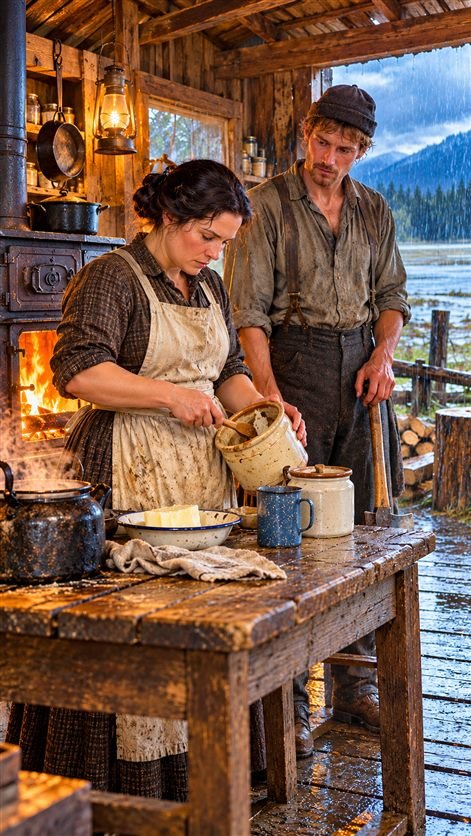
“Leaving it? After you spent two weeks skinning it out of the ledge? The government’s paid the advance on that stone.”
“The government can have its advance back, or it can take the small blocks from the upper shelf,” George said. His voice was lower now, level and devoid of its usual dry rasp. He leaned his forearms on the oilcloth table-cover, his hands flat and open between them. “That big block’s got a frost-fault right through the center. I saw it when the jack slipped. If we put that in the Port Townsend pier under a winter load, it’ll shear by January.”
Caroline stared at him. The rain beat a steady, frantic tattoo against the grease-paper window.
“You’re throwing away three hundred dollars,” she said.
“I’m throwing away the contract,” George corrected. “We’ll square up the smaller stone for the village breakwater. The town council at Samish has fifty dollars left in the road-tax fund, and they want a landing that won’t wash out when the autumn gales come down the flats.”
“That won’t pay for the black powder you burned this month.”
“No,” George agreed, his gray-blue eyes holding hers across the yellow glare of the lamp. “It won’t. But it’ll keep the scows out of your garden, and it’ll leave us enough granite to build a proper foundation for this cook-shed before the deep frosts set in.”
Caroline looked down at her ink-stained fingers. The ledger page between them smelled of salt and old glue. She thought of her uncle’s pier at Whidbey—the way the gray stones had leaned out toward the water like broken teeth after the great freeze of seventy-eight, and the cold, gray winter that had followed with nothing in the larder but salt cod and dried peas.
She reached out, took the pen from her hand, and laid it carefully across the fold of the book.
“There’s half a crock of salt-pork left in the barrel,” she said, her voice dropping an octave into that dry, matter-of-fact tone she used when she wanted an argument to end before it began. “And if you’re going to help me lay foundation stone tomorrow, you can wash that mud out of your beard tonight before you come inside my kitchen.”
George didn’t move away. He sat there in the yellow lamp-light, his long hands resting on the table edge just an inch from her knuckles, watching her with a slow, steady gaze that had nothing to do with granite or government contracts.
“Your garden’s still three feet of sand, Caroline,” he said softly.
“It’s onions,” she said, and for the first time that week, the corners of her mouth twitched upward into something very like a smile. “And they’ll stay where they are.”
*
[END OF PART 1]
The wind dropped around midnight, leaving the Samish flats under a high, washed ceiling of stars that looked like salt-grains spilled on blue slate. By dawn the puddles in the quarry yard were skimmed with ice thin as dragonfly wing, and the breath of the mules rose in white puffs against the gray scrub-willows by the creek.
Caroline was up before the stove drew, her wool shawl pinned double across her chest as she worked the iron lever of the coffee-mill. The beans were old and dry—chicory-cut from the store at Anacortes—and they rattled in the hopper like loose teeth.
George came in from the lean-to without his coat, his shirt-sleeves rolled to the elbow and his forearms streaked with gray lime-dust. He didn’t speak; he took the wooden water-bucket from the bench and walked out to the butt, his boots cracking the thin ice with sharp, clean snaps. When he came back he set the bucket down by the zinc sink, reached behind the flour-bin without asking where she kept it, and set the heavy iron skillet over the hottest part of the stove plate.
“The frost didn’t reach the lower shelf,” he said, leaning his hip against the deal table. “The salt water kept the mud soft underneath. We can get the six-footer out by noon if the team holds.”
“The team’s done,” Caroline said, not turning from her flour-sack. “Jimmy says the bay mule has a swollen hock from the sleet yesterday. You’ll use hand-jacks or you won’t move anything heavier than a shingle.”
“Hand-jacks take four men.”
“Then you and Jimmy and the two boys can pull together instead of shouting at each other in three different dialects.”
She measured two cups of gray flour into the yellow bowl, dropped in a lump of rendered mutton tallow the size of an apple, and began to work the dough with the heels of her red hands. She didn’t look at him, but she knew where he stood by the way the shadow fell across the flour-bin. His presence in the small shed was always heavy—not because he was loud, but because he occupied the room the way an anvil occupied a smithy, hard to ignore and impossible to kick out of the way.
“The town council came down while you were sleeping,” George said.
Caroline’s hands stopped in the dough. “Which ones?”
“Miller and the German fellow from the shingle-mill. They looked at the pile we squared yesterday for the village slip.”
“And?”
“Miller wants to know if we can spare twelve more feet for the butcher’s landing. He says his cart bog down every time the tide comes over the mud-sill.”
“Tell him twelve feet of ashlar will cost him twenty dollars and two cords of dry alder for the cook-shed stove,” Caroline said, her fingers returning to their rhythmic press and fold. “We aren’t running a charity for people who built their butcher-shops below the high-water line.”
George let out that short, dry cough of a laugh. He reached down, picked up a clean wooden peg she had carved for the flour-lid, and turned it over between his thumb and forefinger.
“I told him sixteen dollars and three cords.”
Caroline stopped again, her dark eyes flashing up from the bowl. “You’re a terrible bargainer, George Reynolds. You’d trade a twelve-ton granite block for a sack of turnips and a three-legged dog.”
“The turnips are good,” he said mildly, setting the peg back down where he found it. “And we need the wood. The damp’s getting into your flour-bins.”
He didn’t touch her, and he didn’t move any closer, but his shoulder stayed within two inches of her sleeve as he reached past her to lift the coffee-pot from the hob. The contact was casual—the sort of careless nearness that comes when two people have shared the same four-by-six workspace through three weeks of driving rain and frozen mud.
By Tuesday the Samish breakwater project was no longer a government wharf. It had become something smaller, more stubborn, and entirely local: sixty yards of gray Chuckanut stone laid dry along the curve of the mud-flat, pinned with iron dogs and backed by cedar brush to keep the winter tide from eating away the bottom of Caroline’s garden.
The work went slowly. Without the big scow and the government derrick, every block had to be levered onto a low-slung stone-boat, hauled by the sweating, blowing mules across the frost-crusted salt-marsh, and then dropped into place by hand with oak rollers and three-to-one block-and-tackle.
Caroline spent her afternoons down at the water’s edge, not because she had to supervise, but because the cook-shed grew small and airless when the rain set in again after noon. She wore a pair of her father’s old moleskin trousers tucked into grease-caked calf-skin boots, her woolen skirts pinned up around her waist like an apron-pocket.

Caleb Sterling is an American frontier fiction writer and Old West history researcher based near Sheridan, Wyoming. Dedicated to authentic 19th-century pioneer lore, trail diaries, and homestead sagas, he has penned over 240 serialized tales celebrating the resilience, romance, and untamed spirit of the American frontier.