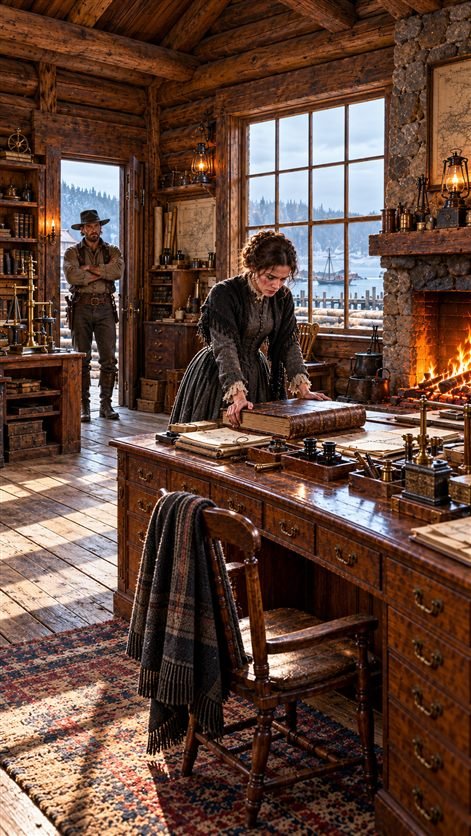
“It’s about time,” she said.
The water reached the lower landing by three in the morning. It did not come as a destructive wall, but as a heavy, brown pulse that surged over the gravel bars, lifted twenty cords of rotting company slab-wood from the dead-water eddy, and sent them spinning down toward the Sound with a hollow, booming clatter against the pilings of the salt-dock.
In the timber office, Mr. Jasper Clough was discovered by the night watchman at four o’clock, standing upon the porch of the boardinghouse in a quilted silk dressing gown, holding a leather valise in one hand and shouting vain instructions at three crates of zinc discharge cylinders that were currently floating toward the kelp beds. By dawn, the steamer *Snoqualmie* had whistled twice off the point, taken on seventy sacks of wet salt-petre at half-price, and carried the rainmaker south toward Olympia without his brass megaphone, which had been permanently wedged between two cedar springboards behind the livery barn.
Lavinia Pennington did not go down to the wharf to watch him leave. She sat at the high walnut desk in the assay office, her skirts smelling faintly of wet ferns and wood smoke, her fingers tracing the neat column of figures where she had finally crossed out *Uncollected Wharfage: Estate of E. Pennington* and written across the margin in black iron-gall ink: *Settled by natural flow, April 1883.*
The sun came up through the Puget Sound mist at six, turning the wet cedar shingles the color of old pewter and striking long, pale shafts of yellow light across the mudflats where the salmon were already beginning to nose into the fresh, cold current of the north fork.
Magistrate Jane Henderson stopped by before the post-bag was sorted. She stood in the doorway of the office, her skirts damp around the hem, holding a cracked porcelain teacup without a handle.
“The bridge held,” the magistrate said, blowing a wisp of grey steam off the top of her tea.
“Mr. Prescott used three-inch iron drift-bolts,” Lavinia said without looking up from her ledger.
“He also used forty pounds of company powder to blow the jams out of the culvert without asking the receiver’s permission in Tacoma.” Magistrate Henderson pulled a small tin box of lozenges from her pocket and offered one with a dry, knowing twitch of her lip. “The receiver sent a telegram asking who authorized the dynamite.”
“Tell him the river did,” Lavinia said.
“I told him Miss Pennington’s accounts were finally liquid.” The magistrate took a slow sip of her tea, her eyes wandering over the mahogany instrument cases that still sat undisturbed in the corner. “The orphan nephews are eating porridge again because the mill hands are back at work. Mr. Prescott is down at the trestle with his broad-ax. He says the piling needs a fresh shoe before the afternoon tide.”
“I know,” Lavinia said.
She closed the ledger with a sharp, clean snap that echoed in the small room. Her hands didn’t tremble now; the bombazine cuffs were frayed at the wrists, and her hair had come loose from its pins during the wet scramble up the ridge, but she hadn’t felt the cold in her fingers since the water broke through the cribbing.
*
The timber trestle spanned a fifty-foot drop where the logging road crossed the lower creek canyon. Below, the water ran clear and cold over the basalt stones, the foam catching on the submerged roots of the vine maples that leaned out from the banks.
Gideon Prescott was astride a twelve-by-twelve cedar stringer twenty feet above the water, his broad-ax flashing in the morning sun as he trimmed a notch for the iron brace. He didn’t look down when the gravel crunched beneath Lavinia’s boots, but he paused the moment the rhythmic *thunk* of his blade stopped echoing against the canyon walls.
She stood on the bank where the trail widened into the loading yard, her black shawl pinned neatly across her chest, holding a small tin bucket filled with black-coffee and three slices of salt-pork lard-bread she had baked over the camp stove before sunrise.
“You’re late,” he said, his voice carrying easily over the roar of the creek.
“I had to settle the wharfage accounts,” she called back, her chin lifting slightly. “The magistrate was in the office.”
“What did she say?”
“She said the receiver wants to know who bought the dynamite.”
Gideon let out a short, dry bark of laughter that sounded like bark splitting under a wedge. He swung his legs over the stringer, dropped four feet into the soft red clay of the bank with a heavy, solid thud, and walked over to wipe his brow with the back of a thick woolen forearm. His face was streaked with cedar dust and sweat, but the dark, speckled eyes were clear.
“Tell her we used the company’s own powder to blow their own dam,” he said, taking the tin bucket from her hand. He didn’t thank her; he just pulled out a piece of the lard-bread, bit off half of it, and chewed with slow, methodical concentration while he looked out over the restored creek. “The water’s clear. The salmon won’t choke this season.”
“No,” Lavinia said, standing her ground beside him in the wet fern-brake. “And Mr. Clough is halfway to Tacoma with sixty dollars worth of damp salt.”
Gideon chewed the bread, his gaze shifting slowly from the water back to her face. The silence between them was no longer the heavy, defensive quiet of two strangers sharing a bleak frontier settlement; it was the quiet of people who had spent an entire night shoulder-to-shoulder against an old timber crib and found that their weights matched.
“The railroad’s moving the camp south next month,” he said after a moment, his thumb running over the rim of the coffee tin. “Down toward the Columbia river-flats. There’s three miles of trestle to build through the cottonwoods before the winter rains start again.”
Lavinia looked down at the toes of her boots, where the dried mud from the ridge was beginning to flake off in the dry morning air. Her heart gave a small, distinct flutter—not the panic of the lonely year she was leaving behind, but the sharp, steady pulse of a choice that belonged entirely to her.
“Do they need a bookkeeper?” she asked.
Gideon looked at her for a long second, his mouth twitching into that rare, faint humor that made him look ten years younger than his forty-odd winters.
“They need somebody who knows the difference between a barometer and an abacus,” he said, setting the bucket down on a cedar stump and reaching out with a hand that was still rough with pitch to take her ink-stained fingers between his broad palms. “And they need somebody who isn’t afraid to break a company dam when the water’s going the wrong way.”
“My uncle’s ledger is closed,” she said softly, her fingers curling into his warmth without hesitation.
“Good,” Gideon said, and his thumb traced the soft curve of her knuckle with a slow, deliberate pressure that needed no words to explain its weight. “We’ll start a new one on the Columbia.”
They stood there together beside the rushing water while the morning sun burned the last gray remnants of the Sound mist off the tops of the firs, neither of them looking back toward the town, and neither of them asking what the winter would bring when the rains returned to the valley.