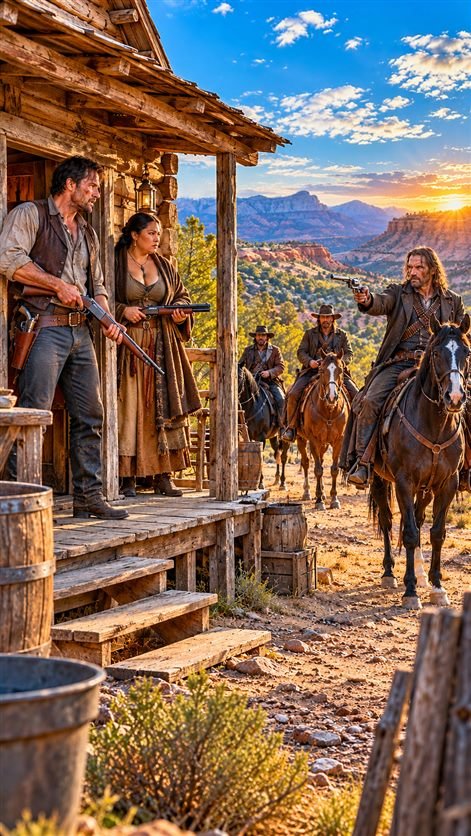
The cold muzzle of the revolver pressed against Elias Mercer’s temple, and for the first time in his legendary career, the cold sweat of genuine terror slicked the palms of his hardened hands. Outside the battered glass of the cabin window, hoofbeats ground into the dust, signaling the arrival of men whose vendettas transcended the law and whose cruelty knew no earthly bounds.
The most feared bounty hunter in the territory had never begged for mercy, never run from a gunfight, and never allowed a woman close enough to break his heart. Yet as the desert wind howled through the canyon, threatening to rip the rotting shingles from the roof of his isolated home, Elias found his entire world reduced to the steady, rhythmic breathing of the woman resting just a few feet away. When a lonely Apache widow looked at him from his own bed and whispered, “Come here, Elias,” his hands began to tremble with a vulnerability he thought he had buried deep beneath the dirt of forgotten graves. What happened that night would change both their lives forever, and before the next sunset, three armed men would arrive to make them pay for every stolen moment of peace.
Elias Mercer was thirty-seven years old, broad-shouldered, weather-beaten, and feared by nearly every outlaw west of the jagged mountain ridge. He possessed a reputation forged in blood and gunsmoke, a ghost who could track a fugitive across miles of barren, waterless desert without leaving a single trace. He could sleep soundly through a howling winter blizzard beneath nothing more than a thin wool blanket, and when he drew his revolver from its holster, the most dangerous men in the territory learned to pray. Yet despite his fierce reputation and the heavy leather bag of gold coins he kept hidden beneath his floorboards, there was one domestic domain Elias simply could not manage. A home.
His isolated cabin, tucked deep into the cedar-studded hills outside the bustling mining town of Red Gulch, was an absolute disgrace. Dust hung heavy in the air, coating every surface in a gray film that smelled of old wood and neglect. Dirty pewter plates and cracked mugs crowded the rough-hewn wooden table, breeding flies and crawling things. Clothes he had worn on long, grueling trails lay abandoned across chairs and floorboards alike, stiff with dried mud and sweat. Empty coffee tins gathered in the dark corners like rusted monuments to his isolation. For years, Elias had convinced himself that four rotting walls overhead, a straw mattress beneath his back, and a working wood stove were all a man truly needed to survive this harsh land.
Then he met Mara.
She was an Apache widow living in a small, weathered adobe dwelling less than a mile down the winding creek bed. Eight years earlier, a vicious strain of scarlet fever had swept through the territory, stealing her husband and leaving her entirely alone in a world that viewed her with deep suspicion and open hostility. Since then, she had survived through quiet endurance, walking alone through a town whose residents never bothered to look past the color of her skin or try to know her heart. They muttered cruel words behind her back and crossed the wooden boardwalk whenever she approached, treating her as though she did not belong in their dusty world.
Elias, however, had noticed something fundamentally different about her. He had watched her from the shadows of the hitching posts as she carried herself with a quiet, unshakeable dignity, even when the local shopkeepers made her wait until every white customer had been served. He saw the straightness of her spine and the steady, intelligent gaze she cast upon a world that tried so desperately to break her spirit. One stifling afternoon, driven by a sudden, inexplicable impulse, he veered his horse toward her little house instead of riding straight out to the badlands.
He reined in his bay stallion, dismounted, and walked up to her porch, his spurs jingling in the heavy silence. Mara stepped out onto the shaded threshold, her dark eyes narrowing slightly as she took in his scarred knuckles and the low-slung iron at his hip. He didn’t waste time with polite pleasantries, because pleasantries were foreign to him.
“I need someone to clean my cabin and cook while I’m away on the trail,” he said, his voice deep and raspy from years of inhaling trail dust. “I’ll pay fair wages, drawn straight from government bounties.”
Mara studied his scarred face, looking past the hardened exterior to search for the hidden malice she usually found in white men who sought her out.
“You’re not afraid of what the people in town might say?” she asked, her voice carrying a melodic cadence that sounded entirely out of place in the rugged wilderness.
Elias shrugged his heavy shoulders, a faint, cynical smirk touching the corner of his mouth.
“Never made a living caring what fools think,” he replied.
For the first time since he had ridden up, her expression softened, a subtle parting of her lips revealing a spark of unexpected warmth.
“I’ll come tomorrow morning,” she said simply.
And she did. True to her word, Mara arrived at dawn, carrying a bundle of rags, homemade lye soap, and a cast-iron skillet. By the time Elias returned from a grueling three-day hunt in the rocky foothills, he barely recognized his own home. Sunlight poured brightly through open shutters that had been nailed shut for years. Clean, gleaming dishes lined the rough wooden shelves, reflecting the amber glow of the hearth. A loaf of fresh, golden cornbread satcooling beside a steaming pot of pinto beans seasoned with wild onions. The wide pine floors were scrubbed completely spotless, smelling faintly of sage and clean water.
For the first time in as many years as he could remember, Elias stepped across his own threshold and felt something entirely unfamiliar wash over him. Peace. It was a strange, unsettling sensation for a man whose life was measured in gunfights, ambushes, and the relentless pursuit of desperate men. He stood in the center of the clean room, his hat clutched in his rough hands, feeling almost like an intruder in his own dwelling.
Yet the real change in their peculiar arrangement happened slowly, almost imperceptibly, as the desert seasons shifted and the nights grew colder. Mara never questioned his dangerous work, never flinched at the sight of the heavy revolver strapped to his hip, and when he returned from the trail battered and bleeding, she didn’t waste words on useless pity or dramatic gasps. She simply went to work.
One particularly brutal evening, Elias entered the cabin with raw, bloody knuckles, a swollen purple bruise blooming beneath his left eye, and a deep, jagged gash across his forearm where an outlaw’s Bowie knife had grazed him. He slammed his rifle against the wall, wincing as a sharp spike of pain shot up his shoulder. Mara didn’t look up from the hearth where she was stirring the evening stew, but she pointed a wooden spoon toward a low-backed wooden chair near the fire.
“Sit down,” she commanded, leaving no room for argument.
“It’s nothing, just a scratch,” Elias grunted, gripping his bleeding arm.
“I didn’t ask how bad it was,” she said, turning to face him with her dark eyes flashing. “Sit.”
The feared bounty hunter, a man who made hardened killers shake in their boots, quietly sat down without another word. Mara brought over a basin of warm water, a clean linen cloth, and a jar of healing salve she had brewed herself from mountain herbs. With agonizing care, she washed the dried blood from his knuckles and tenderly wrapped his wounded arm in fresh, white cloth. Elias stared down at her gentle, capable fingers as they worked with a reverence he had never known. He had survived bullets, knife wounds, freezing blizzards, and brutal ambushes without the aid of another human soul for over a decade. Yet this simple, domestic act of kindness nearly broke him from the inside out.
It nearly broke him because he had completely forgotten what it felt like to matter to another living human being. He was a tool of the law, a purveyor of death, a shadow that walked alone. But sitting there in the flickering firelight, feeling the warmth of her touch against his calloused skin, he realized how hollow his entire existence had truly been.
Later that evening, a violent desert storm swallowed the valley whole, plunging the world into a chaotic symphony of wind and water. Rain lashed viciously against the weathered glass of the windows, and jagged streaks of lightning fractured the darkness, followed instantly by concussive crashes of thunder that shook the very foundations of the cabin. The wind screamed like a dying animal against the exterior shutters, threatening to tear them from their iron hinges.
When Mara finally finished cleaning the supper dishes, she reached for her heavy woolen coat hanging by the door, preparing to brave the deluge and make the dangerous trek back to her own adobe. Elias moved with sudden, decisive speed, stepping into her path and blocking the wooden door.
“You’re not walking home in this,” he said, his voice dropping an octave.
She paused, her hand resting on the wool sleeve of her coat, and turned to look up at him.
“Then where am I sleeping?” she asked, her voice steady despite the howling storm outside.
“The bed,” Elias replied without hesitation.
“And you?” she asked, tilting her head.
“The chair.”
A faint, knowing smile touched the corners of her lips, warming her dark eyes in the dim lamplight.
Hours passed as the storm raged on with unyielding fury. Elias remained seated in the straight-backed chair near the heavy timber door, his hand resting comfortably on the stock of his Winchester rifle, keeping a vigilant watch against the dark. Mara lay beneath his thick woolen blanket on the narrow bed across the room, watching him through the shifting shadows cast by the dying fire.
“Do you always sleep guarding the door?” she asked softly, breaking the steady rhythm of the rain.
“Old habit,” Elias murmured, his eyes never leaving the rain-streaked windowpane.
“Are you expecting danger tonight?”
Elias stared out into the pitch-black night, listening to the groaning timbers of the porch.
“Danger doesn’t send invitations, Mara. It just arrives when you least expect it.”
Silence returned to the small cabin, filled only by the crackle of embers and the drumming of rain. Then Mara spoke again, her voice dropping so quietly that he almost missed the words entirely over the roar of the wind.
“My husband has been dead eight years,” she whispered into the dark.
Elias slowly turned his head, looking across the shadowed room toward the bed.
“When the railroad came through and the mining boom started, my family moved away to find work in the northern territories,” she continued, her gaze fixed on the timber ceiling. “Most nights, I sit in my house listening to absolutely nothing. Just the wind and my own heart.”