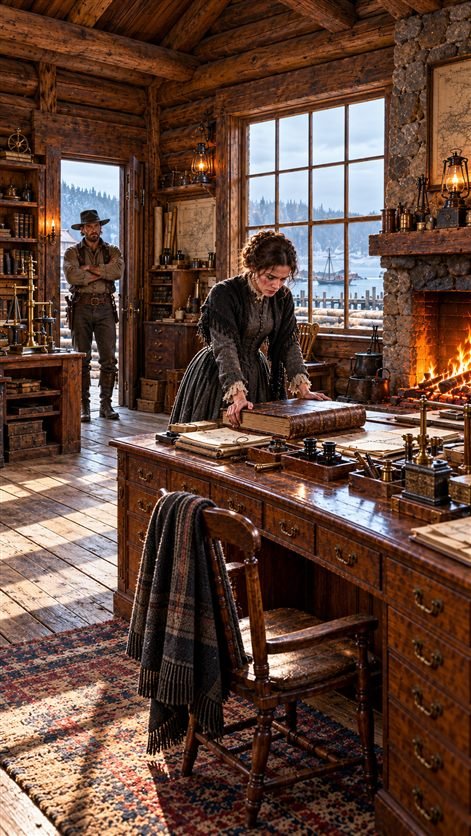
Lavinia dismounted without help, though her knees buckled slightly when her boots hit the damp gravel. She led the mare toward the paddock fence, her jaw set so hard her teeth ached.
“You shouldn’t have done that,” she said, her back to him as she unbuckled the cinch.
“Done what? Taken you out of the mud?”
“Made me look like a schoolchild needing her uncle’s foreman to lead her home.”
Gideon leaned his ax against the peeled cedar rail of the paddock and pulled a stub of a tobacco pipe from his vest pocket. He didn’t light it; he just rolled it between his thumb and forefinger, watching her struggle with the stiff leather buckle.
“You weren’t looking like a schoolchild,” he said quietly. “You looked like a woman trying to stop an earthquake with an abacus. Clough’s a swindler, but the town wants him to be a savior. You don’t break a town’s hope with barometers, Lavinia. You have to show them where the water actually went.”
She stopped with the strap half-pulled, staring at him. He rarely used her Christian name; usually she was ‘Miss Pennington’ in the stiff, formal cadence of the frontier towns where men took off their hats only when someone died or left on the steamer.
“How do you know where it went?” she asked, her voice dropping its defensive edge.
“Because I helped build the mill dam two years ago before the company sold out to the Englishmen,” he said, gesturing with the pipe toward the dark notch in the hills where the creek vanished into the fern brakes. “The diversion ditch isn’t natural. Someone put a bulkhead in the old gravel bed above the north meadow to keep the logging pond deep during the dry spell. If we open it tonight before the rain starts, the creek will be back in its bed by morning. Clough’s show will wash down the flume.”
“That’s illegal,” she whispered. “The mill company holds the charter.”
“The mill company went into receivership in November,” Gideon said, striking a match against his belt buckle and finally getting his pipe to draw. The sweet, heavy smell of burley tobacco drifted into the damp air. “There’s no company left. Just a stack of papers in an Olympia office and a magistrate who wants to believe in magic because the vegetable garden is dying.”
Lavinia looked down at her hands—small, ink-stained fingers that knew every entry in the freight ledgers from Port Townsend to Victoria. She thought of her father’s instruments rusting in their mahogany boxes, and of the way Magistrate Henderson had looked at her with that tired, dismissive pity.
“If we open the bulkhead,” she said slowly, “the water will flood the lower yard. The company’s timber stacks will float.”
“Some of them,” Gideon agreed. “The ones the Englishmen left to rot.”
“And Mr. Clough will lose his demonstration.”
“Mr. Clough will catch the night steamer for Tacoma with his zinc drums before the mud hits his boots.” Gideon stepped closer, his heavy woolen sleeve brushing hers as he reached out to steady the mare’s restless head. There was no theatrical gallantry in it—just the steady, heavy presence of a man who spent his life measuring stress loads against granite. “Well, Miss Pennington? Do we let the rainmaker sell his sulfur, or do we go up the ridge with shovels?”
Lavinia looked up into his face. His eyes were not slate-gray like the poets’ heroes in the San Francisco weeklies; they were the dull, speckled brown of river silt, creased at the corners from twenty years of squinting against the glare of wet timber and open water.
“My uncle’s ledger is already ruined,” she said, her voice dropping into a register that felt dangerously like a choice. “We might as well ruin the north meadow, too.”
*
The rain began just as the sun dropped behind the ridge, turning the Puget Sound grey into the color of a wet slate shingle. By nine o’clock, the wind had hauled around from the southwest, driving the mist against the cedar walls of the camp with a steady, hissing roar that drowned out the sound of the river.
They went up on foot, Gideon carrying two long-handled shovels over his shoulder and a hooded tin lantern that cast a jiggling circle of yellow light against the dripping sword-ferns. Lavinia followed in her oilskin slicker, her boots sinking six inches into the muck with every step. Her chest felt tight, not with fear now, but with an odd, stinging clarity she hadn’t known since before her father’s funeral. For the first time in a year, she was doing something that wasn’t written in a book of accounts.
The bulkhead was an old timber cribbing filled with basalt boulders, wedged into a narrow choke of the ravine where the north fork split toward the mill pond. In the dim lantern light, the structure looked ancient and permanent, its cedar timbers coated in green liver-wort and slick black slime.
“Can we move it?” she asked, her breath pluming white in the chill air.
“We don’t move it,” Gideon said, setting the shovels down in the mud. He reached into his coat and pulled out a short iron pinch-bar. “We just take out the key log at the bottom. The pressure from the beaver dam two miles up will do the rest once the weight hits it.”
“If it breaks too fast,” Lavinia said, stepping to his side and putting her gloved hand directly onto the cold iron of the bar beside his, “it’ll take out the lower bridge.”
Gideon paused, his hand covering hers—not as a gesture of romance, but because she was holding the bar with him, her weight helping to balance the leverage against the slick stone. His hand was enormous, rough-skinned and warm enough to penetrate the wet wool of her mitten.
“The lower bridge is my bridge,” he said, his voice low against the rushing of the invisible water behind the dam. “I built it two years ago with three-inch iron drift-bolts. It’ll hold a log jam twice this size.”
“You’re very sure of your work, Mr. Prescott.”
“I have to be,” he said, and for a second his eyes met hers in the yellow lantern light, dark and heavy with something that had nothing to do with timber or rain. “Nobody else around here is going to rebuild it if it washes out.”
They threw their weight together against the iron bar. There was a dull, groaning shriek of old cedar fibers giving way under thirty tons of pent-up silt, a sudden, cold gush of water that smelled of rotting leaves and deep mountain mud, and then the whole cribbing shuddered and lurched sideways into the dark.
Lavinia stumbled backward into the ferns, sliding six feet down the muddy bank before Gideon’s arm caught her around the waist, lifting her clear of the rising backwash with the easy strength of a man hauling a timber off a skid-way.
They stood together in the pouring rain, the water soaking through their coats as the roar of the liberated stream swelled behind them, filling the canyon with the clean, deep thunder of a river returning to its bed.
“Well,” Gideon shouted over the noise, his face streaming with rain and a strange, quiet grin breaking through the stubble of his jaw. “There’s your rain, Miss Pennington.”
Lavinia didn’t move away from his arm. Her heart was beating hard, not from terror, but from the sudden, sharp realization that the ledger was closed, the magistrate was wrong, and the water was finally running where it belonged.