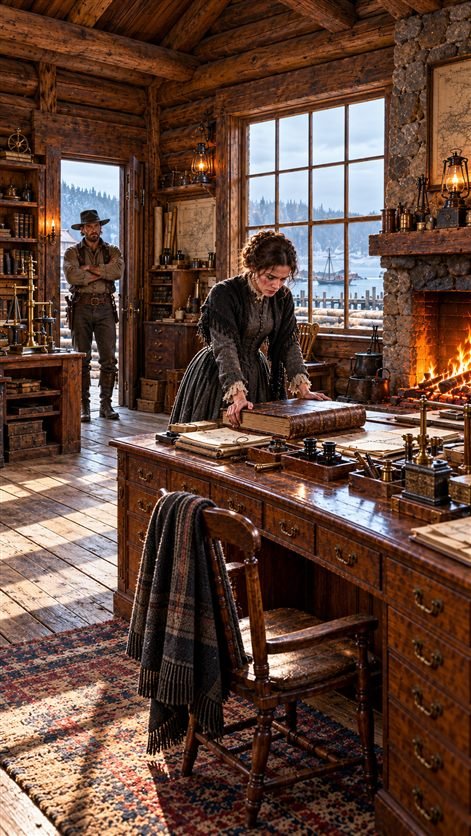
“Tell them the sky is empty, Miss Pennington, and they will simply pay someone else to fill it.” Gideon Prescott did not look up from where he was sharpening his broad-ax against a greasy sandstone block.
The salt wind off Puget Sound rattled the dry cedar shingles of the timber office, carrying the sharp, resinous smell of sawdust and the distant, rhythmic clank of the pile drivers down at the wharf. Lavinia Pennington smoothed the grey wool of her mourning skirt over her knees, her fingers trembling slightly against the coarse fabric as she watched the grey mist rolling inland over the mudflats.
“Mr. Clough has three wagons of zinc drums and a brass megaphone,” she said, her voice dropping into that thin, hurried register she used whenever she felt the entire room weighing her worth against her uncle’s debts. “The town council believes he brought the barometer down from Olympia in a velvet-lined box. They are paying him two hundred dollars to seed the clouds with salt-petre before the salmon run chokes in the dry shallows.”
“It’s about six weeks early for a dry run,” Gideon muttered, testing the blade with a callused thumb that showed white scars from bridge-timber splinters. “And salt-petre won’t coax a drop out of an east wind.”
“I told the mayor that.”
“And?”
“He asked if my uncle left me any bookkeeping experience along with the ledger of unpaid wharfage fees.” She stood up, her small frame looking even smaller beneath the heavy eaves of the timber shed. “I am going to the livery barn. Mr. Clough is demonstrating his pneumatic discharge cylinders at noon.”
“Take the bay mare,” Gideon said, still not looking up. “She won’t shy when he fires his little brass cannon.”
“I can walk, Mr. Prescott.”
“The mud’s knee-deep past the dry-goods store, Miss Pennington. You’ll ruin those town shoes, and then who’s going to listen to your ledgers?”
Lavinia paused at the doorway, her chin lifting with a fragile, defensive stubbornness that cost her more breath than she cared to show. Her throat ached with the loneliness that had settled into her bones during the twelve months since her father’s death—a silence so complete that even the barking of the lumber-mill dogs sounded like an accusation. She did not want Gideon Prescott’s pity, nor did she want his bay mare. What she wanted was for the town of Port Blakely to remember that her father had surveyed every drainage ditch from here to the Dungeness spit before he died penniless, and that water did not obey a man who wore a silk vest and carried letters from Portland merchants.
“If I borrow the mare,” she said stiffly, “I shall expect you to charge my uncle’s account.”
“Put it on the bridge ledger,” Gideon said, a dry, faint twitch at the corner of his mouth being the only sign of amusement he allowed himself. “The railroad’s paying for the timber anyway.”
*
The demonstration behind the livery stable drew half the settlement—loggers in red wool shirts smelling of fir pitch, Chinese salt-cod packers from the cannery wiping their hands on blue cotton aprons, and three boarders from the hotel who were betting five dollars apiece on whether Mr. Jasper Clough’s zinc tubes would whistle before they hissed.
Mr. Clough was a man of magnificent volume. He stood upon an upturned cider barrel, his goatee trimmed into a perfect spade, waving a leather-bound volume of meteorological observations printed in San Francisco.
“The atmospheric pressure in the Sound is entirely unmoored, ladies and gentlemen!” Clough bellowed, his voice carrying easily over the barking of the mill dogs. “Without my discharge units, the salt mist hangs too high to condense! You are baking upon your own cedar roots while the clouds pass over to British Columbia!”
Lavinia sat upon the bay mare at the edge of the crowd, her fingers twisted hard into the braided reins. She knew the barometer readings as well as she knew her own name; her father’s instruments, still sitting in their mahogany cases in the back room of the assay office, told a very different story about the low-pressure front stalling over the Cascades.
“That’s a lie,” she said. It came out too soft, swallowed by the cheer of the hotel clerk as Clough flourished a silver-plated valve.
“Beg pardon, Miss Pennington?” District Magistrate Jane Henderson turned from the front row, adjusting her spectacles with an expression of mild, habitual exhaustion. The magistrate had three orphan nephews living in her kitchen and two timber disputes waiting on her desk; she had no patience for people who disrupted public entertainments without bringing a petition.
“The pressure isn’t unmoored,” Lavinia said, raising her voice just enough to cut through the hum of the crowd. “The barometric trend has dropped four points since Tuesday because of the southwesterly gale off Cape Flattery. The rain will come by Friday whether Mr. Clough discharges his zinc drums or not. He’s simply charging you for the equinox.”
Mr. Clough stopped mid-gesture, his smile frosting over with the practiced elegance of a man who had faced recalcitrant schoolmarms in three territories. “Ah,” he said, spreading his hands toward the assembly. “The young lady from the ledger office. Tell me, my dear—does your arithmetic also tell you when the salmon will die in the shallows?”
A ripple of nervous laughter went through the loggers. A man who spends ten hours a day hewing cedar ties in the damp does not care to be lectured on barometers by a woman in a black bombazine shawl.
“My arithmetic tells me,” Lavinia said, her heart hammering against her ribs like a trapped bird, “that the town council has already paid you eighty dollars for sulfur you haven’t burned, and that the well behind the blacksmith’s shop went dry three weeks before you arrived because the mill diverted the creek.”
“Miss Pennington,” Magistrate Henderson said sharply, stepping between the mare and the cider barrel. “Mr. Clough has a permit from the territorial board of trade. If you have an auditor’s grievance, bring it to the desk on Monday morning during public hours. Do not spoil the town’s arrangements when we are all praying for moisture.”
“The prayer won’t make the well wet, Mrs. Henderson.”
“No,” a deep voice rumbled from behind the wheelwright’s wagon. Gideon Prescott emerged from the shadows, carrying a double-bitted ax over his shoulder with the effortless balance of a man who lived among falling timber. He didn’t look at Lavinia; he looked at the magistrate, his face expressionless beneath the brim of his greasy felt hat. “She’s right about the creek, though. The mill dam’s choking the south fork. If we don’t clear the silt before the tide turns, Mr. Clough’s zinc drums are going to be sitting in three feet of dry mud.”
“We are paying for rain, Mr. Prescott, not drainage,” the magistrate said with a sigh that seemed to deflate her entire bodice.
“Then you’re buying the wrong article,” Gideon said simply. He walked over, took the bay mare’s bridle from Lavinia’s numb fingers, and turned her head back toward the trail leading up to the trestle camp. “Come along, Miss Pennington. The timber’s waiting, and the rain isn’t going to wait on the magistrate’s permit.”
*
The timber camp sat three miles up the valley where the glacial stream cut through a gap in the basalt cliffs. Here the air smelled of wet moss, crushed fern, and the sharp, tannic tang of cedar sap. Gideon’s crew—six Swedes and a taciturn man from Nova Scotia named MacLeod—lived in a long board bunkhouse with a sod roof from which wild mustard flowers were already sprouting.