The rider who dismounted first was not the local sheriff, but Hargrove himself—wearing his fine beaver-trimmed winter coat and silver-buckled gaiters, smelling faintly of the expensive coal-oil he used to grease his harness. Behind him came two hired gunmen from the valley, their Winchester scabbards frosted white, their eyes darting nervously toward the dark mouth of the timberline where Asa’s rifle barrel caught the gray morning light.
“You’re making a cold mistake, Miss Albright,” Hargrove called out, stopping ten paces from the step and slapping a rolled parchment against his glove with a dry, authoritative snap. “The district judge signed the writ of ejectment at dawn. The timber and the water basin belong to the syndicate now by order of the county court. Pack your iron box and your traps and get down the road before my men clear the cabin for burning.”
Abigail did not move. She stepped out onto the frost-rimed threshold, her bad leg held straight, her chin lifted with a quiet, terrifying composure that made Hargrove’s hand pause on his glove.
“You brought the wrong clerk with you, Mr. Hargrove,” Abigail said, her voice carrying clearly across the frozen clearing. She held up the sheepskin folio, the purple seal catching the flat, dull light of the snow. “This is the original federal patent of eighteen-sixty-two, registered in Washington before the county was ever surveyed. The document you filed at the courthouse has an iron-gall ink seal dated four years before that chemical compound was manufactured in the states. I have the ledger entries, the surveyor’s witness marks, and forty miners down at the Forks who want to know why their own water claims are tied to a forged folio.”
Hargrove’s face darkened from cold to a mottled, ugly purple. He took a sharp step forward, his hand dropping toward the pearl-handled revolver at his belt. “That paper’s a worthless scrap of greasy hide, and you’re a trespassing pauper playing clerk with stolen ink. Burn the cabin down,” he snarled, turning to the two gunmen behind him. “Get them out by the collar and put a torch to the floorboards.”
The taller of the two gunmen kicked his horse forward, drawing his pistol halfway from its holster as he reached for the porch rail.
From the dark interior of the cabin, Asa did not raise his voice, but the cold, flat click of the Sharps hammer cocking echoed across the clearing like a pistol shot. “Take one more boot-length inside that fence-line, Miller,” Asa said softly, “and I’ll put a forty-five grain slug through the buckle of your belt.”
The gunman froze, his horse skittering sideways in the slush. Hargrove cursed, his face twisting with rage as he jerked his own revolver clear of the leather. “There are three of us and one of you in the open—”
“There aren’t three of you,” a gravelly voice rasped from the dark doorway behind Abigail.
Micah stood framed in the timber jamb, leaning heavily on a peeled larch crutch, his gray hair wild around his forehead and a heavy ten-gauge scattergun cradled crookedly in his left arm. He didn’t look like a man who had been pinned in a bear trap forty-eight hours ago; he looked like an old Bitterroot scout who had smelled sulfur before Hargrove was out of knee-breeches. And down the trail from the upper timber line, the distant shouting of twenty men—miners and freighters from the Forks carrying shovels, axes, and long rifles—echoed off the granite cliffs as they poured around the bend in response to Abigail’s pre-arranged signal smoke.
Hargrove looked from Micah’s scattergun to the dark line of armed men spilling out of the pine woods above the creek. The color drained entirely from his cheeks, leaving him looking old and small inside his fine beaver coat. He lowered his pistol by an inch, his fingers twitching against the walnut grip.
“You can’t hold this claim against the court,” Hargrove muttered, his voice losing its iron. “The syndicate will tie you up in injunctions until your cattle starve and your timber rots.”
“The syndicate won’t be filing anything in this county come sunset,” Abigail said, stepping down from the threshold and walking right up to the edge of his horse’s stirrup, her eyes level and unblinking. “Because the moment the circuit rider sees these ink-tests, he’ll be issuing warrants for document forgery and land fraud from here to Missoula. Now turn that horse around, Mr. Hargrove, and ride back down the trail before my neighbors decide to inspect the brand on your saddle horses.”
For three long heartbeats the silence of the Bitterroot winter hung over the clearing, broken only by the steam puffing from the horses’ nostrils and the steady drip of melting snow from the cabin eaves. Then Hargrove spat into the slush, jerked his reins around with a curse, and spurred his horse down the freight road toward the valley, his two gunmen trailing close behind him without looking back.
* * *
By late afternoon the clearing was quiet again, the snow trampled flat by twenty pairs of heavy boots and the skid-marks of the departing riders. The neighbors had cleared the debris from the porch, brought a fresh quarter of venison and a sack of yellow cornmeal from the lower settlement, and left Abigail and Asa alone in the lengthening blue shadows of the mountain wall.
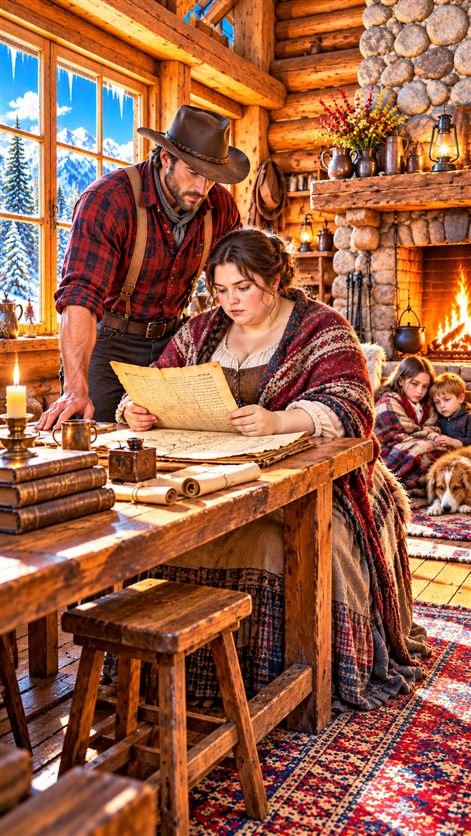
Inside the cabin, the smell of woodsmoke and dried pine had cleared, replaced by the rich, comforting steam of buckwheat griddle cakes sizzling on the heavy iron skillet with a drift of wild sorghum molasses. Lottie and Amos were already asleep on the bench near the hearth, worn out by the excitement of the day, their small, regular breathing the only sound in the room.
Abigail sat at the rough wooden table by the window, her fingers carefully smoothing out the sheepskin patent before sliding it back into the iron strongbox. Her hands were still stained with ink and lye, the skin across her knuckles red and cracked from the sub-zero air, but as she laid the heavy iron lid down with a dull, final thud, the tension that had gripped her shoulders for three long years finally broke.
Asa stood beside the table, holding two steaming tin mugs of chicory coffee. He didn’t set them down at once. Instead, he reached out, his large, rough palm moving slowly to cover her clenched fingers where they rested on the edge of the wood, soothing the tension from her skin with a steady, immovable warmth.
“You won’t have to spend another winter copying freight ledgers for town councilmen who can’t spell their own names,” Asa said quietly, his voice a low, rumbling vibration that filled the dim space between them. “The timber is ours, the water-head is clear, and the valley court won’t touch this title again as long as I’ve got two hands to hold a rifle and a plow.”
Abigail looked up into his gray eyes, seeing the quiet, fierce gentleness hidden beneath the weathered skin and the harsh mountain years. She turned her hand beneath his, her fingers sliding naturally between his calluses, fitting as if they had been shaped for that exact clasp since the first winter they had shared in the shadow of the peaks.
“I have no intention of leaving the ledger-work behind, Asa Quaid,” she whispered, a faint, dry smile touching the corners of her mouth as she reached up with her free hand to brush a stray pine needle from his flannel collar. “Someone has to keep the accounts around here, or you’d trade the winter beef for another Sharps rifle before the first snow fell.”
“Aye,” Asa said, his mouth curving into a slow, rare grin that reached all the way to his eyes. He lifted her knuckles to his lips, pressing a rough, deliberate kiss against the ink-stain on her thumb. “And I’d reckon you’re the only woman in the Bitterroot stubborn enough to keep the books and the cabin both.”
Outside, the last streak of orange light faded from the granite peaks of the Bitterroot divide, leaving the forest to the deep, blue-black quiet of the Idaho night. Abigail leaned her forehead against Asa’s broad shoulder, the heavy wool of his shirt smelling of pine and woodsmoke and home, while the cabin fire flickered warm against the floorboards and the first real peace of their lives settled over the snow-bound land.