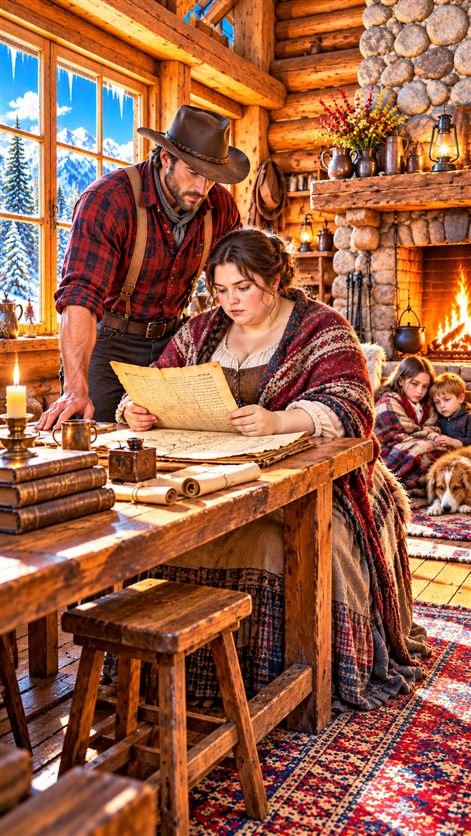
“Where are you going?” Asa asked, emerging from the lean-to with a heavy Sharps rifle cradled in the crook of his arm, his breath pluming white in the sub-zero dawn.
“To check the north ridge,” Abigail said, strapping the leather harness over her thick wool skirt. “When Hargrove’s men came up yesterday to check the notice, their lead rider left a track near the spring-head. I want to see whose boots were in those stirrups.”
They moved through the silent timber in single file, the crust of the snow crunching sharply beneath their snowshoes. The air was so cold it burned the lungs, the pine branches bowed low under heavy white mantles that dropped powdery drifts whenever a bluejay flicked a wing. As they reached the upper gully where the creek wound out from the granite rocks, Abigail stopped, dropping to one knee in the shadow of a windfall larch.
“Look here,” she whispered, pointing down with her gloved finger.
In the scooped hollow of a snow-drift lay a set of snowshoe tracks, but something about the stride was unnaturally awkward. The heels were dug deep into the crust with the toe-marks trailing light and shallow behind them, as if the traveler had walked backward while carefully dragging a heavy pine branch to sweep away his true direction.
“He walked heel-first and backward,” Asa muttered, kneeling beside her and running a calloused hand over the packed snow. “Trying to make it look like someone came up from the valley settlement instead of coming down from Hargrove’s upper claim.”
“And look at the imprint on the heel-plate,” Abigail added, leaning closer until her cheek nearly touched Asa’s woolen shoulder. She reached down, brushing away a scattering of crushed lodgepole pine needles that had fallen from the traveler’s coat. “That square-headed hobnail pattern… that’s not a logger’s boot. That’s the custom repair work done by the cobbler in town—the one who works exclusively for Hargrove’s mining syndicate.”
Asa turned his head, his face inches from hers in the freezing mountain air. The scent of woodsmoke, wet wool, and cold pine surrounded them like a wall. For a second, the vast, silent wilderness seemed to contract until there was only the sharp, electric awareness of their shoulders touching against the snowbank.
“You’ve got the eyes of an old tracker, Abigail Albright,” Asa said, his voice dropping to a rough, low murmur that sent a strange, warm shiver down her spine despite the frost. “And the mind of a Philadelphia lawyer.”
“I have the memory of a woman who has spent ten years watching men try to cheat her father’s grave,” she replied, her heart hammering against her ribs with a sudden, unmanageable violence.
Before Asa could answer, a sharp, metallic crack echoed from the direction of the cabin clearing down-valley—a sound too crisp for snapping timber, followed instantly by the terrified scream of their draft mule from the corral.
Abigail scrambled to her feet, her snowshoes tangling in the crust as she whirled toward the ridge. “The corral!”
* * *
They reached the crest of the clearing just as the gray smoke began to billow from the lower corner of the pole-fenced mule pen. Through the clearing haze, two horsemen could be seen galloping hard toward the timberline, driving their bay draft mule—their only means of hauling firewood or reaching the valley before the heavy passes closed—ahead of them down the snow-choked trail. The animal fought the lariat rope, its heavy legs plunging into the drifts until a rifle shot kicked up snow inches from its flank, forcing it down the trail toward Hargrove’s lower camp.
Abigail stood frozen on the ridge, her fingers clenching into fists inside her wool mittens until the knuckles ached. The loss of the mule wasn’t just an inconvenience; it meant they were completely trapped in the high basin without flour, salt, or medicine, at the mercy of the winter gales and Hargrove’s armed riders.
Asa stepped up beside her, his jaw set in a hard, pale line of absolute fury. He lowered the Sharps rifle, his hand resting heavy and warm over Abigail’s clenched fist, forcing her fingers open with a slow, deliberate pressure that drained the frantic panic from her chest like water through a sluice-gate.
“They took the mule to cut our legs off,” Asa said, his voice as cold and hard as the granite boulders around them. “They think we’ll crawl down to the settlement on our knees by Tuesday begging for a blanket.”
“They don’t know what’s in my father’s strongbox under the floorboards,” Abigail said, her voice dropping an octave, steady and cold as winter iron. She turned her face toward Asa, her eyes dark and blazing with a resolution that made the mountain wind seem suddenly irrelevant. “Let them take the mule, Asa. When the bailiff comes up this trail on Monday with his forged papers, I’m going to show him what happens when you try to evict a woman who knows how to read the ink on a dead man’s bond.”
The cabin floorboards smelled of damp spruce and the dry, acrid taint of burnt kerosene where Hargrove’s men had sloshed their fuel against the porch sill during the night raid. Abigail did not wait for morning to light the tallow lamp. Kneeling by the hearth with her ink-stained whalebone ruler and a small brass-bound magnifying glass, she pried up the second hemlock plank from the corner where the mortar had been freshly chipped. Beneath it lay her father’s heavy iron strongbox, its lid stamped with the seal of the territorial surveyor-general. When she threw the latch, the iron hinge shrieked against the frost, revealing a thick stack of sheepskin land patents, yellowed daybooks, and the original 1862 water-right indenture bearing the embossed purple stamp of the old federal land office.
“The ink on Hargrove’s foreclosure notice is fresh iron-gall, but look at the registrar’s signature on the sixty-two patent,” Abigail said, holding the paper up to the yellow flame of the wick. Her finger tapped a small, deliberate cross-hatch in the margin where her father had initialed a boundary dispute with the mining company twelve years ago. “Hargrove didn’t just alter the tax roll. He forged the whole chain of title using an old blank folio stolen from the probate safe when the clerk died last winter. But he used modern gum-arabic ink for the notary seal. Under the glass, you can see the separation where the chemical drying agent pooled around the fiber.”
Asa leaned over her shoulder, his broad chest blocking the draft from the unchinked wall, his large, calloused hand resting lightly on the edge of the workbench to keep from crowding her. The scent of pine resin and cold flannel hung between them, a solid, immovable barrier against the night wind howling down the Bitterroot gorge. “If the bailiff rides up here Monday with that sheriff’s writ, he won’t look at ink under a glass,” Asa murmured, his thumb brushing the rough wood beside her sleeve. “He’ll look at the rifle in my hand and the snow in our pass.”
“He won’t need to look at a rifle,” Abigail replied, her voice dropping into that cool, professional cadence that brooked no argument. “The law in this territory still recognizes the original federal patent when authenticated by the surveyor’s registered mark. If we take this folio down to the miners’ meeting at the Forks on Monday morning, while Hargrove is holding his sham auction, every man who holds a placer claim from our creek will see that his own water title rests on the same forged book.”
Outside, the wind dropped suddenly, leaving the high Bitterroot basin in a ringing, crystalline silence broken only by the muffled snort of Micah turning on his cot. Lottie and Amos slept soundly beneath the buffalo robes, their breathing light and rhythmic against the bitter draft. For a long hour, as the oil in the lamp burned low, Abigail and Asa worked side by side by the hearth—he sharpening the hunting knives and checking the lead reserves for the Sharps rifle, she collating the fragile sheepskin documents into oiled leather wrappers with the steady, unhurried precision of a woman who had spent half her life keeping the accounts of men who thought her only a drudge.
* * *
The gray dawn of Monday broke without sun, the sky hanging low and heavy like a wet sheepskin over the frozen gully. By mid-morning, the sound of hoofbeats echoed up the freight road—not the heavy, lumbering tread of a supply wagon, but the sharp, synchronized clatter of three horses moving at a hard trot through the slush.
Abigail stood just inside the open cabin door, her wool shawl pinned across her breast with a heavy silver brooch that had belonged to her grandmother. Behind her, Asa sat on the bench by the hearth, oiling the breech of the Sharps without looking up, his face carved from dark pine and shadow. Lottie and Amos stayed back in the dim corner near the stove, their eyes wide and silent.