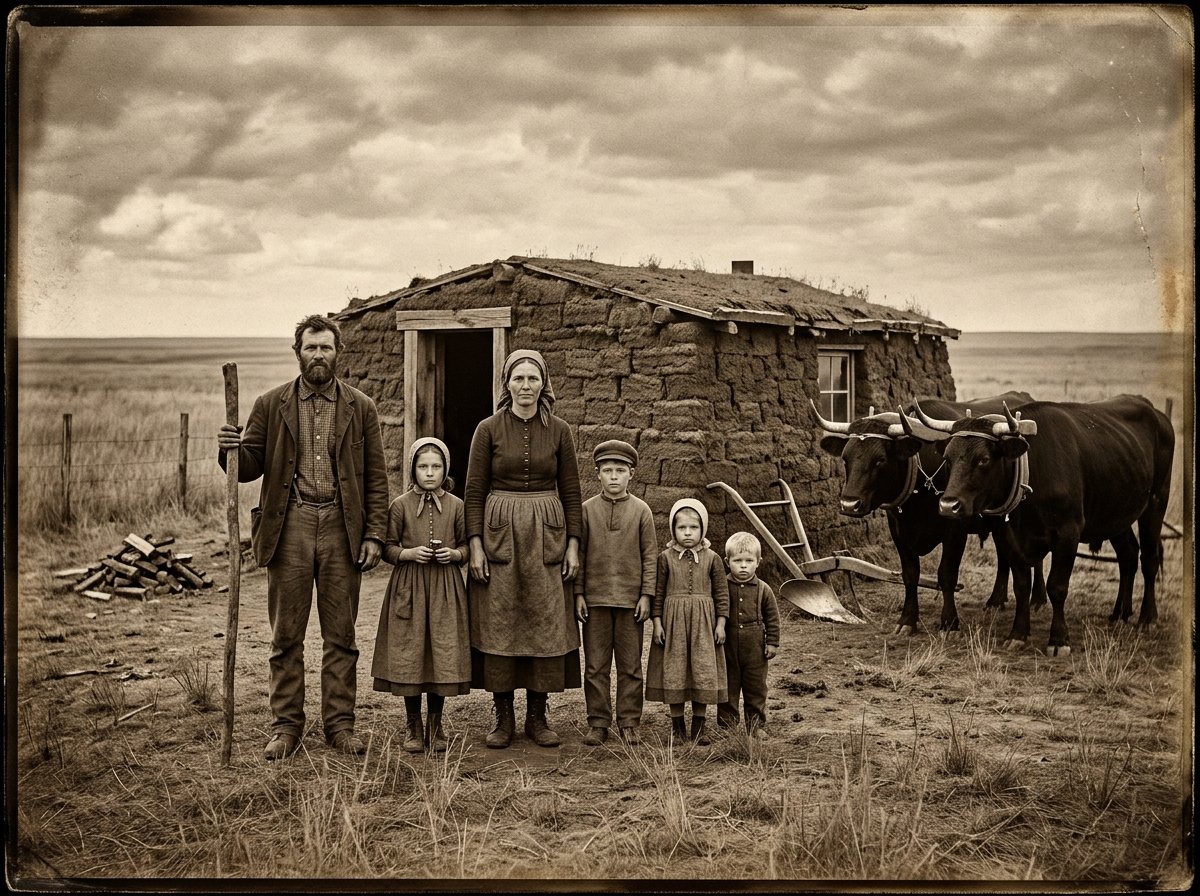
📜 Frontier Fast Facts: The Homestead Act of 1862
Legislative Passage: Signed by President Abraham Lincoln on May 20, 1862 (effective January 1, 1863).
Statutory Terms: Granted 160 acres of surveyed federal public land to any head of household (or citizen over 21) who resided on the claim and cultivated it for 5 years.
Total Scope: Over 270 million acres — roughly 10% of the entire land area of the United States — distributed across 30 states to 1.6 million homesteaders.
The Proving Up Struggle: Fewer than 40% of claimants successfully proved up their final patent due to extreme droughts, blizzards, locust plagues, and financial ruin.
When President Abraham Lincoln affixed his signature to the Homestead Act on May 20, 1862, amidst the cataclysm of the American Civil War, he launched the most consequential social, demographic, and economic experiment in United States history. By transferring hundreds of millions of acres of public domain land directly into the hands of ordinary working families, the federal government fundamentally reshaped the continent, democratic theory, and the Western frontier.
The Long Political War Over Free Soil (1840–1861)
The vision of granting free public land to small, independent farmers had been bitterly contested in Washington for more than two decades. Northern abolitionists and the Free Soil Party championed the policy as a moral imperative, arguing that the frontier should be cultivated by free, self-reliant yeoman farmers.
Conversely, Southern plantation owners and pro-slavery senators adamantly blocked homestead legislation throughout the 1850s. Southern politicians realized that granting 160-acre parcels to small northern emigrants and European immigrants would create a dozen new anti-slavery states across the Great Plains, forever shattering the South’s political balance in the United States Senate.
Only when eleven Southern states seceded from the Union in 1861 did the Republican majority under Lincoln pass the historic statute without opposition. When the act took effect at midnight on January 1, 1863 — the same day the Emancipation Proclamation was signed — Union soldier Daniel Freeman filed the nation’s first official homestead claim near Beatrice, Nebraska.
The Mechanics of a Claim: Proving Up 160 Acres
The statutory process established by the General Land Office appeared deceptively straightforward:
- Filing the Application: Any person who was the head of a family, or twenty-one years old, and a citizen of the United States (or who had filed a declaration of intention to become one), and who had never taken up arms against the U.S. government, could file on 160 acres of surveyed public land for an initial filing fee of ten dollars, plus a two-dollar agent commission.
- The Five-Year Improvement Covenant: The homesteader was legally bound to build a permanent dwelling (traditionally specified as at least twelve by fourteen feet with glass windows), cultivate a portion of the acreage, and reside continuously upon the parcel for five years.
- Final Proof and Patent: After five years, and before the expiration of seven years, the homesteader submitted sworn witness affidavits from two neighbors certifying that improvements had been made, paid an additional six-dollar final fee, and received a permanent land patent signed on behalf of the President of the United States.
Crucially, the Homestead Act did not discriminate by race or gender. Single women, widows, and emancipated African Americans (such as the “Exodusters” who migrated en masse to Kansas in 1879) utilized the law to secure economic autonomy, claiming over a million acres of fertile soil.
The Sodbuster Reality: Dirt, Drought, and Grasshoppers
The romantic vision of verdant family farms clashed violently with the harsh ecological reality of the Great Plains. Stretching from Texas to North Dakota, the plains were virtually treeless. To construct shelter, pioneers became “sodbusters,” using rolling iron plow cutters to carve thick ribbons of prairie sod into heavy turf bricks.
These “soddies” were dark, damp, and frequently infested with mice, fleas, and snakes that dropped from brush ceilings. During heavy rainstorms, roofs leaked muddy water for days after the sun emerged.
Climatic extremes broke hundreds of thousands of settlers. Bitter winter blizzards dropped temperatures to forty degrees below zero, freezing livestock in their tracks. In summer, blistering heat waves and hot prairie winds desiccated corn crops in hours. In the catastrophic summer of 1874, the Rocky Mountain Locust Plague descended upon Nebraska and Kansas in biblical proportions — clouds of grasshoppers so dense they blocked the sun, devouring crops, garden vegetables, harness leather, and the wool right off sheep.
Speculation, Monopolies, and Historical Consequences
While the Homestead Act transferred vast territory to independent farmers, historical land office audits reveal widespread corporate fraud. Transcontinental railroad corporations, timber syndicates, and cattle barons exploited dummy entrymen — hiring cowboys or transient laborers to file claims on waterholes and timber parcels, which were immediately transferred to corporate trusts.
Furthermore, the Homestead Act inevitably accelerated the violent dispossession of Native American nations, who witnessed their treaty lands surveyed, subdivided into square sections, and settled by millions of newcomers.
Despite these profound tragedies and hardships, the Homestead Act proved a monumental catalyst for American development. Over 270 million acres were settled, establishing the United States as the agricultural breadbasket of the world and forging a resilient culture of self-reliance that came to define the American pioneer spirit.
Historical Provenance & Archival Standards
Wild West Stories Historical Research Division • Primary Source Cross-Referenced
This historical monograph is compiled from digitized records preserved at the National Archives and Records Administration (NARA), the Library of Congress Prints and Photographs Division, and Western state historical registries. All dates, geographic coordinates, and legal proceedings have been verified against original 19th-century newspaper archives and territorial government registries.