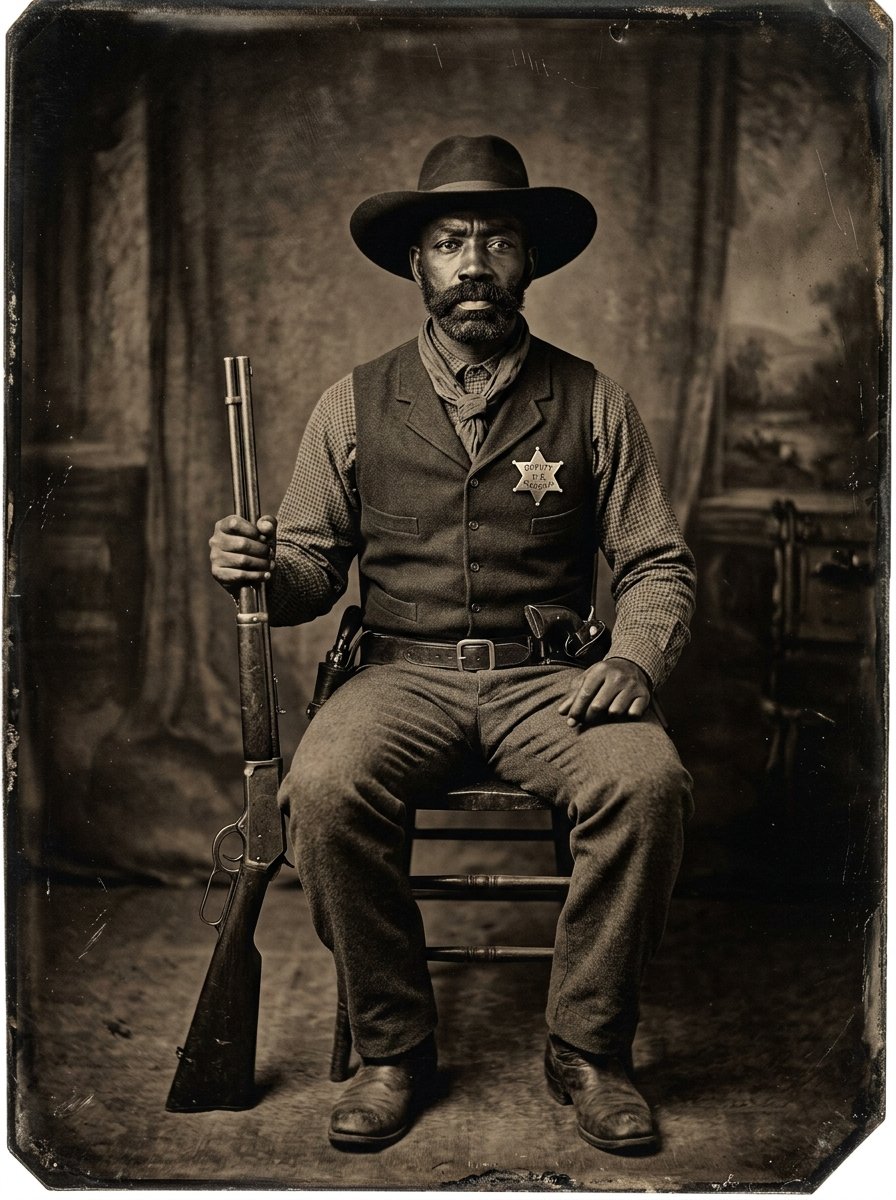
📜 Frontier Fast Facts: Deputy U.S. Marshal Bass Reeves
Service Tenure: 1875 to 1907 (32 continuous years as Deputy U.S. Marshal for the Western District of Arkansas and Indian Territory).
Career Record: Arrested more than 3,000 violent felons, outlaws, and murderers; killed 14 desperados in self-defense; never wounded once despite having his hat and belt shot through.
Jurisdiction: 75,000 square miles of untamed Indian Territory under “Hanging Judge” Isaac C. Parker’s federal court at Fort Smith, Arkansas.
Remarkable Fact: Born into slavery, illiterate his entire life, but possessed photographic memory — having warrants read to him and never serving a warrant on the wrong individual.
Standing six feet two inches tall with broad shoulders, an immaculate gray Stetson, and a meticulously groomed walrus mustache, Deputy U.S. Marshal Bass Reeves was the undisputed terror of badmen across the Indian Territory for more than three decades. While Dime Novels celebrated fictional lawmen and pulp magazines spun embellished tales, Reeves quietly compiled what remains arguably the most astonishing record of law enforcement in the annals of the American West.
From Chattel Slavery to Frontier Scout
Bass Reeves was born into slavery in Crawford County, Arkansas, in July 1838, held in bondage by Arkansas state legislator William Steele Reeves. When the Civil War erupted, William’s son, Confederate Colonel George R. Reeves, brought Bass along as a personal manservant to the front lines. Sometime between 1861 and 1862, an altercation over a card game turned violent. Bass delivered a blow that knocked his owner unconscious and fled into the unmapped wilderness of the Indian Territory (modern Oklahoma).
Living among the Cherokee, Creek (Muscogee), and Seminole nations, Reeves mastered their languages, customs, and tracking methods. He learned to survive on roots, forage in trackless brush, and shoot with ambidextrous mastery. When the Emancipation Proclamation and the 13th Amendment secured his legal freedom in 1865, Reeves emerged from the nations as an expert scout, bought land near Van Buren, Arkansas, and established a prosperous farm with his wife, Nellie Jennie, raising ten children.
Judge Parker and the Western District of Arkansas (1875)
In 1875, federal jurisprudence in the Southwest was revolutionized when President Ulysses S. Grant appointed Judge Isaac C. Parker to the United States District Court for the Western District of Arkansas. Parker’s jurisdiction was immense — covering over 75,000 square miles of Indian Territory. Because the territory was exempt from state law, it had become the sanctuary for thousands of whiskey peddlers, horse thieves, and cold-blooded murderers fleeing Texas, Kansas, and Missouri.
To police this vast badland, Parker ordered U.S. Marshal James F. Fagan to recruit two hundred deputies. Fagan immediately sought out Bass Reeves, appointing him as one of the first African American Deputy U.S. Marshals west of the Mississippi River. Reeves was issued a badge, a federal commission, and a stack of felony warrants.
Tactical Genius: Disguise, Psychology, and Marksmanship
Operating in Indian Territory was extraordinarily perilous; more than one hundred federal deputy marshals were murdered in the line of duty during Parker’s tenure. Reeves survived not merely through deadly marksmanship with his twin .45 Colt revolvers and Winchester rifle, but through brilliant psychological manipulation and disguise.
Unable to read or write, Reeves would have a court clerk or literate friend read him a bundle of warrants before riding out. He memorized each name, charge, and legal description phonetically. In thirty-two years of service, he never arrested the wrong person.
Reeves frequently operated undercover. When hunting the dangerous Brunter brothers in the Red River scrub, he disguised himself as a ragged tramp, walking thirty miles on foot with his boots worn through and bullet holes cut into his slouch hat. He arrived at the outlaws’ mother’s cabin, asking for shelter and claiming to be pursued by a posse. The mother welcomed him, and when her outlaw sons returned that night, Reeves waited until they were asleep, handcuffed both men without firing a shot, and marched them seventy miles to his waiting wagon.
Uncompromising Integrity: The Arrest of His Own Son
Reeves’ devotion to constitutional law was absolute. In 1902, devastating tragedy struck his family when his own son, Bennie Reeves, shot and killed his wife in a jealous rage. Shaken by the crime, other federal deputies hesitated to serve the warrant out of deep personal respect for the elder marshal.
Bass Reeves walked into the Marshal’s office in Muskogee, picked up the warrant for his son, and declared that the law knew no favoritism. Reeves tracked Bennie down, arrested him peacefully, and turned him over to the federal court. Bennie was tried, convicted, and sentenced to life imprisonment at Leavenworth Penitentiary, later receiving a pardon for exemplary conduct after serving over a decade.
The Closing Frontier and Living Legacy
When Oklahoma achieved statehood in November 1907, federal marshals yielded jurisdiction to county sheriffs and municipal police. At age sixty-nine, Reeves retired from federal service and joined the Muskogee Police Department as a regular city patrolman. During his two years on the city beat, not a single crime was reported on his district.
Bass Reeves passed away from Bright’s disease in January 1910, celebrated by both Black and white citizens as a paragon of frontier courage and incorruptible duty. Historians increasingly recognize that his exploits, unmatched marksmanship, gray horse, and trademark silver dollars given to citizens heavily inspired the fictional legend of the Lone Ranger.
Historical Provenance & Archival Standards
Wild West Stories Historical Research Division • Primary Source Cross-Referenced
This historical monograph is compiled from digitized records preserved at the National Archives and Records Administration (NARA), the Library of Congress Prints and Photographs Division, and Western state historical registries. All dates, geographic coordinates, and legal proceedings have been verified against original 19th-century newspaper archives and territorial government registries.