—
The following morning dawned gray and bitter, the valley blanketed in a thick, eerie layer of fog that drifted slowly through the frost-rimed pines. The external threat, however, was not meteorological, but human. Around mid-morning, the sound of heavy wagon wheels crunching through the frozen crust announced the unwelcome arrival of Rutledge and two of his hired enforcers, their horses kicking up dirty sprays of slush as they pulled up directly outside the assay office. Rutledge, a sharp-faced man wearing an expensive beaver-fur coat that clashed absurdly with the rugged frontier landscape, dismounted with deliberate slowness, his boots crunching on the ice. He pushed open the unlatched door of the office without knocking, bringing a blast of freezing air into the warm room. Imogen stood immediately behind the drafting table, her hand resting firmly on the iron strongbox, while Dietrich stepped out from the back room, his hand hovering near the butt of the Remington holstered at his hip. “I’d advise you to take your muddy boots off before you cross that threshold, Rutledge,” Dietrich said, his voice dropping into a low, menacing register that brooked no argument. Rutledge sneered, his thin lips curling into an ugly smile as he looked around the cramped office. “Save your breath, Fontaine. I’m not here for social calls. The county court issued a final writ of execution on these land titles this morning.” He tossed a heavy parchment document onto the drafting table, the official red wax seal catching the pale light filtering through the frost-covered window. “Miss Fontaine’s survey papers have been officially declared fraudulent by the district clerk. By sundown, the sheriff will be here to padlock the doors and seize all property in the name of the Carson Land & Cattle Syndicate.” Imogen stared at the document, her heart skipping a beat before her analytical training took over. She stepped forward, her fingers trembling slightly as she picked up the parchment, running her thumb across the signature block. “This signature isn’t the clerk’s,” she said, her voice unnaturally calm. “And the date stamp is forged.” Rutledge laughed, a sharp, barking sound that lacked any genuine amusement. “Prove it, schoolmarm. The judge is a personal friend of mine, and your word against mine isn’t worth the paper it’s printed on.” Dietrich took a slow step forward, his broad shoulders tensing as he prepared to physically eject the trespasser, but Imogen raised her hand to stop him. She had remembered the central mystery—the peculiar way the original 1856 government benchmark was recorded in the county archives. “You didn’t check the ledger from the original survey of ’56, did you, Rutledge?” she asked quietly, looking him straight in the eye. Rutledge’s sneer faltered for a fraction of a second, a flicker of genuine panic crossing his sharp features before he masked it with a forced grin. “What are you talking about?” “I’m talking about the fact that the original surveyor, a man named Henderson, suffered from a permanent tremor in his right hand,” Imogen said, her voice gaining strength as she laid out the evidence. “Every straight line he drew had a microscopic leftward deviation—a natural signature that no forger in this territory could possibly replicate because they didn’t know it existed.” She unlocked the iron strongbox beneath the table with a small brass key, pulling out the genuine, water-stained field journal that her father had left behind. “Your forged document has straight, mechanical lines drawn with a modern steel pen. Henderson’s original work, recorded right here in this journal, bears the exact tremor marks that match the physical benchmarks still buried in the gorge.” Rutledge took a step backward toward the door, his face draining of color. “You’re bluffing,” he hissed. “The sheriff is already on his way with the eviction squad.” “The sheriff is currently down at the livery investigating why three of your hired men were seen tampering with the public water gauge yesterday afternoon,” Dietrich interjected coldly, stepping between Rutledge and the door. “One of your boys talked when the cold got to him, Rutledge. The whole syndicate is falling apart.” Rutledge glared at them with venomous hatred, realizing that his elaborate fraud had been completely dismantled by a combination of historical records and the keystone skill he had so arrogantly dismissed. “This isn’t over,” Rutledge spat, backing out the door and slamming it shut behind him. Moments later, they heard his horse whip the frozen air as he and his enforcers fled down the road toward town.
—
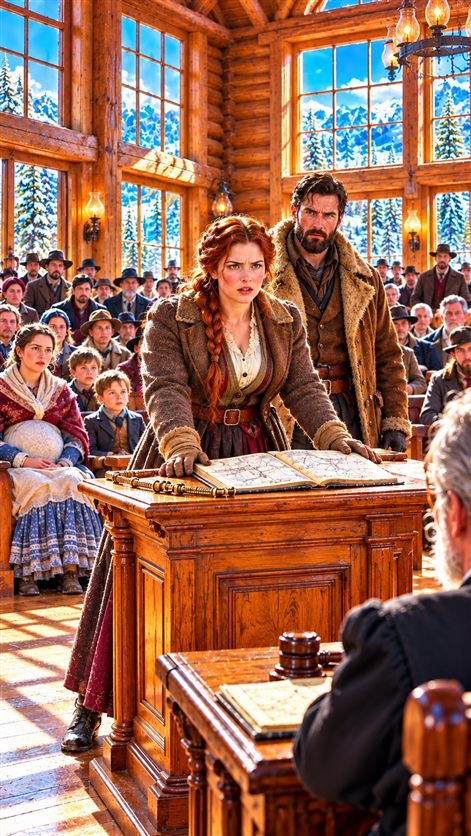
The climax arrived with breathtaking swiftness as the afternoon sun dipped below the jagged silhouette of the western peaks, casting a cold, violet shadow across the valley. The public inquiry and final legal confrontation took place not in a quiet courtroom, but in the crowded, smoke-filled interior of the town hall, where the entire community had gathered in response to the sheriff’s urgent summons. The air inside the hall was thick with the smells of wet wool, pipe tobacco, stale beer, and the nervous sweat of dozens of townspeople packed shoulder-to-shoulder on wooden benches. Imogen stood at the front of the room beside the oak podium, her hands resting calmly on the open pages of Henderson’s original field journal, while Dietrich stood sentinel behind her like an immovable granite cliff. At the back of the room, Rutledge sat flanked by two nervous town councilmen, his face dark with suppressed fury. The circuit judge, an elderly man with thick gray spectacles who had been rushed out from the county seat by the marshal, peered down from the raised platform at the documents spread before him. “Miss Fontaine, you are making a grave accusation against the legally recorded land grants of this county,” the judge said, his voice echoing off the timber rafters. “Can you produce physical, undeniable proof that your father’s survey is genuine and Rutledge’s writ is a fabrication?” Imogen did not flinch under the collective gaze of the hostile townspeople who had shunned her for months. She picked up the surveyor’s brass chain and the iron wedge they had used the night before, holding them up so that the entire room could see the raw, red gashes of steel and stone. “Your Honor, the proof isn’t just in the ink on these pages; it’s buried two feet beneath the limestone floor of the upper gorge at benchmark marker fourteen,” she declared, her voice clear, resonant, and unwavering. “Send a committee of three disinterested men to dig up the marker right now. If the chisel marks on the stone match the leftward tremor of the 1856 survey, my family’s title is legitimate, and Rutledge’s syndicate is guilty of wholesale land fraud.” A murmur rippled through the crowded room as the townspeople began whispering among themselves, casting sideways glances at Rutledge, who sat frozen in his seat, unable to meet the judge’s eye. The judge stroked his white beard thoughtfully, looking from Imogen’s steady gaze to the frightened town councilmen. “Marshal,” the judge commanded, pointing a finger toward the door, “take two deputies and the town blacksmith. Go to the upper gorge and excavate benchmark fourteen. Bring back the stone.” Two agonizing hours passed in total silence within the crowded hall, the ambient frontier chaos—spittoons clanging, boots shuffling on pine sawdust, restless murmurs—dying down to a tense, suffocating hush. Imogen stood motionless beside the podium, her fingers lightly touching Dietrich’s strong, calloused hand where it rested on the edge of the wood. Dietrich leaned down slightly, his lips brushing the shell of her ear. “You did it, Imogen,” he whispered softly. “They can’t bury the truth when you’ve dug it up by the roots.” Finally, the heavy oak doors swung open, and the marshal stepped into the hall, carrying a heavy, frost-encrusted block of gray limestone between two deputies. He hauled it up to the front of the platform and set it down with a heavy thud that rattled the judge’s water pitcher. The judge leaned over his spectacles, shining a lantern directly onto the face of the stone. There, deeply carved into the limestone by hand, was the unmistakable leftward-slanting flourish of Henderson’s 1856 signature, perfectly matching the ink entries in the field journal Imogen had laid open on the table. The judge looked up slowly, his eyes sweeping over the silent, stunned crowd before fixing directly on Rutledge. “The marker is authentic,” the judge announced, his voice ringing through the hall like a gavel blow. “The land titles belong to the Fontaine family. Marshal, arrest Mr. Rutledge and his associates on charges of forgery and conspiracy to defraud.” A collective gasp echoed through the room, instantly followed by a sudden, raucous outburst of shouting and cheering as the townspeople, realizing how they had been manipulated by the greedy syndicate, turned their collective anger toward the disgraced speculators. As the deputies seized Rutledge and dragged him toward the door, the tension that had gripped the community for over a year shattered into the crisp winter air. Dietrich wrapped his strong arms around Imogen, lifting her slightly off her feet as the crowd surged forward to offer their apologies and handshakes, finally welcoming her back into the heart of the community with genuine, earned respect.

Caleb Sterling is an American frontier fiction writer and Old West history researcher based near Sheridan, Wyoming. Dedicated to authentic 19th-century pioneer lore, trail diaries, and homestead sagas, he has penned over 240 serialized tales celebrating the resilience, romance, and untamed spirit of the American frontier.