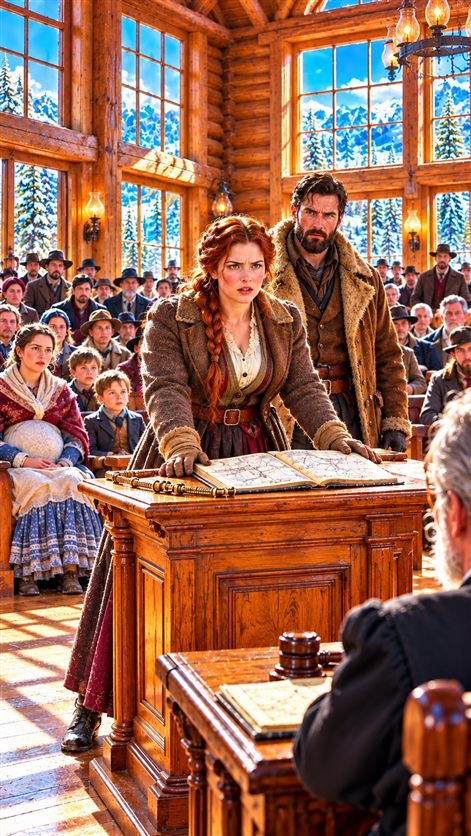
Who kept the water clean when the town council turned their backs on the sick? It was the surveyor’s daughter who traced the old lines through the alkali flats.
The wind rattled the dry cottonwoods along the lower Nevada silver foothills with a hollow, whistling menace that set Imogen Fontaine’s teeth on edge. Exactly four days remained until the county surveyor’s final ruling on the disputed water rights of the upper canyon, a deadline that felt less like a measure of time and more like a noose tightening around her neck. She stood in the damp, freezing shadow of the assay shed, her knuckles raw from scrubbing grease from the brass surveyor’s chain. Every breath plumed white in the thin, sub-zero air, freezing instantly against the woolen scarf wrapped tight across her nose and chin. The winter frost had settled deep into the valley overnight, riming the wagon wheels and turning the mud ruts of the freight road as hard as cast iron. Inside the cramped, uninsulated office, the stovepipe hammered rhythmically against the rafters as the alpine gale pressed down from the crags above, threatening to rip the shake shingles from the ridgepole. Imogen pulled her buckskin gloves higher over her wrists, her eyes fixed on the weathered drafting table where ink bottles sat frozen solid in their wooden stands. She had spent the last two hours chipping away the ice with the tip of a pocket knife, her fingers aching from the bitter chill, determined to finish the resurvey maps before Dietrich returned from his rounds at the lower tailrace. The town of Carson foothills had grown hostile and unforgiving over the past year, whispering behind her back and casting sidelong glances whenever she walked past the mercantile. They called her a ruined woman because of an old scandal engineered by Rutledge and his clique of land speculators, driving a wedge of isolation between her and the community where her family had lived for two decades. Yet Imogen refused to yield to their calculated cruelty, knowing that the title deeds locked inside the iron strongbox beneath the floorboards were the only shield standing between her younger siblings—twins who depended entirely on her quiet strength—and total destitution. She reached for the heavy brass-bound rule, sliding it across the parchment to check the meridian coordinates that had been deliberately altered by unknown hands. “If the baseline is out by even a fraction of an inch,” she whispered into the empty room, her voice hoarse from the dry, freezing draft, “Rutledge steals the entire spring basin.” The heavy oak door swung inward with a sudden, violent crash, letting in a swirl of fine needle-sharp blizzard snow that coated the puncheon floor in white dust. Dietrich Fontaine stood on the threshold, his sheepskin coat crusted with frost, his breath pluming heavily in the lantern light. He slammed the door shut against the howling gale, throwing the iron deadbolt with a resounding thud that rattled the wall-mounted surveyor’s transit. “The northern flume is icing over faster than we can clear it,” Dietrich said, his deep voice carrying a dry, wry edge that masked his exhaustion. He dragged off his heavy leather mittens, slapping them against his thigh to shake loose the frozen slush. “If we don’t clear the intake before midnight, the pressure buildup will blow the entire stone weir.” Imogen turned from her drafting board, her chin lifting defiantly despite the weariness etched deep around her eyes. “The flume can wait twenty minutes, Dietrich; I’ve found a discrepancy in the 1864 survey markers that proves Rutledge forged the original boundary plats.” Dietrich paused, his dark, watchful eyes narrowing as he looked from the frozen ink bottles to the meticulous calculations spread across the table. “You’re chasing ghosts, Imogen; the court won’t look at old paper when Rutledge holds the governor’s seal.” She stepped forward, her heels clicking sharply on the pine boards, refusing to back down from his skeptical gaze. “They will when the paper matches the physical benchmarks still buried under three feet of limestone bedrock in the gorge.”
—
The biting wind outside battered the cabin walls with relentless fury, but within the small shelter, the atmosphere shifted to the slow, steady rhythm of shared survival. Dietrich pulled a heavy oak stool close to the wood-burning stove, dropping several chunks of seasoned juniper into the glowing iron belly until the metal began to radiate a deep, comforting heat. The cabin filled with the sharp, resinous smell of burning pine and the dry dust of old timber. Imogen knelt beside him, uncorking a small tin of mutton tallow to rub into her freezing, cracked knuckles, wincing silently as the oil sank into the raw skin. Dietrich watched her hands with a quiet, deliberate intensity, his own broad, calloused fingers resting on his knees. “Let me see,” he said gruffly, extending a large hand that had been scarred by years of handling heavy mill chains and stone-cutting sledges. Without waiting for her permission, he took her right hand in his, gently smoothing the tallow across her bruised knuckles with a surprising gentleness that contradicted his rough exterior. “You’ve been gripping that brass chain too tight again, Imogen,” he murmured, his voice dropping an octave as the gale shrieked against the eaves. “The land won’t run away just because you loosen your hold for an hour.” Imogen looked down at their joined hands, the contrast striking between his dark, weather-beaten skin and her own paler, chilled flesh. A strange warmth, distinct from the heat of the iron stove, crept up her neck and settled in her cheeks. “If I don’t hold fast, Dietrich, there won’t be any land left to claim by spring,” she replied, her tone softening despite her defensive posture. She pulled her hand away gently, reaching for the heavy wool blanket draped over the spare cot, and folded it around her shoulders to ward off the chill that still crept through the floorboards. Together, they set to work preparing their meager evening meal in the cramped kitchen alcove, moving around each other with the practiced coordination of partners who had learned to share a single confined space without colliding. Dietrich sliced thick slabs of salt-pork on a scarred maple board, the dull thud of the knife keeping time with the howling wind outside, while Imogen kneaded a lump of sourdough in a deep wooden trough, her flour-dusted arms moving with rhythmic grace. “How long do you think the twins can stay hooped up in the loft without driving us both mad?” Dietrich asked, nodding toward the low ceiling where the faint sound of restless footsteps could be heard above. “Another two days of this blizzard and Bobby will have whittled every spare piece of pine into toothpick shavings,” Imogen answered with a dry, wry smile, her fingers working the dough into a smooth, elastic ball. She looked up, catching his eye in the flickering amber light of the tallow candle. “They’re scared, Dietrich. They remember when the sheriff came by last month with the eviction notice.” Dietrich stopped his knife mid-cut, his expression hardening into a dangerous, silent resolve. “Rutledge won’t set foot on this ground while I’ve got two working hands and a loaded Remington by the door,” he said flatly, his voice devoid of bluster. He tossed the pork into the heavy cast-iron skillet, where it sizzled furiously, filling the room with a rich, savory aroma that cut through the stale winter air. They ate in quiet companionship, sitting close together on the wooden bench near the stove, sharing a single tin plate of beans and salt-pork while the storm raged outside. The physical closeness, born of necessity and the bitter sub-zero cold, slowly melted the defensive barriers Imogen had erected over years of public shunning. When Dietrich reached across the rough-hewn table to hand her a tin cup of chicory coffee, his knuckles brushed against hers, lingering for a fraction of a second longer than necessary. Neither of them spoke, but the unspoken understanding between them grew heavier and warmer, anchoring them against the chaos of the howling winter night.
—
The midpoint crisis struck precisely at midnight, when the wind shifted from the north and brought an avalanche of wet, heavy snow that threatened to crush the low-slung stables and bury the water intake. Imogen was the first to wake, jolted from a shallow sleep by the strange, muffled silence that follows a sudden change in barometric pressure. She shook Dietrich awake, her hand firm on his shoulder. “The flume’s gone dry,” she whispered, her eyes wide in the dark. “The ice has dammed the upper gorge.” Within minutes, they were dressed in heavy canvas coats, wool caps, and boots wrapped in burlap for traction, battling their way through the blinding whiteout toward the rocky ravine where the timber flume channeled the mountain spring down to the assay shed. The sub-zero air felt like broken glass in their lungs, freezing their eyelashes together with every blink. Arriving at the stone intake, they found a massive wall of gray ice and frozen timber wedged tight across the narrow gorge, threatening to burst the mortared stone walls. “If this wall goes, the entire spring basin floods and washes out the foundation of the lower claims,” Dietrich shouted over the roar of the pent-up water straining against the ice dam. “We have to break the key log before the pressure shatters the masonry.” This was the moment Imogen’s true keystone skill—her profound, intuitive understanding of structural pressure points and geological hydrology—took center stage. While Dietrich swung a heavy felling axe into the frozen mass, nearly exhausting himself against the unyielding oak, Imogen studied the intricate web of logs and ice with the cold, analytical eye of an experienced engineer. “Stop!” she screamed, grabbing his arm just as he raised the axe for another desperate blow. “You’re hitting the primary load-bearing timber! If you snap that one, the entire northern shelf collapses on top of you!” Dietrich lowered the heavy axe, his chest heaving as he stared at her through the driving snow. “Then what do we do, Imogen? We’ve got five minutes before the stone wall gives way!” “We use the surveyor’s wedge and the iron pry bar,” she commanded, her voice ringing with absolute authority. “There’s a natural fault line in the limestone bedrock beneath the third log. If we drive the steel wedge into the fissure and leverage the weight of the water against itself, the ice will crack along the grain.” Without waiting for his agreement, she scrambled up the slippery, ice-coated boulders, her mittened hands finding secure purchase where Dietrich had only seen a smooth wall of ice. She wedged the heavy iron bar deep into the limestone seam, bracing her boots against a protruding granite shelf. “Dietrich! Give me your weight on the end of the bar—now!” Recognizing her brilliance without a shred of masculine pride, Dietrich threw his entire muscular bulk onto the iron lever alongside her. Together, with a mighty, synchronized heave, they leveraged the immense weight of the freezing water against the bedrock fault. With a sound like a pistol shot echoing off the canyon walls, the massive ice dam fractured clean down the middle. The pent-up torrent roared through the gap, instantly clearing the choked flume and saving the stone weir from total destruction. Panting and soaked with icy spray, they slid down the embankment into the drift below, collapsing against each other in the snow. Dietrich pulled her tightly against his chest, burying his face in her wet wool hood as the adrenaline receded, leaving them shaking with exhaustion and raw emotion. “I swear to God, Imogen,” he muttered hoarsely against her hair, his arms tightening around her with fierce possessiveness, “there isn’t a man in this territory who could have seen that fault line in the dark.” Back inside the cabin, the storm still howled against the glass, but the emotional climate had fundamentally transformed. The twins were still fast asleep in the loft, leaving the main room bathed in the soft, amber glow of the hearth fire. Imogen sat on the edge of her cot, her clothes steaming slightly from the residual heat of the stove, while Dietrich knelt before her to unlace her frozen boots. His calloused fingers were gentle, almost reverent, as he peeled away the stiff leather and wrapped her numb feet in a warm, dry flannel blanket. “You saved the claim tonight, Imogen,” he said quietly, looking up at her with a vulnerability he had never shown before. “And you saved me from my own blind stubbornness.” Imogen reached out, her fingers tangling in the thick, snow-damp waves of his dark hair, pulling him closer until his forehead rested against her knee. “We saved each other, Dietrich,” she whispered, her voice trembling slightly. “For the first time in years, I don’t feel like I’m fighting this town alone.” He looked up, his dark eyes burning with an intense, unspoken devotion, and pressed his lips to her cold knuckles, sealing an unspoken covenant between them in the heart of the winter storm.

Caleb Sterling is an American frontier fiction writer and Old West history researcher based near Sheridan, Wyoming. Dedicated to authentic 19th-century pioneer lore, trail diaries, and homestead sagas, he has penned over 240 serialized tales celebrating the resilience, romance, and untamed spirit of the American frontier.