By late autumn, her family savings were entirely gone, spent on iron wedges and heavy timber supports. When little June asked whether they would have anything sweet for the coming Christmas holiday, Hester promised dried apples and silently prayed the girl would not ask about sugar or butter. That evening, Martin placed his own small collection of smooth river stones beside her larger pile by the hearth. For the part that keeps June warm, he said with solemn determination. Hester waited until both children were fast asleep beneath their blankets before she finally allowed herself to cry, burying her face in her rough apron so the sound would not wake them.
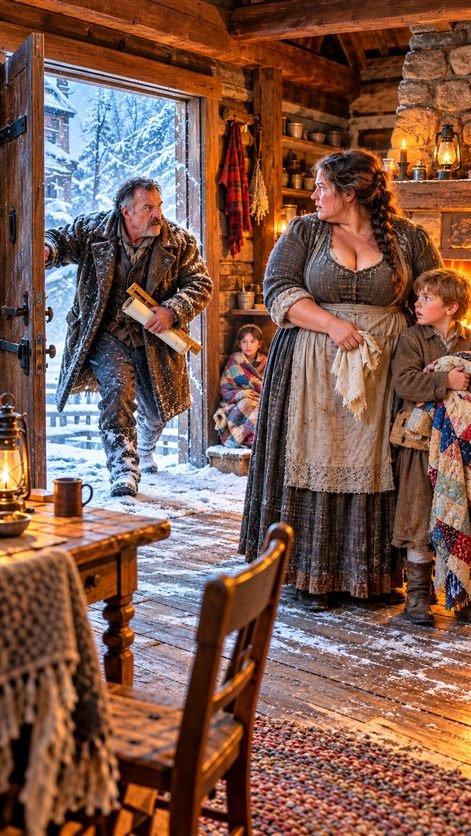
Three days after she completed the final course of stones, a violent north wind swept across the open prairie, bringing a sudden, blinding blizzard that blotted out the horizon. Inside the cabin, the air was still and remarkably temperate. She held her thin strip of wool cloth beside the interior wooden wall, watching anxiously. It hung completely still, untouched by the howling gale outside. Then, someone hammered on the heavy oak door with such sudden urgency that little June dropped her wooden spoon in fright.
The man standing on the threshold was Abel Fenner, the master builder who had personally supervised the construction of the ridge refuge. Snow clung thickly to his heavy wool coat, and a brass folding rule shook violently in his numb fingers. May I measure something, Mrs. Wainwright, please? he blurted out before she could speak. Without waiting for permission, he pushed past her and went straight to the narrow gap between the stone and the timber. He dropped to his knees, pressing a surveyor’s gauge into the void. Once. Twice. Then he slowly stood up, staring at Hester with wide, terrified eyes. Where did you learn these measurements? he demanded, his voice cracking. She glanced anxiously toward her children, who were watching from the corner. Why do you ask, Mr. Fenner?
Abel unfolded a damp, heavily creased construction drawing against the outer stonework of her cabin. Outside, in the swirling snow, heavy wagons were already laboring up the steep incline toward the ridge refuge, carrying terrified families out of the gathering storm. Their walls were changed at the last minute to save time and material, he whispered, his hands trembling as he pointed to a blank space on the blueprint. The thermal expansion buffer shown here in the original design was left out entirely. Hester recognized every single line on that parchment, remembering the long nights spent poring over borrowed engineering pamphlets by candlelight.
Abel pointed a shaking finger to a neat paper nameplate pasted across the bottom right corner of the drawing. I was told this man designed the public refuge, he said, his voice dropping to a hollow murmur. Beneath the lifting corner of that pasted label, another name was beginning to show through the dried glue in the dim light of the cabin. Hester slowly reached out her hand toward the paper, her fingers brushing the rough parchment. It was her husband’s signature, written in his familiar, precise hand, dated three years before the council ever claimed the plans as their own.
Abel stared at the exposed name, then looked from Hester to the thick, unflinching stone wall that surrounded her home. The council bought his designs after he passed, didn’t they, he said, the horrific realization dawning across his weathered face. They took his plans, cut out the critical safety buffers to save money on the public building, and laughed at you for building a replica down here in the valley. Hester did not answer, but the grim set of her jaw confirmed every word. Through the small window, a sudden, deafening roar echoed down from the ridge, a sound like tearing metal and collapsing timber as the high-altitude winds struck the unbuffered stone of the crowded refuge. Abel dropped his rule, turning in horror toward the hill, but Hester only pulled her children closer, listening to the silent, steady air inside the true home her husband had engineered.