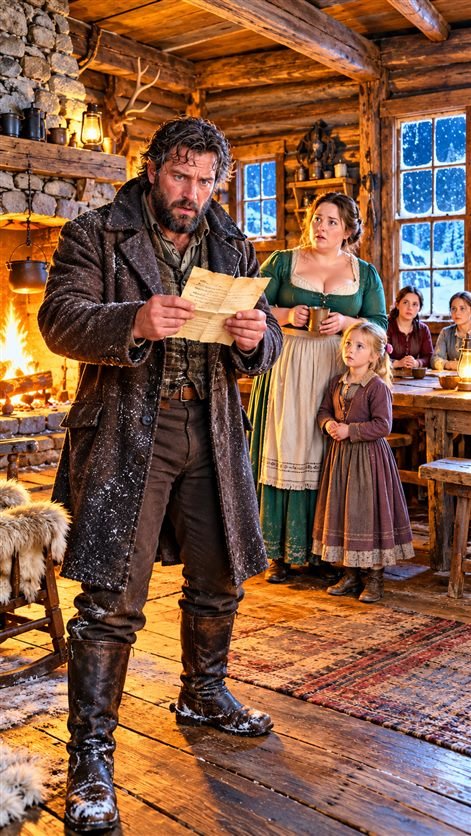
His own name was written across the front in a precise, familiar hand that made his breath catch in his throat. Clara’s face suddenly lost its calm, her eyes widening in alarm. Daisy, she whispered, her voice cracking for the first time. Where did you find that? The girl pointed toward Wade’s late wife’s locked keepsake box, a heavy oak chest that had sat undisturbed in the corner of the master loft for six years. Wade stared at the letter, his mind racing through possibilities that defied logic and reason. He could open it and discover why Clara had really transformed his home, why she had come out west to answer an advertisement from a grieving, bitter man she had never met. Or he could put the divorce papers on the table, sign them in the presence of witnesses, and end everything before learning what his daughters, and his late wife, had apparently been keeping from him. His hand moved toward one of the two papers, hesitating in the cold air between them, and then stopped.
The Weight of the Kept Word
The fire hissed again, throwing long, distorted shadows across the plank walls of the cabin. Wade’s fingers hovered over the edge of the legal document, the paper rough under his calloused thumb. He looked from Clara’s pale face down to the small, ink-stained fingers of his daughter Daisy, who was still clutching the mysterious letter like a shield. The weight of the past six months pressed down on him, not as a relief, but as a dense, suffocating fog. He had ridden up into the mountains to escape the memories that haunted the timberline, believing that distance and time would dull the ache of a house that felt hollowed out by grief. Instead, he had returned to find a ghost of a different kind—a living, breathing household that operated without his permission, guided by a woman he had hired through a matrimonial agency in Chicago with nothing more than a signed name and a bank draft.
You had no business opening that box, Wade said, his voice dangerously quiet, though the anger in it lacked its usual sharp edge. It was unlocked, Nora piped up defensively, her small chin jutting out in an imitation of her father’s stubbornness. Mama said things kept locked away only grow moldy in the dark. Clara did not look at the children. She kept her eyes fixed on Wade’s face, searching for the man she had married by proxy six months ago, the man whose letters had been sparse, transactional, and devoid of any warmth. She had come west on a promise of a partnership, finding instead an empty ranch and three feral children whose mother had died leaving behind a legacy of silence and fear.
Wade stepped forward, his heavy boots echoing on the floorboards, and reached out to take the paper from Daisy’s hand. The child flinched instinctively, but Clara placed a gentle hand over hers, holding her steady. Wade pulled the folded sheet free. The ink was faded, written with the fountain pen his first wife, Martha, had treasured before the lung fever took her in the second winter of the homestead. He unfolded it slowly, his eyes scanning the familiar, sloping handwriting that he had not seen since the day they buried her.
My dearest Wade, if you are reading this, it means the stranger from the East has arrived, and you have finally opened the box you swore never to touch. The words hit him like a physical blow, driving the air from his lungs. He stumbled back a half-step, his hand gripping the edge of the pine table to steady himself. Clara watched him, her lips parted in a silent breath of anticipation. She had not read the letter; the look of shock on her own face proved that she had been as ignorant of its contents as Wade himself had been until this very second.
The letter continued, the ink trembling slightly as if Martha’s hand had been shaking when she set it to paper during her final, feverish weeks. You needed a wife who could break the ice around your heart, Wade, because I could not do it while I was alive. I was too broken by the wind and the isolation, and I let you become as cold as the mountains. I wrote to the agency myself before I took to my bed for the last time. I found Clara’s name among the registries, and I sent her the money from the secret tin under the floorboards. She knows everything about you. She knows about the girls, about your pride, and about the way you hide behind your silence like a fortress.
Wade’s vision blurred, the kitchen lights swimming in the haze of the flickering hearth. Clara was staring at him now, her eyes wide with a sudden, dawning comprehension that seemed to answer questions she had been carrying since the day she stepped off the stagecoach in Helena. She wasn’t just a mail-order bride answering an advertisement in a newspaper column; she was an instrument of the dead, selected and paid for by a woman who knew her husband better than he knew himself.
The silence in the room became absolute, heavier than the snow piling up against the windowpanes outside. The triplets sat motionless, sensing the monumental shift in the air, their small faces turned toward their father with a mixture of apprehension and hope. Wade looked down at the letter again, his thumb tracing the signature at the bottom, where Martha had written your loving wife, now and always.
You knew, Wade whispered, his voice cracking as he looked across the table at Clara. You knew before you ever signed the marriage contract. Clara slowly shook her head, the chestnut strands of her practical knot catching the amber light. I knew nothing of a letter, Wade. When the agency matched us, they only told me there was a rancher in Montana needing a mother for his children and a partner who wouldn’t break under the winter. But she sent me a trunk three weeks before I left Chicago. Inside was the green dress, the recipe for the bread my grandmother used to make, and a note with your address and a single instruction. Clara paused, swallowing hard. She told me to make a home where the children could laugh without looking over their shoulders, and to wait until you had the courage to come back and see what you had been running from.
Wade stood frozen, the divorce papers still clutched in his left hand while the letter from his dead wife rested in his right. The distance between the two pieces of paper felt like the distance between his old life and the terrifying, vibrant reality of the cabin around him. He looked at the handmade stockings, the paper stars, the dried apple decorations on the small pine tree, and finally at June, who was watching him with a quiet, steady gaze that held no trace of fear.
The tension that had defined Blackwood Ridge for six years did not break with a shout or a dramatic gesture. It dissolved in the quiet warmth of the kitchen, beneath the smell of cinnamon and baking bread, as Wade slowly lowered his hand and let the divorce papers slip from his fingers to drift unheeded onto the floorboards. Clara did not move to pick them up. She simply reached out and poured another cup of hot cider, setting it quietly beside his plate as the wind continued to howl harmlessly against the thick timber walls outside.