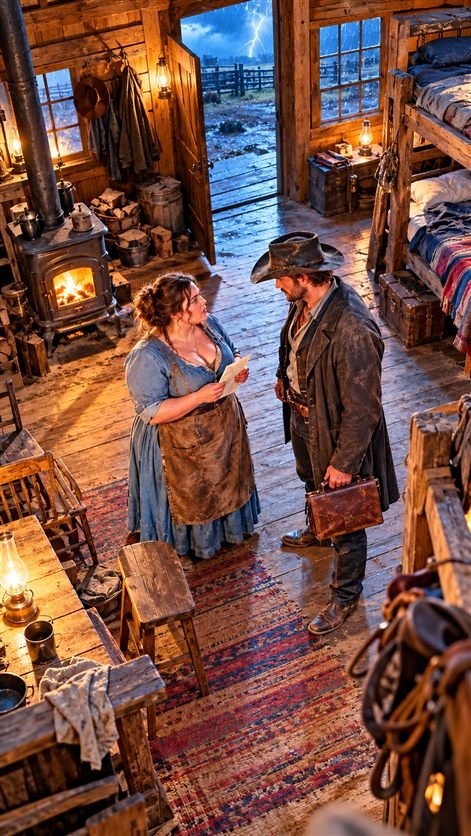
Silas Crowe wanted twelve hundred acres of dry Texas grassland, and he was willing to pay a fortune to get it. Mara Bennett stood in her kitchen doorway, watching the dust kick up from the dirt road, her fingers trembling against the splintered wood as she realized the man would never stop until he owned the entire valley.
Three weeks after burying her husband, Mara Bennett received an offer for her ranch that should have made no sense. Silas Crowe wanted twelve hundred acres of dry Texas grassland, and he was willing to pay twice what it was worth. Mara refused. Two days later, he doubled the offer again. That was when she stopped thinking he wanted the land. He wanted something beneath it. Her husband, Thomas, had spent his final months guarding a secret he refused to explain, burning papers in the woodstove late into the night while muttering about rights and surveyors and a drought that was going to choke the county dry. Then the county clerk appeared at Mara’s kitchen door after sunset. He carried an old survey map, yellowed at the edges and smelling faintly of tobacco and damp basements.
Your spring doesn’t end at your pasture, he whispered, looking nervously over his shoulder into the darkness before stepping past her into the warm glow of the oil lamp.
His finger traced a faded blue line through the valley, cutting a diagonal slash across the topography. The underground water crossed Crowe’s property and continued toward several struggling ranches beyond it, feeding a hidden aquifer that sustained half the livestock for twenty miles in every direction. Whoever legally controlled the Bennett water rights could influence the future of the entire South Range, turning independent ranchers into indebted tenants overnight. Mara finally understood why Crowe would not leave her alone, why he circled her fence lines like a vulture waiting for a carcass to cool. But she had another problem entirely.
Crowe’s foreman, Wade Mercer, had begun appearing near her fences with survey crews and paperwork Mara had never authorized, hammering wooden stakes into her grandmother’s pasture with casual arrogance. Even Sheriff Talbot, once one of Thomas’s closest friends, suddenly stopped visiting, finding excuses whenever she rode into town, refusing to look her in the eye when she asked about the county tax records. Mara was alone, surrounded by men who had wealth, influence, and the quiet backing of the local authorities.
So the next morning, she rode into town looking for help, her boots heavy in the stirrups, her spine stiff against the growing dread. The wooden boardwalks of Red Hollow were quiet, the horses tied outside the mercantile drooping in the heavy heat, their tails swatting lazily at flies. The storekeeper pointed toward the livery yard with a thumb stained blue from ink.
A stranger was repairing a damaged saddle beneath the shade of the corrugated tin roof. His name was Elias Rourke. His coat was weathered, his boots dusty, and he carried almost nothing except a bedroll and a small leather case that looked as though it had seen decades of hard travel. He had arrived four days earlier on a limping bay horse that he had stabled in the corner stall. He asked no questions about anyone, spent his evenings in silence on the bench outside the saloon, and nobody seemed to know where he had come from or what business brought him to a dying cattle town on the edge of the badlands.
I need someone to watch my ranch, Mara said, stepping into the cool gloom of the livery, the smell of leather and horse sweat thick in the air.
Elias studied her for several seconds, his eyes dark and unreadable under the brim of a battered felt hat. From thieves, he asked, his voice low and raspy.
From men who prefer paperwork, she replied.
That finally caught his attention. A faint flicker of amusement touched the corners of his mouth, though his eyes remained watchful and sharp. Mara told him about Crowe, pouring out the details of the escalating offers, the mysterious surveyors trampling her clover, the underground spring that everyone seemed to know about except her, and the county documents someone seemed determined to change while the ink was still drying.
I can pay eighteen dollars a month, she admitted, her pride stinging slightly at the smallness of the sum. You’ll have a room in the bunkhouse and whatever meals I can manage.
Elias closed his leather case with a sharp click. That’s enough.
Mara blinked, taken aback by the lack of hesitation. You haven’t even seen the ranch.
I’ve heard enough, he said, standing up and dusting off his knees.
That answer should have frightened her, coming from a man whose past was entirely unknown, a drifter picked at random from the dirt of a frontier town. Instead, it made her hire him, a desperate gamble driven by the absolute lack of any other option. Before sunset, Elias had walked every fence line, checked the irrigation channels, examined the barn doors, and studied the ridge overlooking the house with the practiced eye of a man who understood angles of approach and lines of fire. Then he stopped beside an old cottonwood near the lower creek. Something had been carved into the bark. Three short marks, clean and deliberate, cutting through the rough grey skin. Elias’s expression changed, his jaw tightening into a hard line.
Someone has been studying this place, he said, running his thumb over the scars in the wood.
Mercer’s men, Mara asked, her hand resting instinctively on the handle of her riding crop.
No.
Then who, she demanded, her frustration finally bubbling to the surface.
He looked toward the distant ridge where the shadows were lengthening across the valley. Someone who knows exactly which records matter, someone who has been inside the clerk’s office after hours, looking for the same thing we are.
The following days became stranger, shifting from a simple property dispute into something far more complicated and insidious. Elias found altered boundary stakes hidden beneath tall weeds along the northern pasture, moved fifty yards inward to slice a clean acre off the Bennett land grant. A page was missing from Thomas’s ranch ledger, torn out with a razor blade so cleanly that the glue on the spine was still exposed. And inside an abandoned line shack five miles out in the scrub, he discovered a scrap of county stationery bearing an official seal, dropped in the corner beneath a pile of empty whiskey bottles. Someone inside the government was helping Crowe, feeding him intelligence and forging documents before the true owners even knew their titles were under threat.