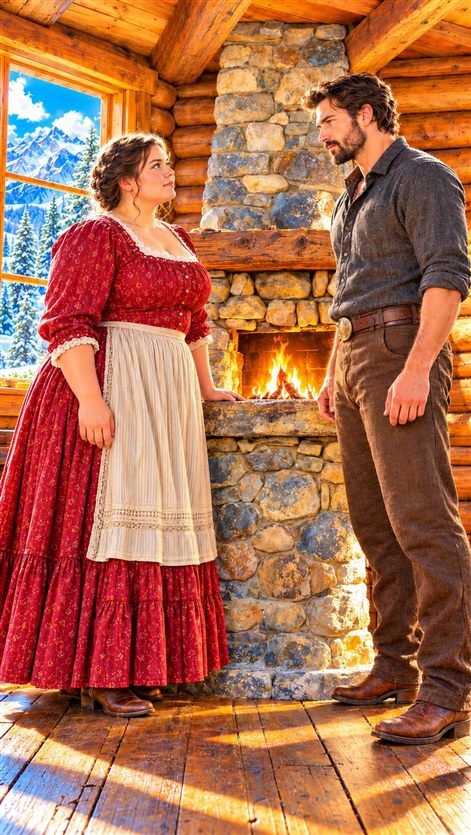
She looked at him, remembering the sound of her father’s voice telling her she was only good for decorative parlor tricks she was too heavy to pull off. Cora didn’t say a word. She pulled her heavy wool shawl over her head, jammed her hands into thick leather mittens, and marched out into the blinding storm.
Wyatt cursed and hurried after her, but by the time he reached the lower bend of the trail, Cora had already hauled herself through the sucking mud to the abandoned wagon. Without hesitating, she heaved a fifty-pound sack of flour over her broad shoulder, wedged a second heavy bag beneath her arm, and turned back uphill toward the cabin.
The mud dragged at her boots with every step, sucking her down into the freezing mire. The sleet lashed at her face like wire, and the dead weight of the hundred pounds of grain pulled cruelly against her collarbones and lower back, threatening to snap her spine. Her muscles screamed in white-hot agony, and every breath tasted of iron and cold panic.
Halfway up the ridge, half-blinded by the sleet, she found Wyatt resting against a massive granite boulder, waiting to intercept her. He stared in absolute disbelief as she trudged past him through the knee-deep sludge, both sacks balanced securely across her shoulders, her breath pluming heavily into the freezing air.
Cora did not stop. She did not ask for help. She kept her eyes fixed on the gray roof of the cabin looming through the storm, her teeth gritted so hard her jaw ached.
By the time they finally reached the warmth of the cabin hours later, her arms were trembling violently, and the damp chill had settled deep into her bones. They stood by the hearth in silence, stripping off their caked, frozen boots as the fire hissed and spat. The tension in the room was thick, charged with the unspoken ghosts of her past, until the confession slipped past her lips before she could stop it.
“My father called me a burden,” she whispered into the firelight, her voice cracking with the sudden, overwhelming weight of twenty-four years of accumulated grief.
Wyatt stopped scraping the mud from the heel of his boot. He looked up, his weathered face shadowed by the flickering orange flames.
“Only weak men complain about the weight of a thing,” Wyatt said, his voice dropping an octave, steady and absolute as the mountain itself.
He glanced up from the floorboards, holding her gaze with an intensity that made her breath hitch. “A strong man builds a better wagon.”
For the first time in her life, Cora did not feel like a mistake to be corrected. She spent the remaining weeks of spring learning the rhythm of the mountain, hauling timber, splitting pine logs with heavy, swinging strokes that rattled the rafters, and sharing silent, companionable meals by the fire. Wyatt rarely spoke, but his presence was a constant, solid architecture in a world that had always felt precarious and cruel. He watched her work with a quiet, appraising respect, never flinching from her size, never offering false pity. In the isolation of the high country, Cora finally learned how to inhabit her own skin without apology.
The summer brought an unexpected visitor to the timberline—a traveling sheriff’s deputy from St. Louis, tracking old warrants and checking identities across the western territories.
The deputy hammered on the cabin door late one afternoon while Wyatt was out checking the higher traps. Cora unlatched the heavy oak door, her brow furrowed in suspicion at the sight of the badge pinned to the stranger’s wool vest.
“Cora Hayes?” the deputy asked, consulting a damp, folded handbill. “Or should I say, Elizabeth Vance?”
Cora’s stomach dropped into a bottomless abyss. The name tasted like ash in her mouth. She backed away from the threshold, her hands clenching into fists at her sides.
“I don’t know any Elizabeth Vance,” Cora said, her voice dropping into a dangerous register.
The deputy stepped past her uninvited, holding the handbill up to the fading light of the window. The paper bore a crude charcoal sketch of a young woman with a strong jaw and heavy shoulders, wanted for questioning in connection with the sudden, violent death of a wealthy St. Louis merchant who had left his entire estate to an estranged, heavy-boned daughter.
“Don’t play games with me, Miss Vance,” the deputy said, a thin, triumphant smile spreading across his face. “Your father didn’t die of a sudden heart failure last winter like the local coroner first supposed. The apothecary found heavy traces of arsenic in his evening porridge—slowly administered over the course of three months, just enough to mimic a lingering illness. The family said you were strong enough to lift a hundred-pound sack of grain without blinking an eye. Said you had the steady hands of someone who could grind poison into flour day after day without breaking a sweat.”
Cora stared at him, her breath hitching in her throat as the cold reality of the cabin closed in around her. The deputy pulled a pair of heavy iron handcuffs from his belt, stepping forward to bridge the distance between them.
“You figured no one in Wyoming would look twice at a mail-order bride sent off by a desperate family,” the deputy sneered, lunging forward to grab her wrist. “Pack your things. We’re heading down the mountain tonight.”
Before the cold iron could snap around her wrist, the cabin door swung open with a resounding crash.
Wyatt stood in the frame, blotting out the fading twilight. His face was entirely devoid of expression, but his eyes were as cold and flat as glacial ice. In his right hand, he held a heavy, blood-stained hunting knife, and over his broad shoulder he carried the freshly skinned carcass of a massive mountain wolf.
The deputy whirled around, his hand instinctively dropping toward the pistol at his hip. “Stay out of this, Harper. This is a matter of the law. She’s wanted for murder in St. Louis.”
Wyatt didn’t blink. He dropped the heavy wolf carcass onto the floorboards with a dull, wet thud that shook the dust from the rafters. Slowly, deliberately, he wiped his crimson hands on a rag tucked into his belt, never taking his eyes off the terrified lawman.
“Murder?” Wyatt’s voice was dangerously quiet, cutting through the silence of the cabin like a drawn blade. He stepped forward, closing the distance between himself and the deputy until the smaller man was forced to take a hesitant step back. “You think a woman who can haul two sacks of flour through a freezing mountain blizzard needs poison to settle a score?”
The deputy swallowed hard, his hand trembling slightly against the butt of his revolver. “The handbill says—”
“The handbill is wrong,” Wyatt interrupted, his voice dropping into a low, terrifying rumble. He reached down, picking up the heavy oak mallet he had used to fix the bed months ago, weighing the dense iron head in his palm with casual, terrifying precision. “She didn’t poison him. She didn’t have to.”
Cora froze, her breath catching in her throat as she stared at Wyatt’s broad back. A sudden, terrifying chill washed over her, far colder than any winter wind that had ever swept down from the crags.
Wyatt turned his head slightly, casting a single, dark glance back toward her—not with the look of a protector, but with the chilling, calculating gaze of a man who had inspected every inch of her frame from the very first moment she stepped off the stagecoach, measuring her raw strength, her silent endurance, and her capacity to break a heavy pine frame without a sound.
“After all,” Wyatt whispered, his lips curling into a slow, grim smile as he raised the heavy mallet and stepped toward the trembling deputy, “some things are just built too heavy to break any other way.”