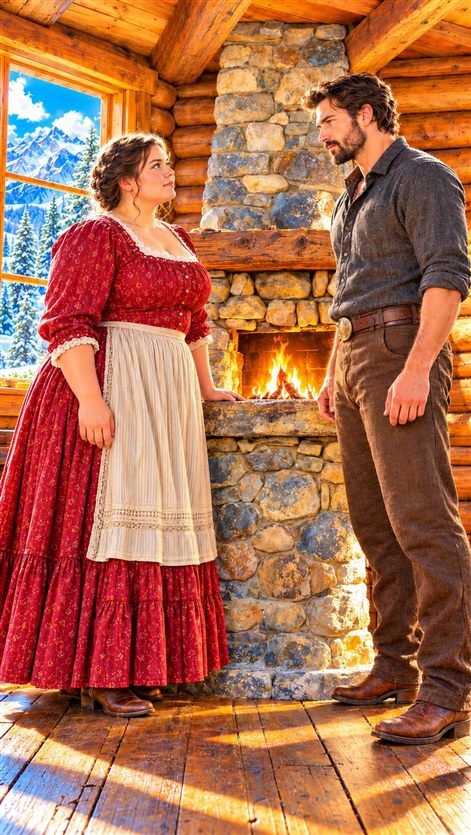
The pine frame splintered beneath Cora Hayes with the sharp, definitive crack of a falling limb, and she braced herself for the inevitable blow of cruelty she had spent twenty-four years learning how to endure. She held her breath in the suffocating darkness of the mountain cabin, waiting for the familiar sneer, the heavy exhale of disgust, the casual insult that had followed her through every room she had ever occupied. Instead, the reclusive mountain man knelt beside the ruins of the bed and quietly uttered two words that unmoored her entirely: “My mistake.”
For twenty-four years, Cora had lived as a living reproach in her own home. Her father, a man who measured human worth with the cold precision of a merchant weighing pork, never once looked at her without calculating her depreciation. He called her sturdy with a tone that implied she belonged in a pasture rather than a parlor, a heavy-boned draft horse of a girl who consumed more than she was ever likely to return in value. When the letters from St. Louis society men dried up completely, her father had surveyed her bulk with a mixture of financial panic and profound relief, deciding that the western territories were the only place where a woman of her unyielding proportions might be quietly disposed of.
When she answered an anonymous advertisement for a mail-order bride posted by a solitary logger in the Wyoming foothills, her family acted with unseemly haste. They pinned a scrap of yellowed, inexpensive lace into her unmanageable hair, stuffed her few modest dresses into a coarse burlap sack, and bundled her onto the morning stagecoach before she could change her mind. They did not weep at her departure; they simply watched the wheels turn through the dust, eager to be rid of the permanent eyesore sitting at the end of their dining table.
The stagecoach had deposited her at the edge of the timberline three days ago, shaking and stiff with cold. Wyatt Harper had been waiting by the livery, a lean, weathered figure whose eyes took in the raw altitude of the mountain and the heavy line of her jaw with equal measure.
When she stepped down from the iron-shod step, her heavy boots sinking into the grit, Wyatt had stared.
“You’re bigger than the picture,” he said, his voice flat and devoid of inflection.
Cora lifted her chin, the muscle along her jaw tightening into a familiar defensive ridge. “I am.” She met his unblinking gaze head-on. “If you want the driver to wait, he can. I can pay my own way back.”
Wyatt had held her gaze for a long, ticking second, weighing her words against the raw wind sweeping down from the crags. Then, without a word, he reached out, hoisted her burlap sack over his shoulder, and turned toward the trail. “I didn’t order a painting to hang on the wall.”
The climb to his cabin was a brutal three-mile ascent through jagged rocks and freezing mud that threatened to drag the boots right off her feet. Wyatt walked at a punishing pace, expecting her to lag, to whine, to beg for a respite that never came. Cora did not ask once for him to slow down. Her lungs burned with the thin, freezing air, and sweat soaked through the wool of her dress, but she matched him stride for stride, her jaw set against the burning ache in her calves.
By the time they reached the low-slung cabin clinging to the side of the mountain like a swallow’s nest, the sun had dropped behind the ridge, plunging the valley into deep purple shadows. Without waiting for an invitation, Cora dropped her coat, seized a dry rag, and set to work. She spent the next three hours scrubbing years of accumulated grease and soot from his iron stove, baking a heavy pan of corn bread, and boiling a pot of beans with salted pork. She moved with a silent, relentless efficiency born of a lifetime of trying to make herself useful enough to tolerate.
Only when the dishes were put away and the cabin had grown deathly still did she lower her exhausted, aching body onto the narrow pine bed in the corner.
The wood shrieked. Then came the violent CRACK.
Cora froze, paralyzed in the dark. The silence of the mountain rushed in around her. She knew the exact cadence of what came next, because she had heard it in St. Louis when she broke a chair at her cousin’s wedding, and in the dry-goods store when her weight proved too much for the old pine stool. People looked at her not with anger, but with an offended disbelief, as if her very mass were an affront to architecture and good taste.
Footsteps fell heavily across the floorboards. Wyatt appeared in the doorway, a kerosene lamp held high, casting long, accusing shadows across his narrow face.
Cora stared up from the wreckage of the slats, her throat tightening with a hot, bitter shame. She waited for him to spit on the floor. She waited for him to call her clumsy, or fat, or useless.
Wyatt looked down at the splintered pine. Then, without a single word of reproach, he turned on his heel and walked out the door into the freezing night.
Cora sat perfectly still in the wreckage, her heart hammering against her ribs. She was certain he had gone somewhere private to laugh, to compose the letter that would send her packing back to the father who despised her. She wrapped her arms tightly around her waist, bracing herself for the humiliation of being cast out before her first week had even begun.
Minutes later, heavy boots crunched on the frost outside. Wyatt re-entered the cabin carrying a thick, unhewed block of seasoned oak and a heavy iron-headed mallet.
“Stand up,” he commanded quietly.
She scrambled off the ruined bed, her cheeks burning with an agonizing heat. She kept her eyes fixed on the floorboards, waiting for the inevitable eviction notice.
Instead, Wyatt knelt on the rough planks. He did not mutter under his breath. He did not heave a dramatic sigh. Methodically, he hammered out the remaining pine fragments, wedged the dense block of oak into the frame as a heavy-duty support beam, and drove three thick iron spikes through the joints. When he was finished, he tested the mattress with both massive hands, pressing down hard, and then frowned—not at Cora, but at the shoddy workmanship of the bed he had built with his own two hands before she arrived.
“Pine’s too soft for this room,” Wyatt muttered, his voice rough with concentration. “Should’ve used oak to begin with.”
He looked up, meeting her bewildered eyes through the dim lamplight. “My mistake.”
Cora’s breath caught in her throat. She stood motionless in the center of the cabin, the words echoing in her ears like a foreign language. No one in her twenty-four years of life had ever looked at something that broke beneath her and blamed the thing that failed. They had always looked at her, as if her existence were a structural flaw in the world.
Spring arrived on the mountain not with flowers, but with a suffocating thaw that turned the lower trails into a treacherous soup of mud and shale. It was a season of isolation, where the melting snow cut off the valley from the rest of the territory, testing the endurance of every soul clinging to the timberline.
The true test came on a raw Tuesday in April. A heavily laden supply wagon broke an axle half a mile below the ridge, spilling its cargo just as a freezing spring sleet began to slash across the timberline. Sacks of flour and salt sat exposed in the freezing muck, and the wagon driver was already cursing his luck and turning his team back toward the lowlands before the trail washed out entirely.
Wyatt returned to the cabin soaked to the bone, slamming the door against the howling wind. He warned Cora that the climb down was lethal, that the mud was deep enough to trap a horse, and that the sacks were far too heavy for a woman to manage in the sleet.