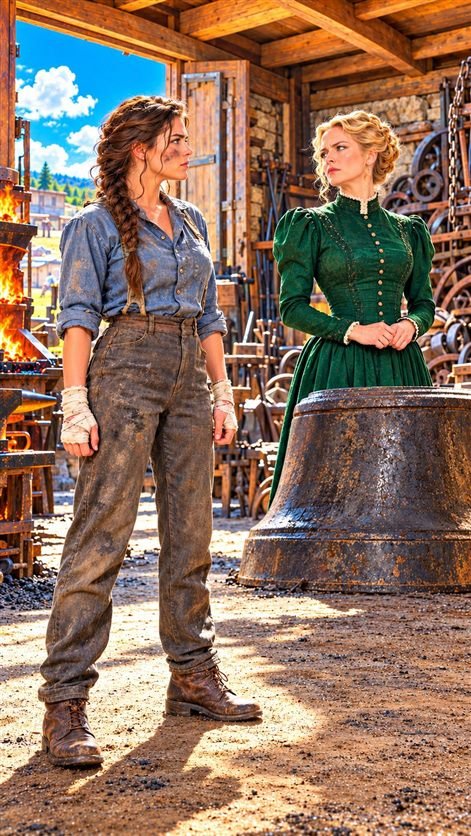
The splintered wood of the bedroll hit the dust with a dry, accusatory thud, kicking up a spray of manure-scented dirt that settled onto the children’s worn-out shoes. Margaret Calloway planted her boots wide, her face hardened into the cruel mask of a woman who had never known hunger or heartbreak, and pointed a manicured finger straight at thirteen-year-old Luke. He stays behind to pay for every scrap of meat and flour his good-for-nothing family consumed since his father died, she announced, her voice slicing through the desolate ranch yard like a butcher’s cleaver. Sarah Bennett felt the cold iron grip of nausea twist her stomach, the shock waves of the demand vibrating through her chest just as violently as the runaway freight wagon had crushed her husband, Jacob, eight months ago.
In the eight agonizing months since the accident, Sarah had poured her life into this isolated stretch of prairie. She had cared for her bedridden, sharp-tongued mother-in-law until the old woman finally expired, cooked three heavy meals a day for a dozen ungrateful ranch hands, mended rotting leather saddles, branded bawling calves in the scorching heat, and balanced the ranch ledgers down to the last penny, all without seeing a single copper coin for her labor. Every hour, every drop of sweat, and every blistered finger had been meticulously recorded inside a thick, cracked leather ledger kept on the mahogany desk in the ranch office. When Sarah instinctively reached for it, her fingers hovering over the familiar spine, Margaret snatched the book away with a vicious jerk.
“That stays here too,” Margaret snarled, clutching the volume to her flat chest. “The ranch books belong to this family, not to vagrants.”
“I am your brother’s widow,” Sarah whispered, her voice trembling not with fear, but with the white-hot fury of a mother pushed past her absolute limit.
“Were,” Margaret spat back, her eyes narrow and dismissive. “Now you are just another mouth to feed, and I am cutting the fat.”
Thirteen-year-old Luke instinctively stepped in front of his mother, spreading his arms to shield his little sisters, nine-year-old Emily and five-year-old Grace. Margaret looked the boy up and down with the clinical detachment of a livestock auctioneer evaluating a fresh colt. Leave him here for three years, she decreed, her tone final. His work will settle your family’s debt. Sarah never raised her voice, maintaining a terrifying, icy composure that made even the hardened ranch hands look away. My son may grow up wearing worn-out boots and tattered shirts, she said, her eyes locked on her sister-in-law, but he will not spend his childhood paying a debt invented by greedy adults. Margaret didn’t hesitate; she ordered them off the property before the high noon sun reached its zenith, her hostility radiating off her like heat waves.
Standing a few yards away near the corral fence, Harold Calloway, Margaret’s spineless husband, kept his wide-brimmed felt hat pulled low over his eyes. He knew the cruelty of what was happening—he knew every entry in that ledger bore Sarah’s handwriting, and he knew Jacob would have risen from the grave to stop it—but lifelong fear of his domineering wife had completely stolen every word from his mouth. With no allies left, Sarah gathered what little they possessed: two meager changes of clothes for each child, her late husband’s worn leather-bound Bible, an old wooden soup spoon with a blackened handle, and little Emily’s threadbare rag doll.
Before Sarah could stand, Margaret lunged forward, ripping the rag doll straight from the little girl’s hands and tossing it onto the dust heap. “That was made with fabric from my house,” Margaret hissed. Emily lowered her head, tears spilling down her cheeks in absolute silence, and blindly followed her mother toward the dusty gravel road. The youngest, little Grace, was burning alive with a sudden, violent fever, her skin flushed crimson and her breathing shallow and ragged. Sarah wrapped the delirious child tightly in a scratchy woolen shawl, hoisting her onto her hip, and walked away from the only home her children had ever known, banished into the vast, unforgiving prairie with nowhere left to run.
They walked for hours until the blazing afternoon sun turned the endless prairie into a shimmering sea of blinding heat and shimmering dust. Luke secretly unbuttoned his shirt pocket, sliding the last piece of salted beef jerky into Emily’s hand while pretending to clutch his own stomach in agony, insisting he had a bellyache so no one would force him to eat a single bite. That night, with the temperature dropping sharply beneath the vast, indifferent stars, they huddled for warmth beneath the splintered wooden porch of an abandoned country church, listening to the howling wind and Grace’s terrifyingly congested cough. By the time pale morning light bled over the horizon, Grace’s fever had spiked dangerously, her tiny body shivering despite the heat.
Late the following afternoon, desperate and delirious with exhaustion, they spotted a lonely, soot-stained blacksmith shop sitting back from the rutted wagon trail outside the small frontier town of Dry Creek. A weather-beaten wooden sign swung back and forth on rusted iron chains above the wide double doors, creaking in the rising wind. MORGAN IRONWORKS: Blacksmith & Wagon Repairs Since 1869. Sarah intended only to beg the blacksmith for a single tin cup of cool water from his rain barrel, but as she stepped toward the hitching post, a deafening explosion ripped through the interior of the workshop. Thick, oily black smoke billowed violently through the cedar-shingle roof, carrying the smell of burning coal and scorched hair. Inside, a terrified pack mule brayed in absolute frenzy, kicking wooden stalls to splinters, followed immediately by the desperate, choked scream of an old man trapped in the inferno. Help! I’m trapped!
Luke grabbed his mother’s torn sleeve, his eyes wide with terror. “Don’t go in there! Grace needs you!” Sarah looked down at her three children, her heart fracturing into a thousand pieces. She was starving, her boots were falling apart, and her hands were cracked, bleeding, and filthy. She could have kept walking down that lonely road, and no one on God’s green earth would have ever blamed her for running. Instead, she gently knelt, laying the feverish Grace beneath the relative shade of an abandoned freight wagon. “Watch your sisters,” she instructed Luke with terrifying calm. “Stay right here.”
Charging headfirst into the burning smithy, Sarah was met by a wall of searing heat and blinding smoke. A massive, blazing pine roof beam had collapsed, pinning an elderly man beneath a tangle of red-hot iron and heavy timbers. His pale, milky eyes stared blindly into the smoke, completely unseeing. Just feet away, a panicked gray mule was kicking out wildly with its heavy iron-shod hooves against a burning tether post, dragging heavy timber closer to the trapped man with every frantic spasm. Without hesitating, Sarah ripped a canvas sack from a nearby workbench, plunged it into a wooden water trough, and threw it over the mule’s head, gently stroking its neck. “Easy now, old friend,” she choked out through the thick soot. “I’m not leaving you here to burn.”
The animal’s violent thrashing slowly subsided into a trembling shudder. Sarah sliced the charred tether rope with a pocketknife, guided the animal safely out the side door, and then grabbed a heavy, six-foot iron pry bar leaning against the forge. Wedging the tip deep beneath the smoldering pine beam, she threw her entire body weight against the bar, screaming as the blisters on her palms burst and fresh blood soaked the cold iron. When I lift it… crawl! she gasped, her muscles tearing. “My forge molds…” the old man wheezed, his voice weak. “You first!” she roared, shoving with a surge of adrenaline born from pure desperation. The heavy beam groaned, shifted an inch, and rolled clear.
Sarah dragged the old blacksmith out into the fresh air of the yard just as neighbors and townsfolk arrived with water barrels, beating back the flames before the entire structure was consumed. The local physician, summoned by a frantic bystander, declared the blind man’s leg badly dislocated, though miraculously unbroken. As the doctor tended to him, Samuel Morgan suddenly froze, his head turning sharply toward the sound of little Emily sobbing softly in the dirt. Sarah had rushed back to Grace, whose breathing had grown terrifyingly faint. “Please… stay with me, sweetheart,” Sarah begged, rocking the burning child. Hearing the distress in her voice, Samuel called out to his elderly housekeeper who was hovering nearby. “Mary,” he commanded, his voice carrying the gravelly authority of a man accustomed to being obeyed. “Put a big pot of beef stew on the stove immediately… and ride into town right now for Doc Harris.”
That evening, inside the modest home attached to the workshop, the three children ate hot, nourishing beef stew, thick buttered biscuits, and warm milk for the first time in weeks. Before the sun crested the horizon the following morning, Grace’s raging fever had finally broken, leaving her sleeping peacefully in a clean, cotton-sheeted bed. Sarah had not slept a wink all night; despite both of her badly injured hands being wrapped in tight linen bandages, she had quietly swept up the ash, sorted through the charred lumber, and scrubbed the blacksmith shop floor until it smelled of clean pine and coal oil before anyone else in the household had even stirred.