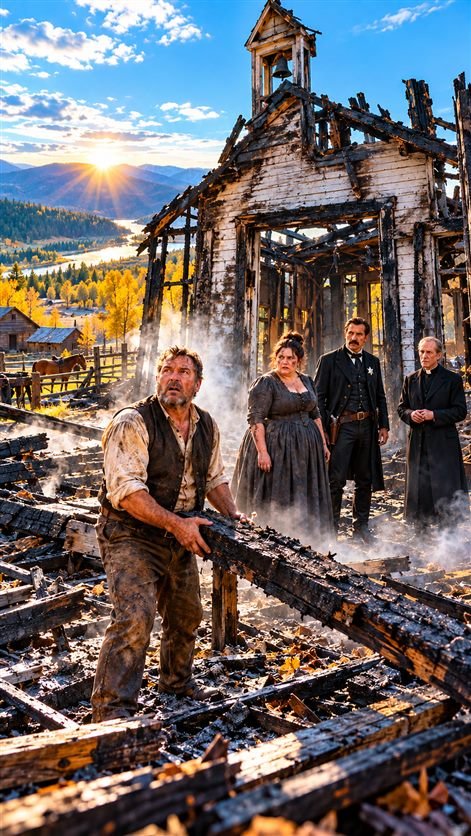
Why would anyone secure a schoolhouse door from the outside, turning a place of learning into a sealed tomb of smoke and ash? The charred timbers of Kettle Bend held a secret far darker than simple arson, and the men sworn to protect the town were terrified of what lay buried beneath the ruins. Wendel Sarka stood in the ruined schoolhouse on Monday morning, staring at a newly fastened wooden beam attached to the fallen oak door. The acrid smell of burnt cedar and scorched earth still hung heavy in the damp morning air, clinging to the back of his throat like dust.
The building had been empty when disaster struck, or at least that was what Kettle Bend wanted everyone to believe. Saturday’s blaze had left the old schoolhouse ruined, but thankfully no children had been there when it happened. By Monday, most townspeople were already calling it a terrible accident, a tragic stroke of bad luck brought on by aging iron wires or a lingering spark from the stove. Wendel wasn’t convinced, not by a long shot.
Part I: The Untamed Crossing
As a school-board member, he knew that building too well to buy into easy explanations. He walked slowly through the remains, his boots crunching over shattered glass and blackened shingles, studying every detail with an investigator’s eye. The old iron stove was still where it belonged, its door hanging ajar and completely cold. The brass school bell had fallen from the roof, half-melted and driven deep into the mud near the threshold.
But the north wall told a different story. The siding there was blistered and warped outward, charred down to the bare framing studs. Whatever had happened appeared to have started outside, near a window, feeding on dry timber before punching through the interior lath and plaster. Then Wendel found the door.
The heavy oak slab had fallen outward almost intact, pushed off its leather hinges by the surging heat from within. And across its exterior was a wooden brace, fastened diagonally into the frame with thick iron screws. Wendel crouched beside it, his fingertips brushing the rough-hewn pine. The hardware looked new.
Far too new for a frontier schoolhouse built back when the county was still a wilderness. He stared at that beam until one terrifying question formed in his mind. Why secure an empty schoolhouse from the outside? Then he remembered Saturday afternoons.
The schoolhouse was officially closed for the weekend, its shutters barred and its padlock clicked shut. Unofficially, Miss Ivey opened it for people who could not attend lessons during the week, offering a sanctuary of books and light to those the world usually passed by. The Ruiz children came to practice their sums, speaking in quiet, respectful whispers. The Ottoson girls came when farm work kept them away on weekdays, eager to copy lines of poetry into their slates.
And seventeen-year-old Wick sometimes slipped through the back entrance because he was still learning to read and desperately wanted his struggle kept private from the sneering boys at the livery. Everyone in Kettle Bend knew about those Saturday lessons. Everyone. Wendel slowly rose, his joints aching in the chill wind.
Then he noticed something in the grass several feet from the window, half-hidden by a clump of dead thistle. A coal-oil can. Standing upright. Its cap carefully screwed back into place.
That bothered him almost as much as the wooden brace. This did not look careless. It looked deliberate, placed with cold precision before the first match was ever struck. Then wheels rattled along the road, the rhythmic clatter of iron-rimmed wagon tires breaking the tense silence of the morning.
Wendel turned sharply. Reverend Coates arrived first in his high-wheeled buggy, his black coat buttoned to his chin against the autumn draft. Sheriff Alderman stepped down behind him, his boots hitting the dirt with a heavy, deliberate thud. Terrible thing, the reverend said solemnly, his eyes cast down at the ashes as if reciting a memorized prayer.
Wendel said nothing, watching them both from the shadow of the ruined doorframe. The important thing is nobody was inside, Alderman added, adjusting the belt of his holster with a practiced flick of his wrist. Wendel looked from the sheriff to the ruined schoolhouse, and then back again. Something about those words made his stomach tighten into a hard, cold knot.
Sheriff, Wendel said quietly, his voice carrying an edge that made the morning air feel even sharper. Come look at this door. Alderman approached slowly, his expression a mask of official indifference. He examined the wooden beam.
Then the fasteners. For one brief second, his expression changed, a flicker of genuine panic crossing his weathered features. Wendel saw it. And just as quickly, it vanished behind a wall of bureaucratic calm.
Part II: Whispers and Trials
Probably been there since spring, Alderman said, though his voice lacked conviction. Could’ve been used against the wind. Wendel stared at him, refusing to let the deflection pass. The hardware is new.
Silence stretched between them, broken only by the restless pawing of the reverend’s horse. There isn’t even rust on it. Wendel, the sheriff warned quietly, a subtle edge of menace creeping into his tone. But Wendel was already looking past him at Reverend Coates, who had begun nervously twisting the silver ring on his left hand.
And Saturdays, he continued, his eyes locked on the clergyman, this schoolhouse isn’t always empty. The reverend froze, his hand stopping mid-twist. The sheriff’s face hardened into stone. You know about Miss Ivey’s lessons, Wendel said, taking a half-step forward.
So do I. So does nearly everyone in Kettle Bend. Neither man answered, the silence between them growing heavier and more suffocating than the smoke that had choked the building days before. Behind them, the ruined schoolhouse seemed suddenly less like the remains of an accident and more like evidence nobody wanted examined, a silent witness to a crime dressed up as tragedy.
Wendel pointed a trembling finger toward the fallen door. If someone secured that entrance from the outside… He stopped dead. Because Sheriff Alderman was no longer studying the door. He was staring directly at Wendel with a look that promised violence.
And Reverend Coates had gone pale, his lips moving in a silent prayer that had nothing to do with salvation. Then the sheriff stepped closer, invading Wendel’s personal space, and lowered his voice to a harsh whisper. Wendel, there are some questions a man should think very carefully about before asking in this town. Wendel felt the warning immediately, a cold realization that he had stepped onto a path with no turning back.
But before he could answer, a woman’s voice came from behind them, sharp and unwavering like a drawn blade. Then perhaps he should ask why that beam has my husband’s mark on it. All three men turned in unison. And Wendel’s breath caught in his throat when he saw who was standing beside the road, half-swallowed by the morning mist, and what she was holding in her hands.
It was Martha Vance, the blacksmith’s wife, her face stained with soot and old grief. In her trembling hands, she held a heavy iron-stamped branding die, the kind her husband used to mark custom timber for the county lumberyard. The symbol on the face of the heavy metal block matched the notched brand burned directly into the wooden brace lying across the schoolhouse door. The silence that followed was absolute, heavier than the fallen roof beams, pressing down on the clearing with the weight of an unyielding verdict.
Alderman took a half-step back, his hand hovering dangerously close to the butt of his revolver. Reverend Coates looked away, unable to meet Martha’s piercing gaze. You kept your husband late in the shop Friday night, didn’t you, Sheriff, Martha said, her voice shaking with a rage that burned hotter than any fire. You told him the county needed heavy framing braces for bridge repairs down by the creek.
You had him cut them to exact measurements. And you picked them up yourself before midnight. Alderman didn’t deny it. He couldn’t.
The lie was too fresh, too thin to cover the vast chasm of their complicity. Wendel looked from the blacksmith’s wife to the lawman, the pieces of the puzzle violently shifting into a pattern so horrifying he could scarcely breathe. The schoolhouse hadn’t burned down by accident. And it hadn’t been targeted because of the children or the reading lessons.
It had been targeted because of what was kept inside the locked wooden cabinet beneath the teacher’s desk. Miss Ivey wasn’t just teaching people how to read. She was helping them read the old land deeds, the ones buried in the basement of the county courthouse before the new boundary lines were drawn by the land syndicate. Deeds that proved half the prosperous farms in Kettle Bend, including the sheriff’s sprawling ranch and the church’s endowment lands, belonged by law to families who had been quietly forced out years ago.
Part III: The Frontier Reckoning
The realization hit Wendel with the force of a physical blow, leaving him dizzy and sick to his stomach. They didn’t lock the door to keep people safe. They locked it to make sure nobody could run when the flames started. Miss Ivey and the Ruiz children weren’t even mentioned in the initial reports because nobody in authority wanted anyone looking for bodies in the ash.
Alderman’s hand dropped away from his holster, the brief impulse to silence them all dying in the face of Martha’s steady, unblinking glare and the distant sound of farm wagons rumbling up the main road from town. You think you’ve uncovered something grand, Alderman said, his voice flat and devoid of any remaining warmth. You think you’re a hero, Wendel. But when the dust settles, who do you think the town is going to believe?
The respectable men who built Kettle Bend, or a bitter school-board member poking through garbage? Wendel didn’t flinch, though his heart hammered against his ribs like a trapped bird. He looked at the charred timbers, then down at the coal-oil can still sitting upright in the grass, a silent testament to their arrogance. We’ll let the circuit judge decide that, Wendel said, his voice steady despite the terror gripping his soul.
The judge is due in town by noon tomorrow. Alderman let out a cold, humorless laugh that sent a chill straight down Wendel’s spine. The judge stays at my house when he’s in Kettle Bend, Wendel. He takes his meals at the parsonage with the reverend.
By noon tomorrow, this place will be plowed under for a new stable, and you’ll be the one who died in a tragic riding accident out on the ridge. The threat was plain, hanging in the air between them like smoke from a dying fire. Reverend Coates finally found his voice, speaking with a quiet, hollow despair that sounded almost like a confession. We tried to stop them from going too far, Wendel.
We really did. But the syndicate… they own the mortgages on every acre for twenty miles. If those deeds came to light, the whole town goes under. Hundreds of people ruined overnight.
So you burned them alive instead, Martha whispered, a single tear cutting a clean path through the soot on her cheek. You burned my cousin’s children. You burned an innocent woman who only wanted to give people a chance at a better life. We saved more than we destroyed, Alderman muttered, though even he sounded desperate to believe his own justification now.
It’s a matter of preservation. Wendel looked at the black-coated reverend and the badge pinned to the sheriff’s vest, realizing with stark clarity that the law in Kettle Bend wasn’t broken; it was operating precisely as its creators intended. But Martha wasn’t looking at the men anymore. She was looking past them, toward the crest of the hill where a cloud of dust signaled the approach of the morning stagecoach from the capital, accompanied by two federal marshals she had secretly telegraphed from the telegraph office two towns over before dawn.
Alderman saw the dust at the same instant, his head snapping around, his face draining of whatever color remained in it. The silence broke, shattered by the steady beat of approaching hooves and the iron rattle of wheels that could not be stopped by a bribe, a threat, or a locked door.