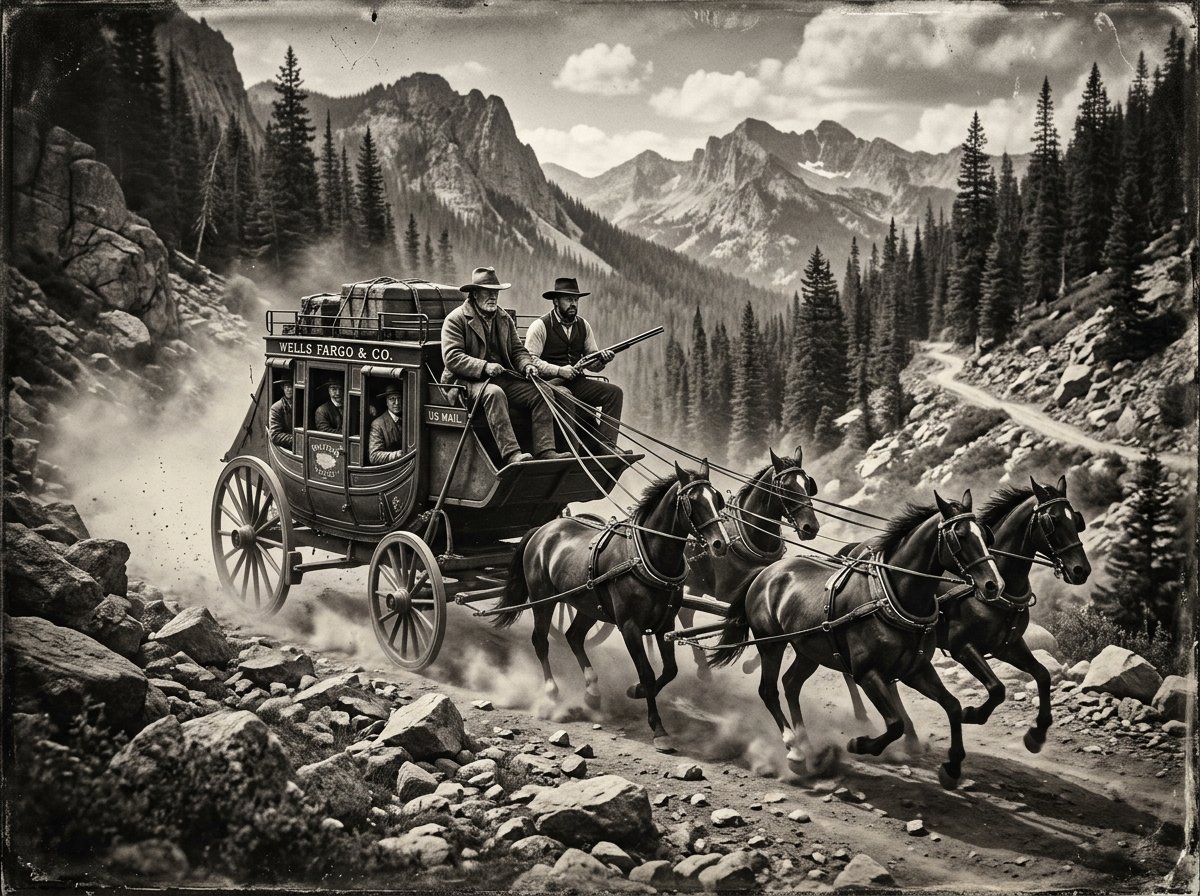
📜 Frontier Fast Facts: The Concord Stagecoach
Primary Manufacturer: Abbot-Downing Company of Concord, New Hampshire (Produced over 3,000 handcrafted coaches from 1827 to 1899).
Suspension Innovation: “Thoroughbraces” — massive three-inch-thick straps of layered ox-hide that absorbed brutal jolts and allowed the coach body to swing like a hammock.
Operating Capacity: Nine passengers inside on leather benches, up to twelve on the roof, plus 500 pounds of US Mail and gold treasure chests in boot compartments.
Major Route Networks: Butterfield Overland Mail (2,800 miles from St. Louis to San Francisco, 24 days) and Wells, Fargo & Co. transcontinental express routes.
Before the joining of the rails at Promontory Summit in May 1869, the undisputed lifeline of the American frontier was the stagecoach. Across boiling alkali deserts, boulder-strewn Rocky Mountain passes, and flooded prairie river crossings, these handcrafted wooden vessels carried the gold dust, payroll treasure boxes, personal correspondence, and adventurous passengers that knit an expanding continent together.
Engineering Perfection: The Abbot-Downing Concord Coach
Pioneer trails were not paved roads; they were rutted wagon tracks carved through sagebrush, river gravel, and granite boulders. Conventional European coaches, built with rigid iron or steel leaf springs, invariably shattered within days of entering the American wilderness. The vehicle that conquered the frontier was engineered in New England by J. Stephens Abbot and Lewis Downing: the legendary Concord Coach.
The Concord Coach was an engineering masterpiece of functional frontier design. Rather than mounting the coach body directly onto iron axles, Abbot-Downing suspended the entire carriage on two massive leather straps known as thoroughbraces. Crafted from multiple layers of top-grade cured ox-hide, three inches wide and over an inch thick, these straps absorbed vertical shocks and transformed bone-jarring jolts into a gentle, swaying motion resembling a ship at sea.
Constructed from hand-selected, seasoned white oak and sweet-scented basswood, with wheels framed in ash and steam-bent elm, the Concord Coach could withstand punishing treatment. Fully loaded, an eight-passenger coach weighed over 2,500 pounds and cost between $1,000 and $1,500 — a fortune at the time, but an investment in indestructible reliability that made Abbot-Downing the gold standard of global overland transit.
The Butterfield Overland Mail: 2,800 Miles of Frontier Endurance
The pinnacle of stagecoach logistical achievement was achieved in 1858 under John Butterfield’s Butterfield Overland Mail Company. Awarded a monumental $600,000 annual federal contract, Butterfield established a semi-weekly mail and passenger service between St. Louis, Missouri, and San Francisco, California.
To avoid the lethal winter snowdrifts of the central Rocky Mountains, Butterfield routed his coaches along an immense 2,800-mile southern “Oxbow Route” curving through Missouri, Arkansas, Texas, New Mexico, Arizona, and California. The operational scale was staggering: Butterfield constructed 141 fortified relay stations, dug dozens of deep desert wells, acquired 1,800 horses and mules, and employed over eight hundred skilled drivers, guards, and mechanics.
Coaches traveled continuously night and day without stopping for rest. Passengers paid $200 for a one-way ticket, enduring twenty-four consecutive days of choking alkaline dust, jolting mountain descents, and sparse meals of fried pork and hard biscuits at remote stations. Famed journalist Mark Twain, who journeyed westward by stagecoach in 1861, chronicled the ordeal in his classic memoir Roughing It, describing the sensation as being tossed about in a wooden barrel rolled down a hillside.
The Jehu and the Shotgun Messenger
Operating a six-horse Concord coach through hostile territory required superhuman skill and iron nerves. The driver — affectionately termed the “Jehu” or “whip” — held six leather reins between his fingers, manipulating his team through mountain hairpins with millimeter precision. Drivers commanded immense respect across the frontier; their mastery of horseflesh and trail hazards made them the elite aristocrats of overland transportation.
Seated beside the driver was the “shotgun messenger,” an armed guard employed by express companies like Wells Fargo to protect shipments of gold bullion and federal currency. Armed with a sawed-off 10-gauge or 12-gauge double-barreled shotgun loaded with heavy lead buckshot, the messenger was the final line of defense against road agents.
The peril of robbery was constant. Outlaws like the infamous Black Bart (Charles E. Boles) made a career of ambushing Wells Fargo stages on lonely mountain turns, stepping out from behind boulders with leveled shotguns to demand: “Throw down the box!” Black Bart successfully robbed twenty-eight stages across northern California between 1875 and 1883, leaving whimsical handwritten poetry in the empty treasure chests before his eventual capture by Wells Fargo detectives.
The Twilight of the Overland Stage
When the Golden Spike completed the Transcontinental Railroad in 1869, the long-distance transcontinental stagecoach line became obsolete overnight. Yet the stagecoach did not vanish; it pivoted. For another three decades, Concord coaches served as feeder lines connecting remote mining booms, military forts, and mountain hamlets to the transcontinental railheads.
From the Black Hills Gold Rush of Deadwood to the high silver camps of Colorado, the Concord coach continued rolling until gasoline-powered trucks and motorcars finally eclipsed horsepower at the dawn of the 20th century. The stagecoach remains the enduring symbol of Western fortitude, proving that human tenacity and New England craftsmanship could bridge the vast American continent.
Historical Provenance & Archival Standards
Wild West Stories Historical Research Division • Primary Source Cross-Referenced
This historical monograph is compiled from digitized records preserved at the National Archives and Records Administration (NARA), the Library of Congress Prints and Photographs Division, and Western state historical registries. All dates, geographic coordinates, and legal proceedings have been verified against original 19th-century newspaper archives and territorial government registries.