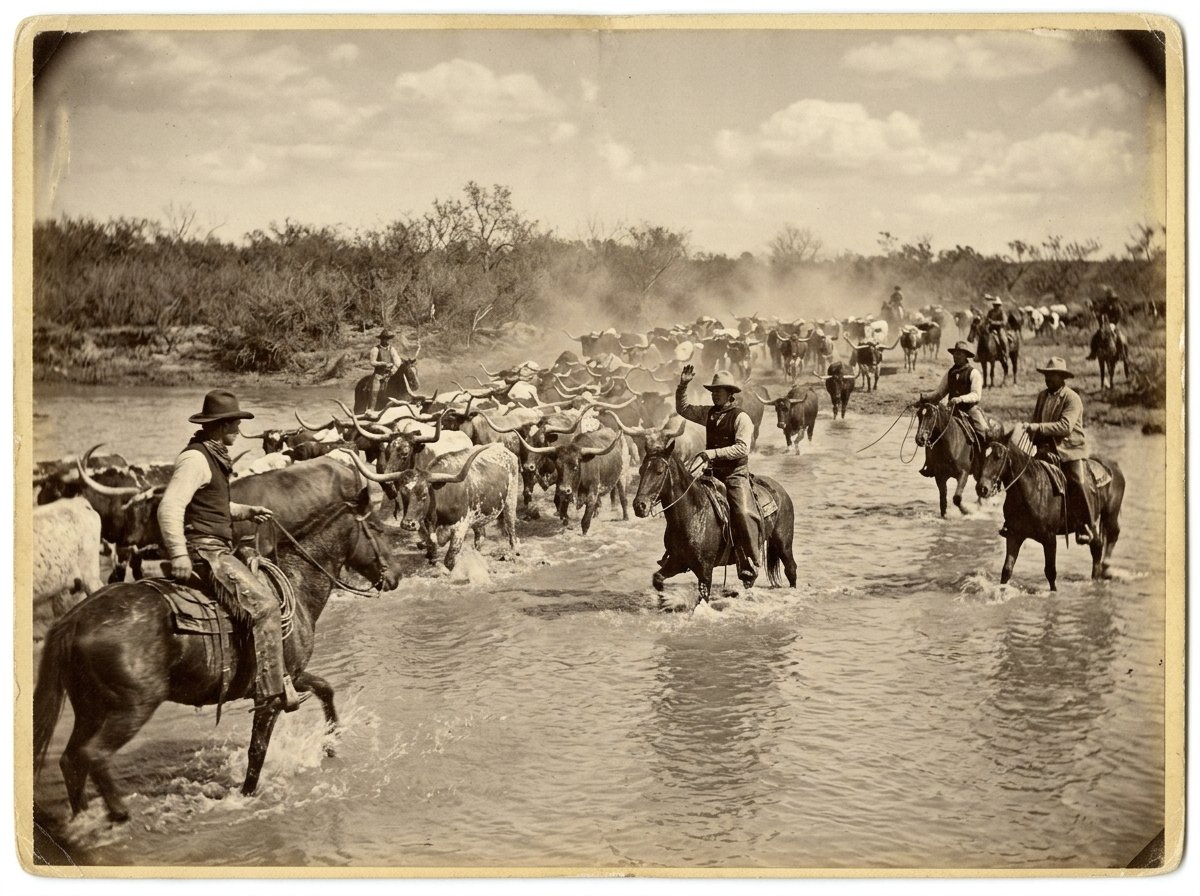
📜 Frontier Fast Facts: The Chisholm Trail
Operational Peak: 1867 to 1884 (Over 5 million Texas Longhorns driven north to Kansas railheads).
Trail Route: 800 miles from South Texas ranches, crossing the Red River, traversing Indian Territory, to railheads in Abilene, Newton, and Wichita, Kansas.
The Economic Arbitrage: A steer purchased in Texas for $3 to $4 commanded $30 to $40 at Kansas rail depots connected to Chicago meatpacking slaughterhouses.
The Trail Crew: 10 to 12 drovers handling 2,500 to 3,000 cattle, led by a trail boss, chuckwagon cook (“Cookie”), and horse wrangler.
No phenomenon defined the mythos, economics, and folklore of the American cowboy more profoundly than the post-Civil War cattle drive. Between 1867 and the mid-1880s, millions of feral, razor-horned Longhorns were driven through searing heat, torrential prairie storms, river crossings, and hostile territory on an eight-hundred-mile network of wilderness trails stretching from south Texas to the newly laid tracks of the Kansas Pacific Railway. Chief among these legendary paths was the Chisholm Trail.
The Post-War Economic Disconnect (1865–1867)
The cattle boom of the 1870s was born from a stark economic contrast created by the Civil War. When Confederate veterans returned to Texas in the summer of 1865, they found their state in financial ruin. However, their brushlands were teeming with livestock. Spanish Longhorns — fierce, lean, and exceptionally hardy descendants of cattle introduced by Spanish conquistadors — had multiplied unchecked across the brush country of the Nueces and Rio Grande valleys. An estimated five million head roamed the chaparral.
In Texas, a healthy steer was virtually worthless, selling for three to four dollars for hide and tallow. Simultaneously, the industrialized cities of the Union East were experiencing a severe beef shortage, with meatpackers in Chicago and New York offering thirty to forty dollars per head. The challenge was purely geographical: how to move millions of wild, semi-feral cattle across eight hundred miles of unmapped territory, cross treacherous rivers, and navigate the sovereign nations of Indian Territory to reach rail transportation.
Joseph McCoy and the Birth of Abilene (1867)
The visionary who solved this transcontinental equation was an enterprising Illinois livestock dealer named Joseph G. McCoy. Realizing that the Kansas Pacific Railway was laying tracks westward across Kansas, McCoy chose a tiny prairie hamlet called Abilene as the ultimate shipping point. Abilene possessed three vital attributes: direct rail access, lush surrounding prairie grass to fatten livestock, and a location west of the quarantine lines established by Kansas farmers against “Texas fever” (a tick-borne disease carried harmlessly by Longhorns that decimated domestic cattle).
McCoy transformed Abilene in less than sixty days, constructing shipping stockyards for three thousand cattle, a rail siding, a three-story hotel (the Drovers Cottage), and a bank. He sent riders south to notify Texas cattlemen that a guaranteed market awaited them. The pathway chosen by the herds followed a trade route mapped earlier by mixed-blood Cherokee merchant Jesse Chisholm, who had established freighting stations in Indian Territory. By the autumn of 1867, thirty-five thousand Longhorns had boarded railcars in Abilene bound for Chicago, inaugurating the great cowboy era.
The Anatomy of a Trail Drive: Crew, Discipline, and Equipment
Moving a herd of 2,500 to 3,000 Longhorns across eight hundred miles was an exercise in rigorous military logistics. A standard trail outfit consisted of ten to twelve seasoned drovers under the absolute command of a Trail Boss.
The specialized positions within a trail crew included:
- The Trail Boss: Responsible for navigation, pacing, negotiations with Native American tribes for passage, and river crossing safety.
- The Point Men: The two most experienced riders who rode at the head of the herd, directing the lead steers and controlling the pace (typically ten to twelve miles per day).
- The Swing and Flank Men: Drovers positioned along the sides of the marching herd, keeping cattle packed and preventing strays from peeling off into the brush.
- The Drag Men: The newest or youngest riders who brought up the rear, choking on blinding clouds of dust, pushing exhausted, injured, or obstinate calves and steers.
- The Wrangler and Remuda: Managed the herd of sixty to eighty fresh saddle horses (each cowboy required four to six mounts per day).
- The Chuckwagon Cook (“Cookie”): The highest-paid man besides the boss, driving the mobile kitchen wagon invented by Charles Goodnight, preparing sourdough biscuits, salt pork, and black coffee.
The Terrors of the Trail: Stampedes and Rivers
Contrary to the relaxed romanticism of Western films, the trail was exhausting, filthy, and profoundly dangerous. Two perils haunted every cowboy’s thoughts: river crossings and night stampedes.
Crossing swollen waterways like the Red River, the Washita, and the Arkansas River required supreme courage. Longhorns were strong swimmers, but when a herd began to mill in deep water, panic could drag dozens of animals — and their riders — beneath the swirling current to drown.
Night stampedes were even more terrifying. A sudden crack of thunder, the flash of prairie lightning, or the snap of a twig could send three thousand terrified Longhorns bolting into a blind, thunderous panic across the pitch-black prairie. Drovers had to gallop into the darkness alongside the roaring wall of horns, risking their lives to turn the lead steers in a spiral circle until the herd exhausted itself.
The Legacy of the Trail
By the mid-1880s, the Chisholm Trail era drew to a close. The invention of barbed wire in 1874 allowed homesteaders to fence off the open range, while expanding railroad networks penetrated deep into Texas itself, rendering long overland drives obsolete. Furthermore, severe blizzards during the catastrophic “Big Die-Up” winter of 1886–1887 devastated open-range herds.
Yet the eighteen years of the Chisholm Trail fundamentally forged the archetypal American cowboy — his Stetson hat, leather chaps, Spanish saddle, and ethos of rugged independence — transforming a temporary livestock trade into an immortal global legend.
Historical Provenance & Archival Standards
Wild West Stories Historical Research Division • Primary Source Cross-Referenced
This historical monograph is compiled from digitized records preserved at the National Archives and Records Administration (NARA), the Library of Congress Prints and Photographs Division, and Western state historical registries. All dates, geographic coordinates, and legal proceedings have been verified against original 19th-century newspaper archives and territorial government registries.