“I brought the mules,” Ransom said, unhooking the trace chains with a practiced clatter. “And I brought the royalty.”
Ezra Gentry looked at Laura. He didn’t take off his hat either, but he touched the brim with two fingers in a gesture that was half-curtsey and half-salute. “Evening, ma’am. The loft’s dry, but the mice have been into the oats.”
“The mice don’t bother us,” Laura said, stepping down from the hub of the wheel into the mud and letting her skirts fall. Her knees trembled once from the eighteen-mile trudge, then steadied. “As long as they don’t eat the dragon’s wings.”
“They’re welcome to the dragon,” Ezra said, turning back toward the door. “There’s salt pork and dried apples on the stove. If the boy’s hungry, tell him not to bolt the lard.”
Ransom stayed by the wagon, his hand on the tailgate. The rain was beginning to slacken, leaving that long, blue-gray Pacific twilight that made the mountains look like they were floating on the mist.
“Well,” Ransom said, clearing his throat. “There’s the barn.”
“There’s the barn,” Laura agreed. She reached into the box and felt for the princess’s head, making sure the crown was still pinned tight with its brass brad. “Are you coming in for supper, Mr. Gentry, or are you going to stand there talking to the mule until dark?”
Ransom laughed—a short, loud bark that scared a jay out of the cedar boughs above them—and dropped the trace chain into the mud.
“I’m coming,” he said, and for the first time since they had met in the shingle-mill yard, he didn’t look like a man who was on his way to somewhere else. “Provided there’s enough salt pork for a working man.”
The larch barn smelled of dry timothy hay, dried leather, and thirty years of sheep fat that had soaked deep into the round logs. Ezra Gentry was not a man for many words, which suited Laura well enough; he spent the first two evenings sitting by the box stove with a pair of sheep-shears between his knees, sharpening the blades on an oilstone with a rhythmic *shick-shick-shick* that sounded like grasshoppers in dry stubble.
Tommy recovered his color within a week. The mountain air was thin and cold, but it lacked the thick, oily soot of the Puget Sound mills, and the boy spent his mornings following an old, half-blind sheep dog named Major through the fern-brakes behind the horse pasture. He didn’t cough nearly as much once Laura boiled up some spruce-gum and horehound she found growing near the creek.
On the third afternoon, Ransom came back from the upper ridge with three fresh pine poles and a bundle of rawhide strips. He dropped them by the wagon tail with a dull thud that made the king rattle in his wooden crate.
“The wind’s coming around from the east,” Ransom said, scraping the red mud off his boots with a shingle-end. “If we don’t brace that lean-to, the snow’s going to drift right over the marionette boxes before April.”
Laura was sitting on an upturned nail keg by the barn door, mending one of Tommy’s flannel shirts with coarse gray thread. She didn’t look up from her stitching. “You said the snow was done for the season when we crossed the pass, Mr. Gentry.”
“I lied,” Ransom said easily, sitting down on the edge of the horse-trough and reaching for his tobacco pouch. “Or I was mistaken, which sounds better in a church. The Cascades don’t care what month it is on the calendar. They’ve got their own weather.”
“You’ve been here three weeks,” Laura said, her needle moving with steady, even clicks. “The mules are rested. The trail down to Ellensburg is passable.”
Ransom didn’t answer immediately. He rolled a cigarette with brown paper and coarse, biting “Bull Durham,” licked the edge with a dry tongue, and struck a match against the heel of his boot. The blue smoke drifted out into the damp air, smelling sharp and sweet against the pine odors.
“My cousin needs help with the lambing,” Ransom said after a moment. “And the stage isn’t running through the gap until the washouts are cleared.”
“You aren’t a herder, Ransom.”
“I’m whatever’s needed between here and the Salt Lake,” he said, blowing a thin ring of smoke toward the rafters. “Besides, the boy likes the dragon. And you haven’t fixed the king’s vinegar-valve yet.”
Laura stopped sewing. She looked down at her hands—the dark walnut stain was slowly wearing away at the fingertips, replaced by the pale, clean skin of someone who wasn’t constantly lifting wet cedar boards or greasing axles. “The king’s valve is ruined. The tin rusted through.”
“I’ve got a bit of copper sheeting from an old stove-flue in the shed,” Ransom said. “We can solder it.”
“You think you can fix everything with solder and tallow.”
“Most things,” he said, grinning that quick, crooked grin. “Except people who are determined to be miserable.”
“I am not miserable,” Laura said, though she smiled despite herself. “I’m merely practical.”
“There’s no profit in being practical in the mountains, Miss Henderson. If people were practical, they’d have stayed in Ohio where the roads are square and the water doesn’t bite you.”
The work settled into a rhythm that felt less like an expedition and more like a life. Every morning at sunrise, Ezra Gentry took his pipe and his dogs up toward the high bench where the ewes were dropping their lambs in the gorse. Ransom stayed about the ranch, mending fences, hauling water from the creek, or helping Laura grease the marionette boxes so the damp wouldn’t swell the joints.
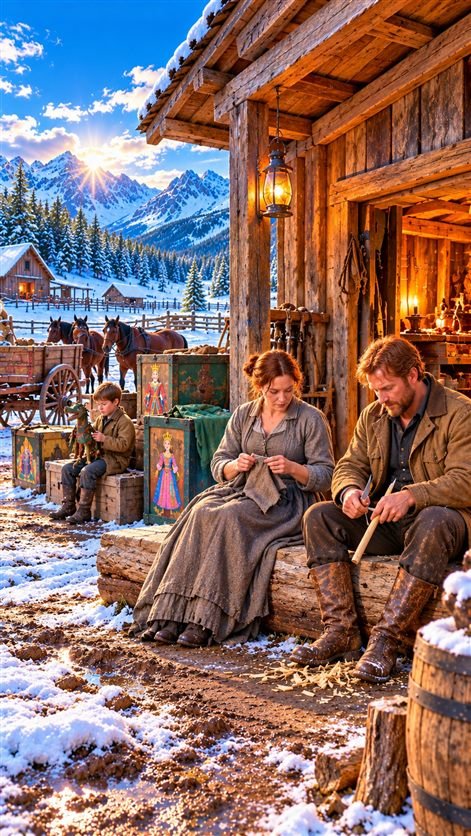
In the afternoons, when the mountain shadows lengthened until they touched the roof of the sheep-barn, Tommy would pull the green baize curtain across the front of the cider press, using two hickory poles for footlights and a single tallow candle for the sun. Laura operated the king and the princess, while Ransom stood in the dark behind the grain bins, working the wire for the dragon’s tail and making the roaring sound by blowing through a piece of greased stove-pipe.
“Ladies and gentlemen,” Tommy would pipe out, his voice thin and clear in the dry barn air. “The king has lost his crown, and the dragon has eaten the bishop!”
“The bishop wasn’t on the bill,” Laura whispered from behind the baize curtain.
“He is now,” Ransom muttered back, his face red from exertion as he pulled the wire that made the dragon’s neck lurch forward. “The audience likes clerical error.”
The “audience” consisted of three mangy hounds, two stray calves that had wandered in from the lower meadow, and Ezra Gentry, who sat on a salt-barrel every evening with his pipe unlit, watching the wooden puppets clatter against the cedar floor. When the show was over, Ezra would nod once—a slow, solemn dipping of his bearded chin—and go back to his accounts.
“He liked the king,” Tommy announced one night after the candle had guttered out and the barn was left in the smell of cooling tallow and sheep-wool. “He laughed when the crown fell off.”
“Ezra doesn’t laugh,” Ransom said, coming out from behind the grain bins with the stove-pipe in his hand. “He merely approves.”
By the middle of April, the snow on the high ridges began to turn blue and slide away in long, wet ribbons down the shale. The grass in the bottoms came up bright and green, studded with small yellow lilies that the ewes nibbled down to the roots.