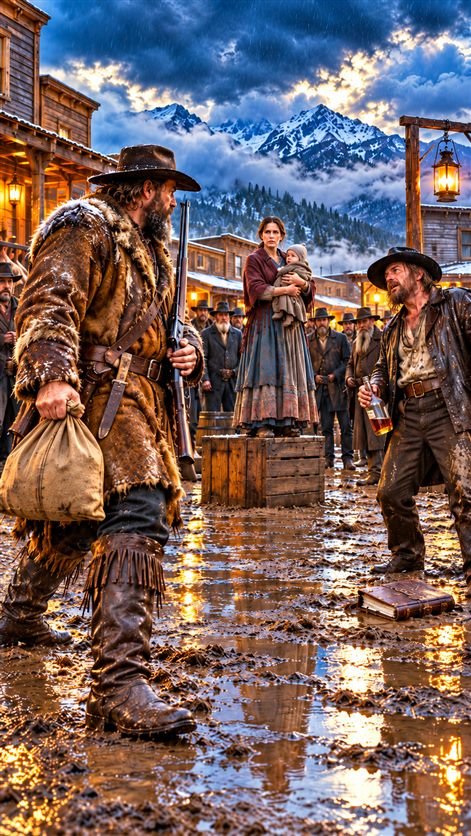
The rusted buckle of the debt ledger bit into Roy’s palm as the freezing November rain slicked the hair across his forehead, but the stinging cold did nothing to sober the grease-soaked malice in his eyes.
“Twenty-five dollars, right here on the barrel head,” Jeb spat, his tobacco-stained teeth flashing in the gray Misery Bend gloom as his gaze crawled over Maeve’s broad frame with the predatory leer of a cur eyeing a lame sheep.
Maeve stood frozen on the frost-whitened timber crate, the raw weight of six-month-old Henry pressed so hard against her ribs that she could feel the frantic, fluttering drumbeat of the infant’s heart through their damp clothes. The icy wind sliced straight through her faded cotton dress, tightening the fabric over her full waist and heavy hips, but it was the jeers of the local men—the chuckles, the crude wagers on whether she could still turn a handspike after six children and a lifetime of lean-to starvation—that made her skin crawl with a desperate, suffocating terror. She had spent a decade swallowing the cruel jokes about her size, enduring Roy’s drunken sneers that a big woman ought to be grateful for a roof that didn’t leak, but standing here like a condemned heifer in an open square was a fresh kind of hell.
“Going once,” Roy slurred, swaying dangerously as he lifted his half-empty whiskey bottle in a mocking toast to the shivering knot of townspeople. “She doesn’t eat much more than a hog, and she’ll keep her mouth shut if you use the back of your hand—!”
“One hundred.”
The word dropped into the mud like a thrown hat, flat, heavy, and absolute.
The laughter died instantly. The men turned, their boots sucking at the mire as they parted to clear a lane through the square. A stranger stood at the edge of the crowd, swathed in a stiff buffalo-hide coat that smelled of pine smoke and old snow. His beard was thick and dark, frosted with rime, and his shoulders were so wide they seemed to stretch the heavy hide to its breaking point. A repeating rifle was cradled casually in the crook of his massive arm, and a skinning knife with a blade nearly as long as Maeve’s forearm rode his hip. His pale gray eyes didn’t look at the crowd; they locked onto Roy with an intensity so cold it made the local blacksmith step back.
Roy blinked, his grease-slick brain struggling to catch up. “You… you said a hundred?”
The stranger didn’t answer in words. He reached into his coat and tossed a heavy canvas sack into the mud at Roy’s feet. It landed with a dull, metallic chink that set the coins inside grinding against one another.
“Count it,” the stranger said, his voice a deep, gravel-grated rumble that vibrated through the frozen ground.
Roy dropped to his knees in the filth, tearing at the string of the pouch with trembling fingers, completely ignoring the woman and child he had just bartered away. The stranger turned his unblinking gaze upward, fixing it upon Maeve.
For one agonizing second, Maeve felt the full weight of her insecurities crash down upon her. She knew what she looked like: wide-hipped, thick-armed, softened by too many winters of potatoes and lard, her hair escaping its pins in damp, unruly strands. She braced herself for the same mocking leer Jeb had worn, the same dismissive disgust Roy offered every morning he woke up sober enough to look at her.
Instead, the stranger’s eyes held a quiet, terrifying assessment. There was no mockery. There was only the heavy, calculating focus of a man who measured everything in terms of life and death, endurance and ruin.
“Come down,” he said.
Maeve swallowed hard, shifted Henry higher against her chest, and stepped off the crate. Her boot heel caught the splintered edge of the wood, and she pitched forward, expecting to slam face-first into the freezing mud with her baby crushed beneath her.
Before she hit the ground, a hand clamped around her upper arm. The grip was massive, hard as iron, yet it checked her fall with effortless, terrifying precision, lifting her upright as though she weighed no more than an empty grain sack. The moment she found her footing, the hand released her as if she were burning coals.
“My wagon’s at the edge of town,” the man said, turning his back on her.
Maeve followed. She had no money, no home, no option left on God’s green earth, and the snow was beginning to spit from the bruised belly of the clouds.
For three brutal hours, they climbed higher into the jagged timberline of the crags, leaving Misery Bend and its miserable secrets far below. The wagon wheels shrieked against the frozen ruts, the iron tires biting into thickening drifts. Maeve sat on the bench beside the stranger, her teeth chattering so violently she could feel the bones in her jaw ache. Her heavy woolen shawl was soaked through from the melting sleet, and the damp hem of her dress froze stiff against her ankles, turning every breath into a struggle against numbing exhaustion.
She did not complain. She had learned long ago that complaining only invited violence. Instead, she pressed her face into the soft crown of Henry’s head, breathing in the sour-sweet smell of baby sweat and wool, using the child’s warmth as a shield against the encroaching frost.
Without warning, the wagon jolted to a halt beneath the skeletal branches of a stand of dwarf pines.
Maeve’s stomach seized. The trees were dense here, the silence absolute save for the hiss of the wind through the needles. They were miles from the nearest settlement, entirely cut off from the law, alone with a man who had just bought her with heavy gold from a drunken degenerate.
The stranger reached behind the seat.
Maeve flinched, tucking Henry tighter against her breast and squeezing her eyes shut, bracing for the blow, the demand, the crude violation she had half-expected since the moment the auctioneer’s hammer fell.
A heavy weight settled over her shoulders.
Maeve opened her eyes. The stranger was draping a thick, dry wolf-pelt blanket around her, wrapping it securely over her broad shoulders and tucking the corners in so tightly that the freezing wind was instantly locked out. Without a word, he pulled a tin cup of water from a leather holster, holding it out to her.
“Drink,” he ordered.
Maeve stared at the cup, her fingers numb and clumsy as she took it. It wasn’t whiskey. It was clear, mountain-spring water, tasting of iron and snow. She drank until her throat stopped aching, the cold liquid shocking her system back to full awareness.
An hour later, the trail became too steep and drifted for the horses, forcing them to continue on foot. The altitude and the biting cold conspired against Maeve’s exhausted frame; her knees buckled without warning, her boots slipping on a patch of black ice hidden beneath a skim of powder. She pitched sideways, her arms instinctively tightening around Henry as she went down.
Before her knees hit the stone, strong hands caught her by the waist and hoisted her back to her feet.
Before she could regain her balance, the stranger reached out and gently, firmly pried Henry from her arms.
Maeve let out a strangled cry of pure maternal panic, clawing at his sleeve. “Please! Please don’t hurt him! Take me, do whatever you want, but leave the boy—!”
“Stop fighting,” the stranger snapped, his voice hard enough to crack flint. He tucked the squalling infant expertly against his broad chest, burying Henry’s face inside the warmth of his buffalo coat. “You’re falling. You drop him on a rock, he dies. Do you want him to die?”
Maeve stopped dead, her chest heaving as hot tears froze on her cheeks. She looked down at her own trembling, useless legs and hated herself with a bitter, consuming rage. She hated that her body had betrayed her, that she was too soft, too heavy, too exhausted to carry her own child through the snow while a stranger had to bear the burden for her.