For a brief, telling moment, his expression shifted, the practiced mask slipping to reveal a flash of genuine panic in his dark eyes. Then he recovered, his jaw tightening as he dismissed the question with a wave of his hand, calling Celeste a business associate and blaming the lingering scent on a ledger she had been holding in her office.
I did not argue, and I did not cry. Everett looked at my dry eyes and quiet demeanor and seemed to breathe a sigh of relief, thinking that was the first time I had ever doubted him.
He was desperately mistaken. Long before that morning, the foundation of our marriage had begun to crumble beneath the weight of small, unexplained absences, telegrams that vanished from his desk before I could read them, and casual conversations that abruptly died the moment I stepped into a room. His answers to simple questions had frequently failed to match things he had let slip weeks earlier, creating a patchwork of contradictions that only a fool would have ignored.
Quietly, methodically, and with a cold precision that surprised even myself, I had kept a hidden journal containing copies of intercepted notes, exact dates of his unexplained journeys, and detailed records of every lie he had told. I knew the exact number of times he had visited the bank late at night under the guise of auditing freight receipts; I knew the names of the telegraph operators he paid off to keep certain messages quiet; and I knew that the river house was only the most visible piece of a much larger puzzle he was keeping from me.
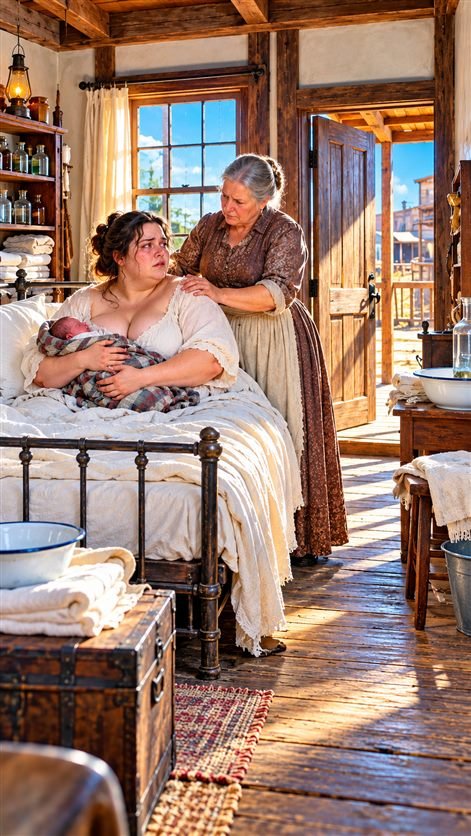
After he left my room, offering a brief promise to return later with a carriage, I did not weep into my pillow. Instead, I waited for my mother to return from checking on the baby in the nursery, and when she sat down beside my bed, I caught her wrist.
Send a message for me, I whispered, watching the door to ensure the hallway was empty. Not to Everett. Send it to Harrison Vance, the attorney in town whom I trust with my life.
My mother looked startled, but she saw the fierce, unyielding light in my eyes and nodded without asking a single question. She left immediately, her boots clicking briskly against the wooden boardwalk outside, carrying a request that would set in motion a chain of events Everett Dole could never anticipate.
When the attorney arrived late that afternoon, a tall, impeccably dressed man with sharp gray eyes and a reputation for unearthing secrets that powerful men wished to keep buried, I waited until the door of the recovery room was firmly closed and bolted from the inside. Vance pulled up a straight-backed wooden chair, placed his worn leather briefcase across his knees, and looked at me with a mixture of professional curiosity and profound sympathy.
If my marriage ends today, what happens to Everett’s vast ranching empire, I asked directly, wasting no time on pleasantries or complaints about his infidelity.
Vance studied me for a long moment, his fingers drumming thoughtfully against the brass clasp of his case, as if weighing my resolve against the magnitude of what he was about to reveal. Before I answer that question, Florence, there is something about his property, his wealth, and his entire standing in this territory that you need to know.
He popped the brass latches of his leather case with a sharp snap that made me jump, reached inside, and pulled out a heavy parchment document yellowed with age and covered in neat, cramped legal handwriting. He unfolded it carefully on the blanket across my lap, pointing a manicured finger at the bottom where a signature was scrawled in dark iron-gall ink.
I recognized Everett’s bold, sweeping signature at once, the flourish at the end of his last name as familiar to me as my own reflection in the looking glass. But beneath his name, crowded into the margin like an afterthought that held the weight of a thunderhead, was another signature—one written in a delicate, sloping hand that I never expected to see in a thousand years.
What could that name mean, I whispered, staring down at the parchment as the room seemed to tilt sickeningly on its axis, the ink swimming before my eyes until the letters dissolved into a meaningless blur of black lines.
Vance did not answer immediately; he simply watched me with a heavy, sorrowful gaze that told me the nightmare I was living was only the prologue to something infinitely darker. That name, he said softly, breaking the silence of the room like a hammer striking an anvil, belongs to the woman who legally owns every single acre of the land, every head of cattle, and every dollar in the bank accounts you believe belong to your husband.
My breath caught in my throat as I looked closer at the signature, the letters spelling out a name I had seen on old tax receipts, a name Everett had claimed belonged to a distant, deceased aunt who had left him nothing but debts. But the date on the document was not from twenty years ago; it was signed six months before our wedding day, witnessed by two men who had since left the territory, and notarized in a town three counties over where no one knew our faces.
It was not Celeste Rowan’s name, and it was certainly not mine. It was the name of Catherine Vance, the attorney’s own estranged sister, who had vanished from society years earlier after a mysterious scandal involving forged land grants and a missing railroad surveyor.
Everett did not build this empire from his own sweat and cattle sales, Vance continued, his voice dropping to a low, conspiratorial murmur that barely carried over the sound of the wind rattling the windowpanes. He married into it under an assumed identity, taking the name of a dead man he resembled just enough to fool the land office out in the territories, and then he married you to secure a respectable front for property that could be seized by the federal marshals the moment his true past caught up with him.
I sat there in the dim light of the infirmary, the baby sleeping fitfully in the next room, feeling the cold realization settle over my bones like winter frost. Everett had never loved me, and he had never truly loved Celeste either; we were both simply pieces on a chessboard he was playing against an opponent I was only now beginning to see. He had used my quiet reputation, my family’s standing in the valley, and my blind devotion to shield himself from an investigation that was already closing in around him like a noose made of hemp and iron.
The lavender perfume, the midnight meetings at the river house, the telegrams from Celeste—they were not just the sordid details of a common adulterer; they were the panicked maneuvers of a desperate man trying to keep a crumbling empire from sliding out of his grasp. Celeste was not his former lover returning for solace; she was the federal auditor’s daughter sent to watch him, or perhaps she was something far more dangerous—a partner in a crime so vast that ordinary people could not even conceive of its scope.
My mother returned just then, pushing the door open with a basket of fresh linens, her eyes darting between the attorney and me with visible anxiety. Did he come back, she asked, thinking of Everett and the carriage he had promised to send.
No, mother, I said, and as I spoke, the sound of my own voice startled me with its absolute, terrifying calm. He is not coming back, and when he does, he will find that the house he built on sand has finally washed away.
Harrison Vance closed his leather case with another sharp snap, stood up, and tucked the parchment document securely beneath his arm. I will file the injunctions within the hour, Florence, and by tomorrow morning, the sheriff will have warrants waiting at the river house for a man named Thomas Vance, wanted for federal land fraud, forgery, and embezzlement across three states.
I nodded, watching him walk toward the door without offering a single word of regret or hesitation. The baby stirred in the nursery down the hall, letting out a faint, mewling cry that broke through the oppressive silence of the room, reminding me that I was no longer just Florence Wynn, the neglected wife of a powerful rancher. I was the woman who held the key to his destruction, and I had every intention of turning it until the locks gave way.
Outside, the sun was beginning to dip below the western horizon, painting the sky in violent shades of bruised purple and burning orange, casting long, jagged shadows across the cottonwoods by the river house where Everett sat in the dark, waiting for a future that had already been erased.