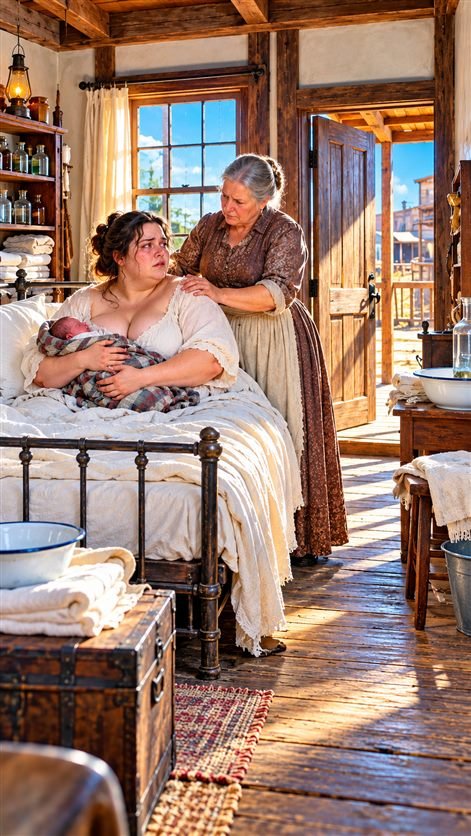
Florence bit into her own trembling lip as the agony tore through her lower back, a white-hot iron brandishing flesh that felt as though it might split apart on the coarse linen sheets. Outside the high, small windows of the town infirmary, the afternoon sun beat down with a merciless glare, but inside the room, the air felt thick, stagnant, and heavy with the scent of carbolic soap and copper.
For six hours she had labored to bring their child into the world, relying on the quiet strength of her mother and the steady hands of the town doctor. Yet the man whose name she bore had chosen that precise, agonizing juncture to fold a yellow scrap of paper, slide it into his vest pocket, and walk out the door without a backward glance. Now, with the raw ache of abandonment pressing harder than the contractions in her womb, Florence knew her life had splintered along a fault line that could never be mended.
My Name Is Not Florence
I was six hours into labor with our first child when my husband read a telegram, folded it, and headed for the door. My mother looked from him to me as I clutched the bed sheet, her knuckles white with an anger she was trying desperately to suppress for my sake.
Where are you going, she asked, her voice tight and clipped against the harsh sounds of my breathing.
Something came up, Everett said, his dark eyes refusing to meet mine as he adjusted his coat. I will be back.
He left before either of us could stop him, the heavy oak door swinging shut with a soft, final click that echoed in the small room like a gavel falling in a courtroom.
My name is Florence Wynn. For years, I had built a quiet fortress out of the belief that Everett Dole saw me as more than the woman people judged by her size and the quiet plainness of my background. I was full-figured, with a round face, thick dark-brown hair that refused to stay pinned, and broad hips that the gossips in town whispered were meant for farm labor rather than parlor society. Yet Everett had sought me out, courted me with a quiet persistence that defied the expectations of his wealthy peers, and made me feel cherished in a world that usually overlooked anyone who did not fit a certain narrow mold.
He was one of the most powerful ranchers in our territory, controlling vast cattle herds that grazed across the rolling hills, lucrative freight routes that supplied half the county, and commercial interests that reached far beyond our dusty frontier town. For a long time, I thought he was different with me, that beneath his cold exterior and sharp business acumen beat a heart capable of unconditional devotion.
As the hours passed and the pain escalated into a dull, rhythmic roaring in my ears, I kept looking toward the infirmary door, praying for the sound of his heavy boots on the floorboards. He will come back, I whispered to the empty space beside the bed, and my mother held my hand without answering, her eyes dark with a grief that frightened me more than the labor pains.
But Everett was not handling ranch business, and he was certainly not wondering when his firstborn would draw its first breath. He had gone straight to the railroad depot, the steam engine hissing and wheezing as it hissed plumes of white smoke into the dry afternoon air. He stood on the wooden platform waiting for Celeste Rowan, the woman he had loved before me, the woman whose memory had haunted our marriage like a ghost sitting uninvited at our dinner table.
Celeste had stepped down from the passenger car with an expensive leather traveling case in her hand and a telegram clutched in her black-gloved fingers, claiming she had nowhere else to go after her fortunes in the East had dried up like a summer creek. When she saw Everett standing tall and unyielding on the platform, she did not look surprised; she simply smiled with the easy confidence of someone who believed the world still owed her everything she desired.
I knew you would come, she told him, her voice carrying a sweet, melodic cadence that belonged in the parlors of St. Louis rather than the rough timber towns of the frontier.
Without a word, Everett took her luggage, his broad shoulders tensing under the weight, and led her away from the bustling station toward the secluded eastern edge of town. He brought her to a handsome private house nestled quietly beside the river, completely surrounded by towering cottonwoods and rolling pastureland that kept it hidden from the prying eyes of the townspeople. I had never seen the place, though as I would later learn, he had owned it long before our marriage, keeping it like a secret garden locked away from the rest of his life.
Celeste walked through the front parlor, trailing her fingers over the polished mahogany furniture and the heavy velvet drapes as if she had stepped backward into a memory she had never truly left. You kept it just as it was, she murmured, turning to look at him with a gaze that practically demanded confirmation.
Everett said nothing, but a slow, complicated expression crossed his features, and he smiled.
Back at the infirmary, the clock on the wall ticked off the minutes with agonizing slowness as the delivery grew increasingly complicated. The doctor’s brow beaded with sweat as he urged me to push through the exhaustion, telling my mother that time mattered and every minute counted against the safety of the child. My mother, her face etched with grim determination, sent Everett a telegram at the general store, pleading with him to return to his wife’s bedside.
When no response came, she sent a second one, sharper and more demanding.
Still the telegraph office remained silent, the brass instrument clicking out messages for other people while my name went unmentioned.
Finally, desperate and running out of time, my mother paid the boy double to deliver a third message directly into Everett’s hands wherever he might be found. A message came back within the hour, and when my mother read the slip of paper handed to her by the breathless courier, she went completely still, the color draining from her face until she looked like carved marble.
What did he say, I managed to gasp out between contractions, my throat burning with thirst and strain.
She swallowed hard, her hand trembling as she crumpled the yellow paper into a tight ball. He says he cannot leave right now.
His wife was bringing their first child into the world in agony and peril, and he had chosen to stay with another woman, drinking tea in a hidden river house while the doctor fought for our lives.
The hours blurred together into a dizzying nightmare of bright lights, shouted instructions, and the sharp sting of exhaustion, until finally a thin, reedy cry pierced the heavy air of the room. Our son had arrived safely at last, but the doctor looked grave as he wrapped the tiny, purple form in a warm blanket, explaining that the infant had swallowed fluid during the prolonged delivery and needed careful, constant observation through the night. I was too weak to protest, too drained of spirit to do anything more than stare at the empty space beside my pillow where a husband should have been standing.
Everett was not beside me when I first held our fragile baby boy against my chest, feeling the frantic, tiny heartbeat that mirrored my own broken rhythm. He was not there when I woke up shivering in the pre-dawn hours and searched blindly for the strong hand I had expected to find holding mine. He was still across town with Celeste, sitting in the dim parlor of the river house, talking about old letters, old plans, and the life they had once imagined together before reality had forced them apart.
Everett returned to the infirmary the next morning with a face as calm and unreadable as a frozen pond, walking through the door as if he expected no questions, no accusations, and no consequences for his absence. I had ranch business to handle, he said smoothly, stepping up to the side of the bed and offering a cool, dry kiss to my forehead that felt less like affection and more like a transaction.
Then I caught it, a faint, undeniable scent drifting off the wool of his coat like an accusation written in invisible ink. It was the sharp, unmistakable aroma of lavender perfume, sweet and cloying in the antiseptic air of the recovery room. It certainly was not mine; I used unscented tallow soap and worked too hard among the flour sacks and laundry tubs to ever wear French toilet water.
Why do you smell like another woman, I asked, my voice dangerously quiet, carrying a weight that made him pause mid-sentence.