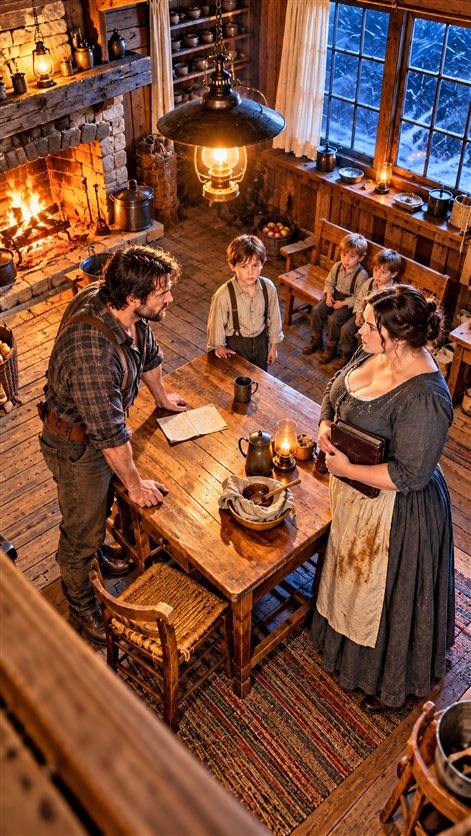
Children present, but not the primary concern of this arrangement. Those were the brutal words Garrick Holloway printed in the advertisement asking a complete stranger to become his wife.
At thirty-six, Garrick owned four hundred acres of unforgiving Montana grass, a struggling ranch that bled money every single month, and a farmhouse that had once been filled with laughter. Now it held three children who had learned to live around an empty chair. Eleven months earlier, Garrick had lost his wife, Margarite, after a sudden, violent fever swept through their isolated home and stripped the warmth right out of the timber walls. Tobias, nine, became serious almost overnight, his young shoulders weighed down by an invisible burden. Junior, six, sometimes placed an extra plate on the breakfast table before remembering who would never sit there again, staring at the empty space with wide, uncomprehending eyes. And four-year-old Wyatt remembered less about his mother every month, slipping away into a quiet haze. He remembered the smell of fresh bread baking on cold mornings. He remembered being held tightly when thunder rolled over the prairie and shook the windowpanes. But the details of her face were already beginning to fade like ink in the rain. Garrick loved his children fiercely, yet grief had turned him into a hardened man who could provide everything except the emotional warmth they desperately missed. Then another problem arrived to crush what little hope he had left. His ranch was carrying heavy debt, and a crucial land deadline was approaching fast. If Garrick failed to keep the household and ranch functioning according to the strict terms of his bank loan, everything Margarite had helped him build could disappear into foreclosure. His sister suggested something practical during a brief, desperate visit. Find another wife, she had urged. Garrick hated the idea with every fiber of his being. He wasn’t searching for romance, and he certainly wasn’t looking for a woman who would arrive pretending she could replace Margarite in their beds and hearts. So he wrote the coldest, most clinical advertisement he could manage to deter the faint-hearted. Rancher, widower, seeks capable wife for household and land duties. Then came the sentence that would make most women turn the page in disgust. Children present, but not the primary concern of this arrangement. Two thousand miles away in Springfield, Illinois, Odessa Farweather read those exact words in a crumpled newspaper left behind on a tavern table. Her landlady laughed aloud at the audacity of it. Odessa didn’t laugh at all. At twenty-nine, Odessa had spent eleven years managing other people’s homes, complex accounts, meager meals, and overwhelming problems. She had lost her own parents young in a tenement fire and learned early that physical survival often depended on noticing what people refused to say out loud. She had also worked long enough for difficult, abusive employers to recognize genuine cruelty when she saw it on paper. And Garrick Holloway’s harsh advertisement did not feel cruel to her. It felt frightened. It felt like a wounded man trying to turn unbearable grief into rigid rules. Odessa answered the notice that very night by lamplight.
Weeks later, Garrick stood at the windy frontier station watching a woman step down from the coal-dusted passenger train carrying one weathered trunk and a small bookkeeping case. Their first conversation lasted barely five minutes on the wooden platform while the engine hissed steam into the cold air. He explained the harsh realities of the ranch, the crushing debts, the grueling physical work, and the strictly business nature of their marriage arrangement. Then he made one condition painfully clear, his voice as hard as the Montana granite. My children already had a mother, he warned her. Odessa held his steady gaze without blinking. Then I won’t try to become her, she replied calmly. That precise answer was the only reason Garrick brought her home to the isolated prairie. But neither of them understood what those words would truly mean as the seasons shifted. Odessa never demanded empty affection from Tobias. She never corrected Junior for remembering Margarite out loud. She never asked Wyatt to call her anything except Odessa, keeping a respectful distance from their shared past. Instead, she repaired the fractured household accounts with a razor-sharp eye. She organized the messy pantry down to the last grain of flour. She worked beside Garrick in the freezing dawn until the ranch books finally began making sense and the ledgers balanced out. And quietly, without asking for permission, she began to notice the children in ways Garrick had forgotten how to do. When Tobias struggled over his difficult schoolwork by the hearth, a sharpened pencil mysteriously appeared beside his book. When Junior woke from a bad dream sweating and crying, Odessa left a dim lantern glowing softly outside her room to chase away the dark. And when thunder rolled across the vast ranch and Wyatt crawled beneath the heavy kitchen table, Odessa didn’t reach for him or coddle him. She simply sat on the wooden floor nearby and began telling him a ridiculous story about a cow that believed it could sing opera. Eventually, Wyatt crawled out by himself and sat near her hem. Garrick saw all of it from the shadows of the hallway. And it terrified him to his core. Because Odessa wasn’t trying to replace Margarite. She was giving his children something entirely different, something he was helpless to provide.
The ranch was slowly coming back to life under Odessa’s steady hand, but the underlying tension between Garrick and his new wife remained thick enough to cut with a butcher knife. Garrick spent his days riding the fence lines, checking cattle, and fighting the endless exhaustion that came with trying to save a failing enterprise. Whenever he returned to the house, he retreated into silence, retreating behind a wall of ledgers and tools. He watched Odessa cook, clean, and manage the boys with an efficiency that bordered on clinical, yet her gentle interactions with his children gnawed at his conscience. He had demanded detachment, yet she offered a subtle, grounding presence that the boys gravitated toward like iron filings to a magnet. One evening, a fierce autumn gale swept across the prairie, howling through the eaves of the old farmhouse and rattling the glass in the windowpanes. Inside, the kitchen was warm, lit by the amber glow of oil lamps and the steady heat of the cast-iron stove. Garrick pushed open the heavy back door, shaking the rain from his broad-brimmed hat, and froze in the threshold. Wyatt was fast asleep against Odessa’s shoulder, his small breathing steady and deep. Junior sat right beside her on the bench, braiding straw into a small figure exactly the way Margarite once had during long winter nights. And Tobias, the boy who had spent eleven months trying to force himself to become the hardened man of the house, was finally laughing out loud at a quiet joke Odessa had just shared. It was a genuine, carefree sound that Garrick hadn’t heard since the fever took his first wife. Garrick stood completely paralyzed in the doorway, a sudden knot tightening in his throat. Odessa looked up at the sound of the dripping coat and the draft of cold air. The laughter instantly vanished from her face. Because Garrick wasn’t smiling at the domestic scene. He was holding the original marriage advertisement in one hand, crumpled from days in his pocket. And in the other hand was a sealed letter that Odessa had never meant for him to find, a letter that had fallen from her bookkeeping case when he moved it earlier that afternoon.