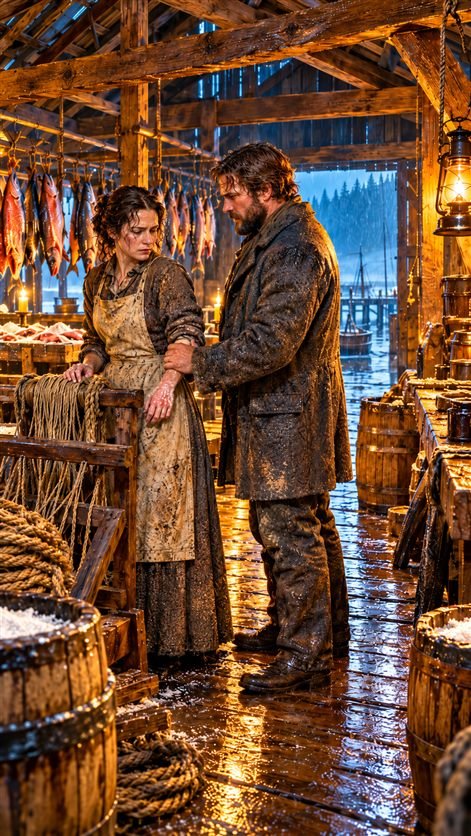
Mabel Baldwin did not care for salt fish, but she understood the gray film it left on the pine floorboards of the Puget Sound curing sheds better than anyone between Port Gamble and the sandspit at Dungeness. When the tide came rushing in off Hood Canal, smelling of rotting kelp and cold iron, the wet brine worked its way up through her boot soles until her stockings felt like frozen seaweed. She sat on an upturned nail keg by the door, scraping the scales off her thumbs with a dull horn knife, watching the rain grease the surface of the pilings where the steam scows tied up. Across the narrow gap of salt-water, Thomas Mason was wrestling a five-hundred-pound spool of tarred hemp line onto a flatbed dray, his shoulders hitched beneath a gray wool coat that had seen three winters of saltwater spray and zero brushings. He did not look like an independent millwright; he looked like a man who had been squeezed through a block and tackle and left out to dry in a November nor’easter.
“You’re going to snap a tendon if you heave it that way, Mr. Mason,” Mabel called out, her voice pitched over the hiss of the tide against the creosoted piles. “The drum’s warped on the starboard flange. It’ll catch the lay of the yarn and throw the whole five thousand yards into a snarl.”
Thomas stopped, one heavy hand flat against the damp hemp, his chest heaving beneath the damp wool. He wiped a streak of gray grease across his forehead with his forearm, leaving a smudge that made him look remarkably ferocious and entirely approachable. He had a round, solid face that belonged behind a baker’s counter or a parish desk rather than a commercial wharf, though his fingers were thick-jointed and split at the knuckles from cold iron and salt water.
“It’s not warped, Miss Baldwin,” he said, pitching his voice back with a dry, flat cadence that had no iron in it. “It’s merely settled into the salt-rot. A man learns to allow for a timber taking its own shape once it’s lived in the mud six months. If you force it straight, it snaps. If you let it lean, it’ll pull true enough when the strain comes.”
“That’s a fine philosophy for a shingle mill, but not for deep-sea anchor cable,” Mabel said, standing up and shaking the salt flakes from her apron. She was neither tall nor slight; her frame had the solid, square-shouldered heft of a woman who had spent four years hauling firewood up muddy riverbanks without the luxury of a teamster. Her dark hair, escaping its pins, hung in wet ringlets around her ears, graying slightly at the temples not from years but from the sheer bleach of the mist. “A ship’s captain doesn’t want his hawser leaning into a squall. He wants it plumb.”
“Then he shouldn’t have bought his cordage from a bankrupt ropewalk in October,” Thomas replied, stepping down from the dray and shaking the mud from his boots with two heavy thuds. He walked toward the shed with the rolling, unhurried gait of a man accustomed to shifting heavy weights on uneven decks. He was shorter than he looked from across the slip, compact and low-slung, with a round jaw that he kept clamped shut when he was thinking about figures. “Winters & Co. took your gold because they knew you couldn’t haul the raw Manila out before the rains closed the wagon trails. You bought three tons of wet fiber, Miss Baldwin. We’re both of us trying to make dry rope out of river fog.”
“I bought three tons of *dressed* hemp,” Mabel corrected him, stepping back as he ducked under the low lintel of the shed. The smell of fish oil, Stockholm tar, and damp wool rushed into the small space between them. “And I have a signed bill of lading from the Seattle factor that says it was housed under slate, not left in the open tide-marsh.”
“Factors lie when they’ve got thirty tons of rotting cordage on their hands and a freight bill due,” Thomas said, pulling a small, calfskin-bound ledger from his inner coat pocket. He laid it flat on the brine-stained counter between them, flicking the brass clasp open with a thumbnail. “And you didn’t check the weights before you paid the master. You took his word because the ink was fresh.”
“I took his word because my uncle was dying in the back of a wagon in Tacoma and I had twenty-four hours to clear his debts before the probate court put a seal on the loft,” Mabel said sharply, her chin coming up with a quick, defensive jerk. She did not look away from him; her eyes, a pale, washed blue, held his with a raw, unprotected directness that had nothing to do with business. “You knew my uncle. You knew what his credit was worth.”
“His credit was worth about as much as a dry biscuit in a bucket of bilge,” Thomas said quietly. He didn’t say it with malice; he said it like a man reading the weather report. He flipped open the ledger, his thumb lingering on a smeared ink-entry near the margin. “Which is why I’m here. Winters sent me to audit the tail-end of the stock so he can write off your notes as a bad debt and take the wharf rights for back taxes. But I’m not Winters.”
“No,” Mabel muttered, looking down at the columns of numbers in the ledger—neat, meticulous figures written in Thomas’s cramped, upright hand. “You’re the man who has to tell me I’m ruined in a particularly legible hand.”
“I haven’t told you you’re ruined yet,” Thomas said. He reached into his coat and pulled out a small piece of tallow-dipped linen, wiping a smear of red rust from the edge of the brass scale on the table. “I said the fiber was wet. Wet fiber can be carded out if you’ve got five hands and six weeks of dry wind. You don’t have the wind, and you don’t have the hands. But you’ve got the loft, and I’ve got four months of idle time before the Great Northern lays the new spur across my mill-pond. We could run the combing-drums together. Split the salvage fifty-fifty.”
Mabel stared at him, her fingers twisting the edge of her wet apron until the linen groaned. “You want to partner with a woman who doesn’t even know the difference between Manila and sisal by the smell?”
“You know the smell of a bad debt better than I do,” Thomas said, leaning his weight against the edge of the salt-crusted table. His breathing was steady, his broad face close enough that she could see the tiny burst blood vessels across his nose from too many hours staring at forge-fires and wind-driven rain. “And you didn’t run when Winters threatened to seize your bedding. Most people run. You just stood there in the mud and told me my flange was warped.”
“It *is* warped,” she whispered, though the sharpness had gone out of her voice, leaving only an exhausted, hollow vibration.
“Then we’ll hammer it true,” Thomas said.
*
The rain did not stop for three days. It settled into a steady, gray slate-gray drizzle that erased the horizon, turning Puget Sound into a mirror of dull lead where the fir-covered bluffs of Bainbridge Island dissolved into the mist. Inside the ropewalk loft, the air was thick with the suffocating, oily stench of fish-oil soap and wet vegetable fiber. The hand-cranked spinning jenny—an ancient contraption of cast iron and ash wood that had been hauled across the plains in a prairie schooner twenty years earlier—groaned with every turn of the crank, its wooden teeth clicking like the jaws of a starving dog.
Mabel stood at the feeding table, her fingers raw and swollen from the alkaline wash used to strip the salt from the hemp strands. Every time she reached into the brine-soaked hamper, her joints flared with a dull, throbbing ache that went straight up her forearms. Across the frame, Thomas was oiling the main driving axle with a greasy rag, his movements unhurried, economical, and infuriatingly steady. He hadn’t asked her for help since Tuesday, and he hadn’t offered any hollow comfort about the weather or the price of cordage in San Francisco. He simply worked beside her twelve hours a day, his silence heavy and warm like a wool blanket draped over an iron stove.
“You’re favoring your left wrist,” Thomas said without looking up from the axle, his thumb pressing hard into the bronze bushing.
“I am not favoring anything,” Mabel lied, immediately dropping her shoulders and forcing her fingers deeper into the wet hemp.
“You’re dragging your knuckles,” he said, setting the oil can down with a dull *clink* on the floor. He straightened up, wiping his hands on a scrap of burlap, and walked around the frame until he was standing directly behind her. He didn’t touch her—he knew better than to crowd her when her spine went stiff like an old timber—but he stood close enough that she could feel the heat radiating off his wool coat, smelling of woodsmoke and damp horsehair. “Give me the fiber.”
“I can finish the run,” she said, her teeth set.
“The run’s crooked, Mabel. Look at the lay.” He pointed a thick, calloused finger at the spinning wheel where the yellow-gray cordage was bunching into tight, hard knots instead of a smooth, even thread. “You’re pulling too hard on the second draw because you’re mad at the weather. The hemp doesn’t care about the rain. It only cares about the tension.”
“I am not mad at the weather,” she snapped, turning on him with her wet hands raised, a streak of gray fiber stuck to her cheek like a scar. “I’m mad at myself. My uncle spent thirty years building this wharf, and I’ve spent three weeks turning it into a salt-marsh graveyard because I couldn’t read a bill of lading without my hands shaking.”