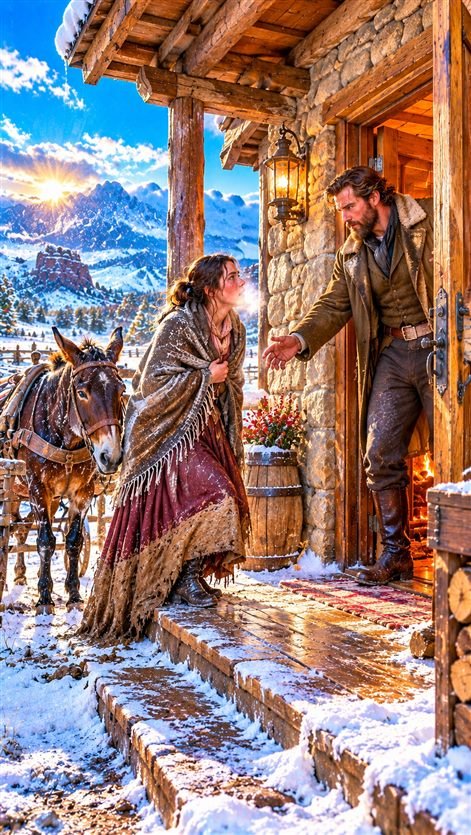
Why did the apple blossoms wither before the autumn frost touched the limestone gorge? They died because the poisoned hives carried a secret as old as the county line.
Genevieve Albright dragged her mud-caked hem through the swirling sleet of the Texas Hill Country, her fingers numb inside her woolen mittens as she guided a limping, draft-weary mule toward the flickering amber glow of the stone ranch house. The October wind shrieked down the limestone bluffs, carrying the acrid, metallic tang of an approaching prairie fire from the dry pastures to the west, mixing with the sharp scent of damp earth and rotting cedar. She had walked three miles through the freezing downpour after her buckboard axle snapped near the dry creek bed, her lungs burning with every breath of the sub-zero gale. When she finally reached the heavy oak porch of the Callahan homestead, she collapsed against the doorframe, her teeth chattering so violently she could barely form the words of warning lodged in her throat. The heavy timber door swung open inward, revealing Cyrus Callahan silhouetted against the roaring hearth fire, his broad shoulders filling the entryway and his sharp gray eyes narrowing as he looked down at the shivering, exhausted woman on his threshold.
“You’re far from the wagon tracks in this weather, miss,” Cyrus said, his voice a low, gravelly rumble that vibrated through the floorboards as he reached out a calloused hand to steady her by the elbow.
“My axle… snapped by the limestone ridge,” Genevieve managed to stammer, her voice catching on a dry, rattling cough as she pulled her damp woolen shawl tighter around her narrow shoulders. “There’s a fire… moving fast off the ridge, driven by this unseasonal northern blow, and your sheep pens are directly in its path.”
Cyrus did not flinch, though his jaw tightened perceptibly beneath his rough-trimmed beard. “The fire won’t reach the lower bottoms tonight; the limestone shelf stops the grass line,” he replied flatly, though his keen gaze swept over her soaked skirts and the trembling mule tied to the porch rail. “Get inside by the hearth before you turn to ice. I’ve no mind to dig a grave in frozen rock tonight.”
He stepped back, allowing her into the warm, fragrant kitchen where the smell of roasted chicory and woodsmoke hung thick in the air. Genevieve stumbled toward the hearth, holding her blue-tinged fingers out to the crackling cedar logs, her heart pounding with a mixture of exhaustion and lingering terror from her solitary trek across the windswept prairie. She glanced around the austere, well-kept room, noticing the neat stacks of ledger books on the pine table and the heavy iron skillet resting near the coals. Cyrus moved with practiced efficiency, pouring hot chicory into a tin mug and handing it to her without a word, his movements measured and deliberate.
“I’m Genevieve Albright,” she said softly, taking the hot mug between her palms and letting the warmth seep into her aching bones. “I was told Mr. Slocum’s freight line had a spare axle at the livery, but the agent turned me away when I couldn’t pay the coin upfront.”
Cyrus paused, his mug halfway to his mouth, his gray eyes studying her with a sharp, assessing intensity. “Slocum’s agent is a crook who preys on stranded travelers,” Cyrus said, his voice dropping an octave. “And what brings an orchardist out to this dry limestone stretch with only a mule and a broken buckboard?”
“I came to claim my late uncle’s homestead near the spring,” Genevieve answered, her chin lifting with quiet dignity despite her bedraggled state. “Though from the looks of it, someone has been systematically poisoning the valley’s bee colonies and destroying the orchards before I even drew a breath of Hill Country air.”
Cyrus set his mug down with a sharp clink against the tabletop, his brow furrowing as the realization of her identity settled over him. “Albright,” he muttered, the name clearly carrying weight in the valley. “You’re the niece who inherited the northern parcel. If you think orchards can survive Slocum’s railroad syndicate and this blasted drought, you’re a braver woman than the last tenant who packed up and fled in the night.”
“Courage has nothing to do with it, Mr. Callahan,” Genevieve retorted, her voice steadying as she met his gaze head-on. “It’s a matter of survival, and I happen to know how to keep a valley alive when everyone else is ready to burn it down.”
—
The morning sun broke pale and cold over the limestone ridges, casting long, sharp shadows across the frost-rimed grass as Cyrus and Genevieve stood shoulder-to-shoulder by the outdoor worktable, preparing for the grueling physical labor of mending the broken buckboard axle and securing the apiary boxes against the impending smoke. The crisp autumn air smelled of scorched cedar and sweet, rotting clover, the residual smoke from the distant prairie fire still hanging in a hazy blue bank along the horizon. Genevieve rolled up her sleeves, revealing forearms corded with quiet strength from years of hauling heavy honey supers and tending stubborn draft stock, her movements efficient as she sorted through Cyrus’s collection of iron bolts and washers.
“Hand me that half-inch crescent wrench and the tallow pot,” Genevieve instructed, her tone brisk and professional as she knelt beside the shattered axle of her buckboard, her fingers probing the fractured oak housing with practiced precision.
Cyrus handed her the heavy iron tool without a word, crouching down beside her on the gravelly soil, his broad shoulder brushing hers as they worked in close proximity. “You handle those tools like a certified blacksmith’s daughter,” he observed, watching the smooth, economical way she positioned the lever to lift the wagon bed off the ground. “Most women from the settlements would be sitting in the parlor waiting for a hired hand to do the heavy lifting.”
“Most women from the settlements aren’t trying to save three hundred failing apple trees and fifty colonies of starving Italian bees before the first hard freeze,” Genevieve replied without looking up, her face flushed from exertion as she smeared the rendered animal fat along the rusted metal joint to ease the friction. “My father taught me how to work iron and timber before he taught me how to embroider handkerchiefs. Not that the townspeople cared much for either once the bank foreclosed on our orchard.”
Cyrus fell silent for a moment, his own hands busy filing down a rough burr on the replacement steel pin. He knew what it meant to lose everything to a rigged debt and a shifting land claim; his own sheep range had been steadily squeezed by Slocum’s railroad agents using forged grazing permits and hired thugs to cut water lines. “My own father made a promise he couldn’t keep,” Cyrus muttered darkly, his jaw tight as he remembered the day the bank men came with their stamped papers. “He swore this land would be free and clear for us, but a handshake on the frontier isn’t worth the breath it takes to make it when men like Slocum hold the pen.”
Genevieve paused, her hands resting on the wooden axle as she looked over at him, sensing the deep, bitter weight of his past behind his laconic exterior. “A broken promise is just a poorly constructed joint, Mr. Callahan,” she said softly, her voice carrying an unexpected gentleness that caught him off guard. “You don’t throw away the whole wagon just because one bolt snapped under the strain. You strip it down, clean out the rust, and rebuild it stronger than before.”