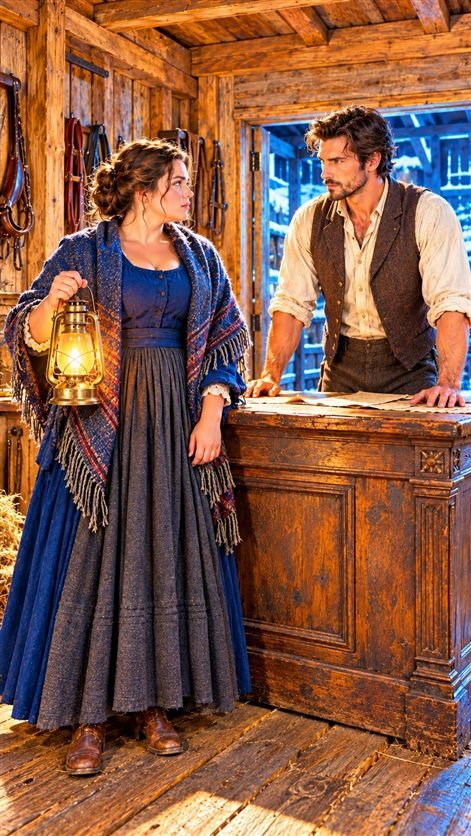
The rusted hinges of the barn door screamed like a trapped animal against the freezing midnight wind, drowning out the frantic thud of Ruth’s own pulse in her ears. She stood shivering on the frost-bitten porch of her new marital home, clutching her heavy woolen shawl around her rounded shoulders, her mind racing back to the terrifying confession Jonah had just hissed into the dark hallway before walking away. What dark secret did the town’s most respected rancher carry about his dead wife, and why had he offered his respectable name to a ruined boardinghouse girl only to flee to a livestock stable on their wedding night?
The silence that followed his departure was heavy, oppressive, and thick with unspoken dread. Ruth’s heart hammered against her ribs, a wild bird trapped inside a cage of bone and muscle. Everyone in the valley called her lucky. Standing inside the little white country church earlier that afternoon, she had heard the venomous whispers cutting through the polite congratulations of the congregation. The disgraced boardinghouse girl had somehow snared Mrs. Jonah Clay’s former life, or at least her title—the wife of the most dependable, stone-faced man in the county. Her reputation had supposedly been rescued from the gutter. But staring at the empty, shadowy expanse of the yard leading to the barn, Ruth knew her heart was about to break under the weight of a deception much darker than local gossip.
At twenty-two, Ruth was a soft, full-figured young woman in a town that worshipped fragile, willow-thin grace. Her cheeks flushed a humiliating crimson whenever strangers stared, and her thick waist and broad hips felt like a permanent mark of shame. She had spent years working her fingers to the bone, carrying heavy baskets of laundry and scrubbing floors at the local boardinghouse without a word of complaint, yet the townsfolk only ever saw her physical bulk. Months ago, the wealthy banker’s son had exploited that vulnerability, whispering sweet, intoxicating promises of love and marriage into her ear while making her believe her lack of money didn’t matter. He had even touched her waist, murmuring that he adored the softness of her flesh. Ruth had believed him with every desperate fiber of her being.
Then his father discovered the clandestine courtship. The golden boy vanished overnight, the grand promises evaporating like morning mist, and the town turned its collective fury upon Ruth. The narrative twisted instantly: the rich boy was cast as the innocent victim of a calculated trap, while Ruth was branded a shameless predator. The pastor’s wife stopped visiting, the general store cut off her credit, and women who once smiled at her suddenly turned their backs. Desperate and isolated as winter drew its icy claws across the valley, Ruth had pulled her dark shawls tighter, trying desperately to make herself invisible.
That was when Jonah Clay had materialized out of the gloom. He hadn’t shouted at the gossips or demanded justice. He had simply walked onto the boardinghouse porch, his face carved from weathered granite, and looked straight into her terrified eyes.
“Would you rather wear my name than let them keep chewing on yours?” he had asked.
It wasn’t poetry. It wasn’t romance. It was an anchor tossed to a drowning soul. At thirty-four, Jonah was a widower renowned for his unshakeable steadiness—children obeyed him, horses trusted him, and neighbors relied on his honor. Ruth had said yes because she had nowhere else to turn.
Now, standing in the upper hallway of his simple, pine-scented ranch house, those decisions felt like stepping stones leading off a cliff. Jonah had carried her small trunk upstairs with infinite care, placed it inside a beautifully appointed guest bedroom, and told her it was hers. When she asked where he would sleep, his flat, evasive reply had cut her to the bone: *“The horses won’t mind the company.”* He had refused to share her bed, not out of disgust for her heavy body, but out of a rigid, terrifying restraint. Jonah Clay wasn’t avoiding her because he felt nothing; he was avoiding her because whatever he felt was eating him alive.
And then he had dropped the bomb. *“There’s something about my first wife you need to know.”*
Ruth didn’t return to the guest bedroom. Instead, she paced the length of the pine floorboards, her boots clicking softly against the wood as the grandfather clock downstairs ticked away the agonizing minutes toward one in the morning. The wind howled against the windowpanes, rattling the glass like skeletal fingers begging to be let inside. Why had Jonah married her? If his first wife was the key to this bizarre midnight exile, what had happened to her within these very walls? The town whispers about the late Mrs. Clay had always been vague—a sudden illness, a tragic accident on the range, a fragile flower who simply withered away in the harsh frontier climate. But town gossip was a manufactured commodity, designed to protect the powerful and punish the vulnerable.
Unable to bear the suffocating quiet another second, Ruth descended the stairs. The house was freezing, the hearth fire reduced to a bed of dying, glowing embers that cast long, grotesque shadows across the living room furniture. She grabbed a heavy woolen coat from the peg by the back door, wrapped it over her nightdress, and pulled a lantern from the hook, striking a match until the yellow flame steadied behind the glass.