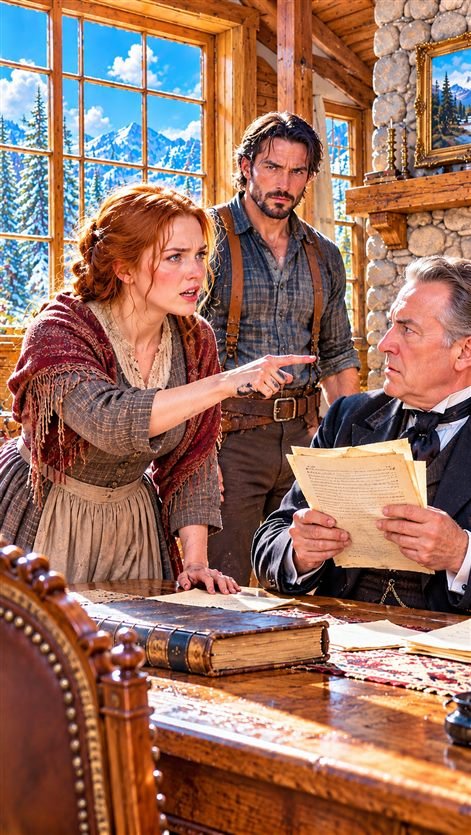
Unjustly branded a thief and cast out into the freezing Montana snow, a desperate young woman finds shelter with an enigmatic, grieving rancher. She never imagined that the ledger entries she kept to survive would unravel a web of deceit, proving the silent outcast was the true heiress all along.
*
The pewter soup spoon clattered against the rim of the empty bowl, the sharp sound echoing through the dining parlor of the Kincaid house like a judge’s gavel. Ottilie shrank back against the stiff velvet upholstery of the wingback chair, her fingers automatically smoothing the darned hem of her woolen skirt. Her skin burned with the humiliation of three pairs of eyes boring into her. Across the mahogany table, her uncle, Judge Thaddeus Kincaid, laid his silver-handled ledger flat against the white linen, his expression a mask of manufactured sorrow and immovable righteousness.
“You were trusted with the household accounts, Ottilie,” Thaddeus said, his voice dripping with a practiced, fatherly disappointment that made her stomach turn. “You had access to the pantry, the linen chests, and now, the iron safe in my study. Three hundred dollars in federal notes, vanished. And this morning, this porcelain saucer was found shattered behind your cot in the root cellar, with dried plum preserves smeared across your pillowcase.”
“I did not take your money, Uncle,” Ottilie whispered, her voice trembling, though a hard core of defiance kept her spine straight. She held up her chilblain-scarred hands, the ink-stained fingertips testifying to fourteen-hour days spent ledger-keeping for his freight business without a penny of wages. “And I have not tasted plum preserves since my mother died. You know the cook locks the stores.”
“Silence!” her aunt Gwendolyn shrieked, clutching her lace collar as though Ottilie were carrying the plague. “Liar and a thief! Just like your wretched mother, who brought nothing to this family but debt and disgrace. Thaddeus, put her out. I will not have a criminal under my roof another night, not with our daughter Aurelia’s coming-out ball only a week away.”
Thaddeus sighed heavily, playing his part to perfection. “My heart breaks for you, Ottilie, but justice must be maintained. The sheriff has been informed. You may take the clothes on your back and the shawl your mother left you. Nothing more.”
Before Ottilie could protest, two farmhands grabbed her arms, dragging her away from the warmth of the hearth and out into the biting November wind of Bitterroot Valley, Montana, 1884. They shoved her down the front porch steps, sending her sprawling onto the frozen gravel. The heavy oak door slammed shut with a finality that seemed to echo across the entire prairie. A freezing sleet began to fall, turning the dust into a slick, icy sludge.
Ottilie huddled on the side of the deserted wagon road, clutching her moth-eaten wool shawl around her shoulders. Her teeth chattered uncontrollably, and tears froze instantly upon her cheeks. She was twenty-two years old, penniless, and publicly branded a thief in a town where her uncle’s word was law. She looked down at the dark, bruised skin on her wrists where the farmhands had gripped her. For years, she had endured the small slights, the backbreaking labor, the systematic erasure of her inheritance after her father’s mysterious carriage accident. But this—this outright banishment into a killing frost—was designed to break her completely.
Instead, something cold and sharp settled in her chest. *I will not die in this dirt,* she vowed silently, her knuckles whitening as she gripped the frozen gravel.
Rising on unsteady legs, she began walking north toward the foothills of the Sapphire Mountains, away from the judgmental eyes of the township. By midnight, the sleet had turned into a blinding blizzard. Her boots were soaked through, her toes long since numb. As her vision blurred into a dizzying swirl of white, a monstrous dark shape loomed out of the swirling snow—a massive timber-and-stone barn, flanked by a sprawling ranch house with a welcoming yellow light glowing from a second-story window.
Gathering her remaining strength, Ottilie staggered toward the porch, raised a frost-bitten fist, and struck the heavy pine door twice before her knees buckled.
The door swung open instantly. A tall, broad-shouldered man stood in the threshold, framed by the warm amber light of the hallway. He wore a heavy wool shirt, sleeves rolled up to reveal forearms corded with muscle, and a dark beard shadowing a jaw that looked as though it had been chiseled from granite. His deep-set hazel eyes locked onto her crumpled form in the snow.
“God Almighty,” the man muttered, his voice a deep, resonant rumble that cut through the howling wind.
He didn’t hesitate, didn’t ask her name, and didn’t recoil from her ragged appearance. Ansel Vance swept her up into his arms as easily as if she were a bundle of dry hay, carrying her straight into the warmth of his kitchen.
When Ottilie awoke, the smell of roasted venison and boiling coffee filled her senses. She was lying beneath heavy, clean-smelling Hudson’s Bay blankets on a narrow cot near a massive stone fireplace. The room was sparsely furnished—rough-hewn pine walls, shelves stacked with leather-bound ledgers, and a rifle mounted above the mantel.
Sitting across the room at a heavy oak table was the man who had carried her inside. He was poring over a stack of shipping manifests, the flickering candlelight casting deep shadows across his face. He looked up the instant he heard her shifting.
“You’re awake,” Ansel said, his tone neutral, devoid of pity or suspicion. He stood, pouring a mug of steaming black coffee and walking over to hand it to her. “Drink this slow. It’s hot.”
Ottilie accepted the mug with trembling hands, letting the heat seep into her frozen fingers. “Where am I?”
“Vance Ridge. My ranch,” he replied, leaning his hip against the edge of the hearth and watching her with an intense, analytical gaze. “Ansel Vance. Found you half-buried in a snowdrift by my cattle gate. You’ve got Kincaid’s blood in your carriage, don’t you? I saw the copper tint in your hair before the frost got to it.”
Ottilie stiffened, pulling the blankets tighter around her shoulders. “Judge Kincaid is my uncle. Or was. He threw me out tonight. Accused me of stealing from his safe.”
Ansel crossed his arms, his eyes narrowing slightly, not in judgment of her, but in quiet calculation. “Thaddeus Kincaid wouldn’t give a starving dog a bone unless he could skin it for the hide first. What did he really throw you out for, Miss Kincaid?”
Her breath hitched. For the first time in her life, someone was looking past the scandalous accusation and listening to the reality of her existence. “My name is Ottilie. And… and because I balanced his freight ledgers too well. I found discrepancies in the shipping weights dating back three years—ghost shipments, phantom payrolls, and land titles transferred to a shell company in Helena.”
A slow, grim smile touched the corner of Ansel’s mouth, though his eyes remained serious. “Thaddeus runs half the county through rigged freight contracts and court-ordered receiverships. My own father lost his south pasture to one of his paper shuffles before he died.” Ansel pushed away from the hearth and walked toward the door, pausing with his hand on the latch. “You can stay here until the blizzard clears, Ottilie. There’s a dry room upstairs, and plenty of wood. But if you stay past tomorrow, I need someone who can work. My housekeeper left for her sister’s in Oregon last month, and my bookkeeper quit after my eyesight started giving me trouble in the lamplight.”
He turned his head, fixing her with a steady, unblinking stare. “I don’t care about Kincaid’s lies, and I don’t care about your town-bred reputation. But I do care about honesty and a sharp mind. If you can cook a decent meal and keep these cattle books straight without stealing from me, you’ve got a job.”
That morning marked the beginning of a profound transformation. At Vance Ridge, Ottilie discovered a world entirely foreign to her experience: a place where effort was met with fair compensation, and silence was not a weapon of oppression. Ansel Vance was a man of few words, but every action he took spoke volumes of his quiet honor. He was a widower who had lost his young wife and infant son to a winter cholera epidemic six years prior—a tragedy that had left him walled off from the town, living a solitary life among his cattle.
As the weeks passed, their working relationship deepened into something rare and sustaining. Ottilie tackled the ranch ledgers with a vengeance, utilizing her extraordinary head for figures to uncover the subtle inefficiencies draining Vance Ridge’s profits. Ansel watched her over the rim of his coffee cup each evening, noting how her brows furrowed when a column didn’t balance, and how her posture straightened whenever she solved a complex calculation. He began bringing her books on veterinary medicine, law, and agricultural science from his own private library, quietly encouraging a mind that her uncle had spent years trying to suppress.