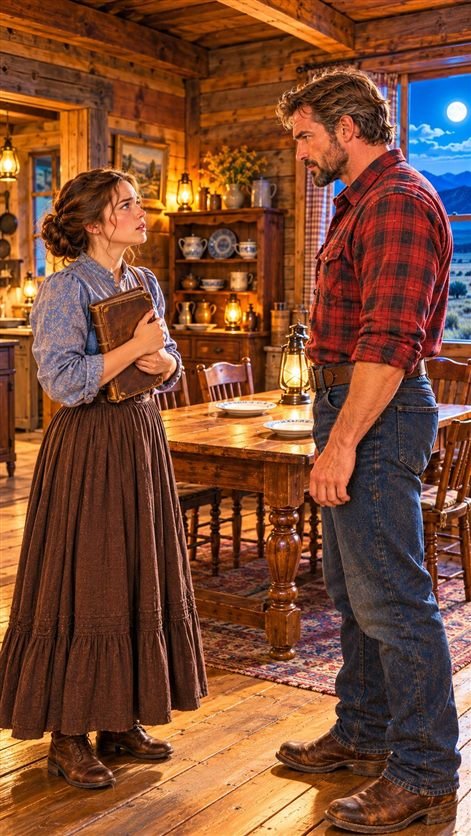
The trigger of the revolver pressed against the back of Adah’s neck felt as cold and unyielding as the iron ledger tucked inside her worn carpetbag. She did not scream, nor did she drop the heavy stoneware plate she was carrying across the plank floor of the Harlo Ranch dining room. “If you make a sound before I finish the tally, the boy dies in the corral before the sun hits the fence posts,” a voice hissed from the dark hallway, thick with malice and smelling faintly of stale tobacco and burnt powder. The shadow detached itself from the doorframe, a gaunt stranger with a jagged scar bisecting his left eyebrow—a man Adah recognized instantly from a burned-out railway station fifty miles back, a man who had sworn he would hunt down every last ledger page of the embezzled bank syndicate, no matter whose blood stained the paper.
Yet, only a heartbeat before that cold steel kissed her skin, Eli Harlo had stood right there by the wooden table.
“Will I be eating in the kitchen?” she had whispered, her voice fracturing under the weight of a dozen different terrors.
The rancher had frozen, his broad shoulders tensing beneath a faded flannel shirt. Then, reaching into the open cupboard, he had pulled down one more heavy ceramic plate and quietly set it beside his own. Neither of them knew that this simple act of kindness would become the moment that saved a dying ranch—and forever changed two broken lives. Or so Adah had believed, until the stranger stepped from the shadows and pointed a gun at her skull, revealing that Eli Harlo was not the simple, struggling widower he pretended to be.
Eli didn’t blink. When the stranger emerged, stepping fully into the amber glow of the dining room lantern with a snub-nosed revolver aimed squarely at Adah’s spine, Eli simply set down the plate. His hand remained steady on the rim of the white ceramic. He didn’t drop it. He didn’t curse. He looked at the armed intruder not with fear, but with the weary recognition of a man watching a debt finally come due.
“You’re late, Miller,” Eli said, his voice a low, gravelly rumble that filled the quiet room.
Miller sneered, pressing the barrel a fraction of an inch deeper into the soft flesh of Adah’s neck. Adah gasped, her fingers tightening around her plate until her knuckles turned porcelain-white. “Train delays, Harlo. Turns out the law takes an interest when a whole town’s worth of bank notes vanishes into thin air. And it looks like our little bird here brought the last nest egg right to your front door.”
Miller jerked his chin toward the worn leather ledger sitting innocently on the sideboard—the very book Adah had clutched like a lifeline through the blistering West Texas heat.
Adah’s mind raced backward, tearing apart every single moment since she had stepped down from the rattling buckboard. The faded newspaper advertisement she found at the boarding house in Crestfall—had it ever been meant for the public? Or had it been a beacon, planted by someone who knew her routes? She looked at Eli, her chest heaving, betrayal burning hotter than the desert sun. “You knew who I was,” she breathed, the words tasting like ash. “You didn’t just hire a housekeeper off a random handbill. You were waiting for the ledger.”
Eli didn’t look away from her. His dark, steady eyes held a profound, aching sorrow that hadn’t been there when she first arrived. “I needed the numbers, Adah. And you needed a place where the Pinkertons wouldn’t think to look for a disgraced bank teller on the run. We were both hiding from ghosts.”
“Quiet!” Miller snapped, waving his pistol with a jagged tremor of desperation. He was sweating now, the heat of the Texas night finally breaking his cold composure. “Hand over the ledger, Voss, or the kid in the yard gets a hole through his chest. I saw him out there feeding the roan. He’s right in my line of sight.”
Thomas. The nine-year-old boy with the shy nod and the dusty knees. A knot of sheer panic twisted tight in Adah’s stomach. She thought of the way the boy had eagerly shown her every cupboard, every corner of the lonely ranch, trusting her with the innocent abandon only children possessed. If Miller hurt him—if Miller killed him because of the stolen railway gold hidden within the ledger’s binding—she would never survive the guilt.
“Don’t touch him,” Adah whispered, stepping away from the table, her body trembling. “Take the book. Take every page. Just let the boy go.”
“Step back from the table,” Miller ordered, his eyes darting hungrily toward the thick leather book. He kept the gun pinned to Adah, edging closer to the sideboard with jerky, erratic movements. “Both of you. Hands where I can see ’em. Harlo, don’t try any of your frontier heroics. I’ve put down better men than you for less than a handful of cattle.”
Eli raised his hands slowly, his massive frame shifting slightly as if he were calculating distances, weighing the bounce of the floorboards against the twitch of Miller’s trigger finger. “Miller, you don’t want those pages,” Eli said smoothly, his tone conversational, belying the absolute ice in his gaze. “That ink was treated with lead-based drying agents. The federal marshals didn’t just track the serial numbers on the cash; they chemically tagged every ledger distributed to the western branches. The moment you open that binding in any town with a telegraph office, the local sheriff will have a warrant before your horse can drink.”

Caleb Sterling is an American frontier fiction writer and Old West history researcher based near Sheridan, Wyoming. Dedicated to authentic 19th-century pioneer lore, trail diaries, and homestead sagas, he has penned over 240 serialized tales celebrating the resilience, romance, and untamed spirit of the American frontier.